
One relaxed weekend is all it takes to see where your money really goes. Photo by Wright Brand Bacon on Unsplash.
Reading time: 7 minutes
Quick answer:
If your finances feel chaotic, or you don’t have a clear overview and it’s starting to make you anxious, you’re not alone. A few focused hours now can save you years of worry. Block one weekend (or one morning a week for a month) and work through four steps in order: find out your real numbers (and baseline financial trajectory), spot the easy savings, put saving on autopilot, and agree with your partner on where you’re heading. You won’t fix everything at once, but you’ll know where you stand, and see how a few small changes can add up to years of extra freedom.
How to Get Your Finances in Order When Life Is Busy
Why a Whole Weekend?
In our previous article we looked at why so many high earners in their 40s feel behind, or simply don’t have a good overview of their financial situation. While we identified several reasons, one that comes up again and again is time. Between high responsibilities at work, kids, and, increasingly, aging parents, it feels impossible to find time to attend to your finances. There’s always a perfectly valid reason to push the money review to “later.” Unfortunately, later rarely comes.
Most of us spend close to 2,000 hours a year working for an employer. We block time for meetings, deadlines, and project reviews without a second thought. So why does blocking a day or two a year for our own finances feel like too much? If we give that much time to someone else’s priorities, I’d argue our own future deserves at least a weekend. Especially if you don’t want to spend four decades, or until 67, in a job you’re not excited about. And that’s most of us: Gallup finds that only 1 in 5 employees worldwide is engaged at work.
People who manage to retire early aren’t more intelligent than everyone else. They just had the discipline to carefully look at their plan, adjust it according to their goals, and, most importantly, stick with it. Procrastination, on the other hand, is the reliable path to working until you’re 67 and risking retiring into poor health.
So, allow me to float one idea. If you have kids, ask the grandparents or a babysitter to take them for a morning or a full day. Then sit down together with the shared goal of getting a clear picture of your current financial situation and decide whether anything needs changing.
Some folks may be able to do this in one afternoon, while others may need the entire weekend. If a full weekend isn’t realistic, try blocking one Saturday morning for a month. Although there are different scheduling approaches for this, what’s important is to allocate time and tackle the four different blocks presented below.
Before explaining what each block consists of, it’s important to remind ourselves that we should go easy on each other. If you’re sitting down as a couple, remember you’re working as a team. Every small improvement counts. Give it a few years and you’ll be surprised how much they add up.
Block 1: Find Your Real Numbers (Saturday morning)
This is the very first step, and everything else builds on top of it. It’s important to use real data, not estimates or guesses.
Pull your last 12 months of bank and credit card statements. It’s best to use a full year, not a “typical” month, where irregular costs like car repairs, birthdays, holidays, or annual insurance might not show up. From there, we need to work out four key numbers:
Annual spending: everything that went out.
Savings rate: what you saved and invested, divided by your net income. This is your baseline, and, arguably, the most important number to track over time.
Net worth and invested assets: record both. Your net worth includes your home, if applicable (minus any remaining mortgage). Your invested assets are the income-generating ones, which for most people means their investment portfolio, such as index funds and retirement accounts.
To estimate your Financial Independence (FI) timeline, use your invested assets, since that’s what would eventually fund your spending without a job. If you own your home, leave it out of this number. It still matters, though: once it’s paid off, your portfolio only has to cover your spending beyond housing. It’s also worth tracking your home equity separately, because downsizing or moving later can free up capital.
Before moving on, double check your numbers: your annual spending should roughly equal your net income minus what you saved in the past year. And what you saved is the change in your investments and cash over the last year, minus market gains.
The next step is to plug your numbers into a FI Calculator (see screenshot below). Entering the numbers you just figured out will show you your baseline: how many years until you reach Financial Independence if you keep your current savings rate.
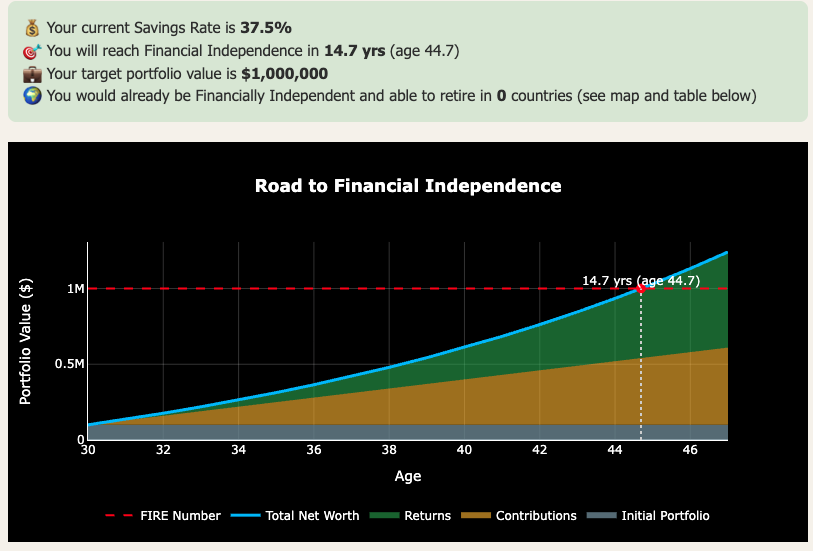
Figure 1: Screenshot of our free FI Calculator (email unlock). Enter net income, savings, and current portfolio value. If it’s the first time using it, enter the following assumptions: 4% Safe Withdrawal Rate; 5% returns; and set expenses in retirement to be the same as expenses now.
Block 2: Spot the Easy Savings (Saturday afternoon)
Now that we have established our baseline trajectory, it’s time to optimize our FI timeline. Go through your spending line by line and sort each item into one of three categories:
Keep: it genuinely adds value to your life. Not willing to trade for a shorter timeline to early retirement.
Cut: you barely use it or wouldn’t miss it. Absolutely willing to trade if it means less time in the office.
Optimize: you want to keep it, but could pay less for the same thing.
I’d recommend starting with recurring expenses, since it’s an easy way to lock in savings every month. In my own tracking, I like to keep these recurring expenses at the top of my monthly sheet, separate from one-off spending. Common items to go through and classify (keep-cut-optimize):
Subscriptions and memberships
Insurance policies
Phone and internet contracts
Bank and investment fees
Energy and utilities
Eating out and food delivery
If you’ve never done this before, expect a few surprises: forgotten subscriptions, old contracts, and costs you stopped noticing years ago. Even after years of tracking our spending, we still find new things to revise. In our latest round this November, we downgraded a music streaming service we weren’t using enough, gave up a postbox we no longer needed, swapped the internet contract at our allotment garden for a summer-only prepaid SIM (we need it for automated watering, but not the whole year), and moved my phone, which I was still dragging along from my previous job, to a cheaper plan.
Together that's about $4500 a year. Again, these aren’t huge improvements, because we’ve already optimized the low-hanging fruit. But it’s a useful reminder that the addition of many small changes over time adds up. In addition, we also scheduled “tasks” for ourselves: my wife is in the process of changing our electricity provider (where we live, there are always meaningful welcome packs available once our two-year contract is up); and I will do the same for our house internet as soon as it expires (again, many welcome offers).
Also, take a quick look at the big three: housing, transport and food (plus childcare for many families). If this is your first time doing this, hold off on big decisions here and stick to the easy wins for now. Just note how much of your budget they take up, so you know where the bigger levers are later.
The output of this second block is to have identified a list of concrete changes to tackle. Some you may be able to do on the spot (e.g., cancelling a subscription you don’t use enough), while others may need more time. That’s fine; what’s important is to identify them, and record when you will tackle them. For those using the whole weekend as a one-time sprint, try to tackle as much as possible now; for those a bit tighter on time, be sure to at least schedule the task in your calendar. For example, if you’re aware you could get a better internet deal, but need to shop around first, block 45 mins in your calendar to look into it and make the decision (including ordering it).
Block 3: Put Saving on Autopilot (Sunday morning)
This is arguably the most important block. Block 1 gave us information on where we stand and Block 2 started to reduce our monthly expenses. Block 3 makes sure those savings automatically go toward a higher savings rate, instead of being spent on something else. Savings shouldn’t have to rely on willpower, or on what’s left at the end of the month.
We need systems instead: set up a standing order on payday that moves money into your investments before you spend anything, then live on what’s left. This is called “paying yourself first.” If in Block 2 you managed to free up, say, $250 a month, then this is the amount you need to increase your investment contributions by.
For those who are following the whole weekend plan, try adjusting your savings rate on the spot after having made all the adjustments. For those who prefer to go slower or have difficulties adjusting their monthly spending, consider the gentler 1% Savings Method: raise your savings rate by just one percentage point each month. You’ll barely notice the difference month to month, but after a year of progress you’ll have managed to increase your savings rate by a very meaningful amount.
Before you start investing more, though, double check two things:
That you have a basic emergency fund
That any high-interest debt is paid off
Then update your FI Calculator with your adjusted expenses and see how it moves your Financial Independence timeline.

The numbers set the stage, but the real progress comes from talking about what you both want. Photo by Docusign on Unsplash.
Block 4: The Conversation (Sunday afternoon)
This last block is less about numbers and more about direction. You’ve now seen how small changes add up, and how they meaningfully move your timeline to FI. Now is a great time to ask yourself (or each other) the bigger questions. For example:
What do we want our life to look like in our 40s, 50s, and 60s?
Do we enjoy our jobs enough to stay until 67, or would we rather use our health and energy differently, earlier?
What would we happily spend less on to gain more freedom, and what are the non-negotiables we refuse to give up?
Every conversation will be different, and there’s no right answer, just a balancing of tradeoffs depending on each person’s unique circumstances, values, and lifestyle preferences. But what applies to everyone is that more spending today means more years of work later, and vice versa. The point is to consciously choose a balance that makes sense for you and your family.
Agree on one or two priorities, when you’ll meet again, and how to track your progress. In our case, I spend no more than 30 minutes at the end of each month tracking our expenses, and my wife and I sit down at least once a year to review where we stand and what we could improve.
Save These for Next Time
As mentioned, some important topics deserve their own session, so don’t try to make radical changes right away:
Big decisions such as the house, the car, schools, or a career change. Now that you understand the relationship between your savings rate and your FI timeline, it's the right time to start thinking about them. But don’t let your first money reset weekend turn into analysis paralysis. Focus now on the little wins and re-evaluate when you’re ready.
Your investment portfolio. It matters a lot. Are unnecessary fees eating into your stock market returns, costing you 6 figures over time? Do you hold more bonds than your savings rate can afford? Have you been tempted by chasing hot stocks? Each of these decisions can cost you years too, so make sure they’re included in your next financial weekend.
Need a Hand?
Financial Independence Calculators are great for getting started and a high-level picture. But if you’re closer to retirement, or your family finances have a lot of moving parts (kids’ costs that change over time, a mortgage, career breaks or changes, a possible move, etc.), more sophisticated modeling really helps.
That’s what I do in my 1:1 FI Strategy Sessions. In Build & Optimize (Package I), we model your full picture, including changing kids’ costs, your mortgage, and career changes, and stress test your plan so you know it holds up. If you’d rather have someone “Marie Kondo” your spending with you, Savings Rate Optimization (Package III) walks through the Keep / Cut / Optimize exercise above together, plus what it does to your timeline. I’ve been on this FI path for eight years now and have written more than 160 articles on personal finance, and I’m happy to support you in any way I can.
Next steps:
👉 Find your baseline with our FI Calculator (free, email unlock)
👉 Raise your savings rate gradually: The 1% Savings Method
👉 Check your buffer: How Much Emergency Fund Do You Really Need?
👉 Work with me: 1:1 FI Strategy Sessions
👉 Subscribe for free FI tools and monthly insights. One-click unsubscribe
Disclaimer: I’m not a financial, tax, legal or investment adviser, and nothing here is financial, tax, legal or investment advice. This article and my 1:1 sessions are educational and for informational purposes only. All modeling (including any tax scenarios) is illustrative and informed by software, not a substitute for professional advice. All decisions are your own.
Frequently Asked Questions (FAQs)
-
Block a few hours, pull 12 months of bank statements, and work out your annual spending, savings rate and invested assets. Then cut a few recurring costs and automate saving on payday.
-
Divide what you saved and invested over the year by your net (after-tax) income. For example, saving $15,000 on a $100,000 net income is a 15% savings rate.
-
Start with recurring costs: subscriptions, insurance, phone and internet, bank fees and utilities. You only have to change them once, and the savings repeat every month.
-
A short monthly check-in (about 30 minutes) to track spending, plus one deeper review a year with your partner, is enough for most households.
Join readers from more than 100 countries, subscribe below!
Didn't Find What You Were After? Try Searching Here For Other Topics Or Articles: