Only 21% of People Are Engaged at Work. What Does That Mean for the Rest of Us?

How happy are people with their jobs? Photo by Israel Andrade on Unsplash.
Reading time: 8 minutes
Quick answer
Gallup’s 2025 State of the Global Workplace shows that only 21% of workers worldwide feel engaged at work. Most workers are disengaged or emotionally detached, often described as “quiet quitting.” Engagement has fallen since 2023, and manager disengagement plays a major role, because managers account for roughly 70% of team engagement. The data suggests that for most people, work alone is not a reliable source of happiness—making financial and identity diversification increasingly important.
What you’ll get from this article
✔ What Gallup’s 2025 data actually says about job happiness and engagement
✔ Why managers—not perks or offices—are the biggest driver of wellbeing
✔ How engagement, stress, and life satisfaction interact
✔ What individuals can realistically control (and what they can’t)
✔ Why Financial Independence can act as a buffer against work dissatisfaction
TL;DR — Are People Happy at Work?
😐 Only 1 in 5 workers feel engaged
📉 Engagement has declined since 2023
🧑💼 Managers drive ~70% of team engagement
😮💨 Stress, anger, and loneliness remain elevated
🧭 Work alone is a weak foundation for long-term happiness
🔑 Financial and identity diversification matter more than ever
Are People Happy in Their Jobs? Gallup’s 2025 Insights
If you’ve ever wondered “Are people actually happy at work?” Gallup’s 2025 State of the Global Workplace gives a sobering answer: only 21% of workers worldwide feel engaged. In today’s post I unpack the key numbers—where engagement and life satisfaction are falling, how managers and work location shape wellbeing, and what both employers—and especially individual workers—can do about it. I'll also share how today's topic relates to my own decision to leave a traditional career and pursue a more entrepreneurial path—and why data like this makes rethinking your relationship with work feel less like a lifestyle choice and more like a rational response.
Global Job Engagement in 2025: What’s Changed Since 2023
Two years ago, when I first wrote about Gallup’s State of the Global Workplace, the big picture did not look good—I was surprised to see terrible statistics related to job engagement and satisfaction across the globe. However, there were a few reasons for being cautiously optimistic: engagement had ticked upward after the pandemic, and there was the hope at the time that flexible work and new enabling technologies could usher in a more balanced era of work.
Fast-forward to the 2025 report and the picture, if anything, has darkened further. Global employee engagement slipped from 23% to 21%—a two-point drop on par with the Covid lockdown lows (Figure 1). Let’s take a minute to consider this again—roughly four fifths of global workers are disengaged or emotionally detached from their jobs.
This is a reminder that beneath the glossy (and often performative) LinkedIn updates lies a quiet epidemic of disconnection from work. The phenomenon often called “quiet quitting”—doing the bare minimum without formally resigning—helps explain why so many are watching out for a new role while staying put.People often ask for the “quiet quitting percentage,” but Gallup doesn’t label it that way; instead we need to use its engagement categories as the closest proxy.*
Manager engagement, which the report focuses on strongly this year as a main driver of the poor results, slid even more sharply—from 30% to 27%. It shows how managers affect the wellbeing of employees; Gallup estimates 70% of team engagement depends on the manager’s approach.
*A quick clarification: Gallup categorizes workers as engaged, not engaged, or actively disengaged. “Quiet quitting” is often used to describe the large middle group—people who are psychologically disconnected, doing what’s required, but not emotionally invested in the job.
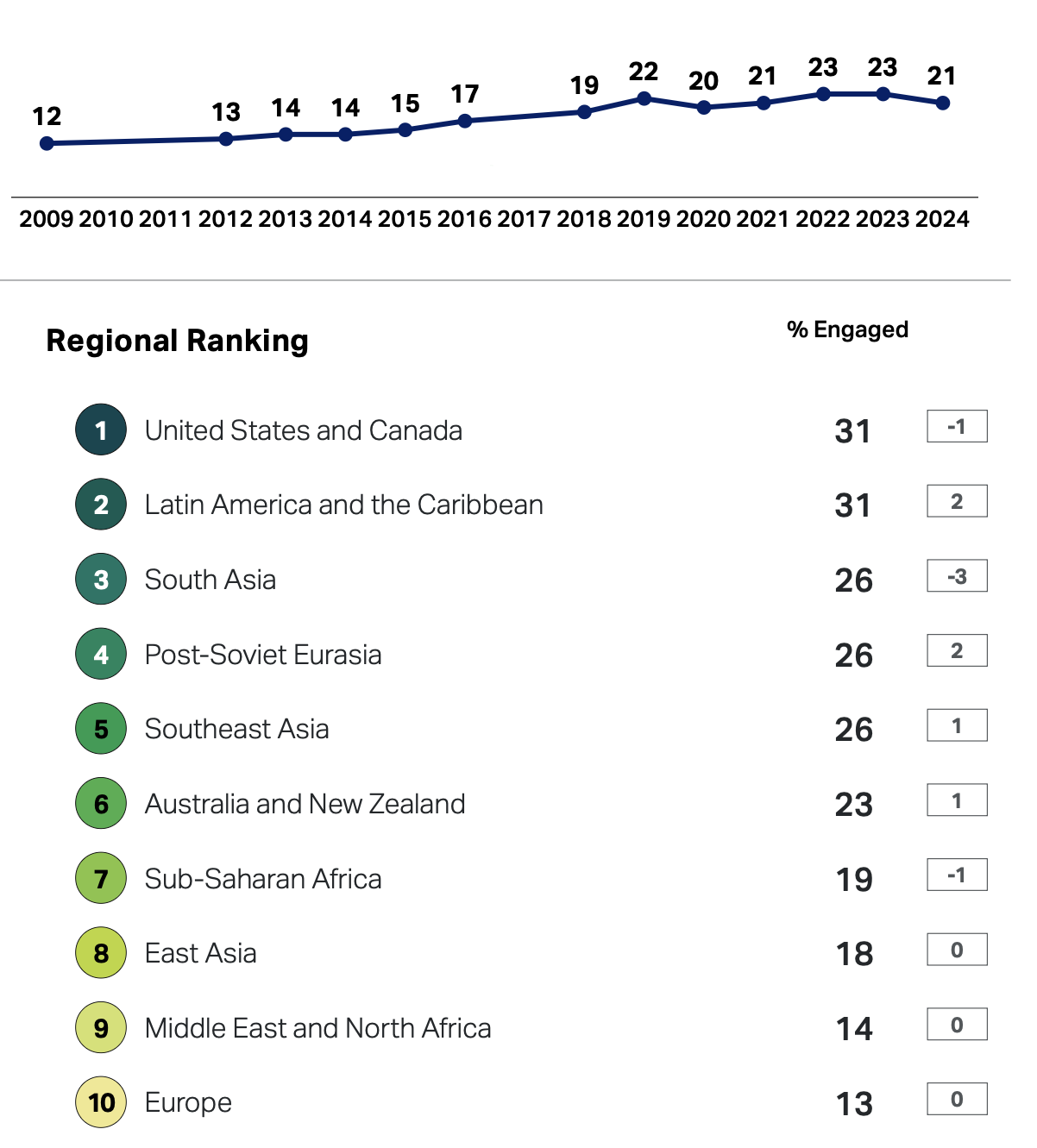
Figure 1. Only 21% of workers worldwide report being engaged at work in 2025—a two-point drop since 2023. Four out of five employees say they are disengaged. Engagement varies across region—highest in the US and Canada and lowest in Europe. Source: Gallup (2025).
Other wellbeing signals were mixed but stubbornly low in the last year of data assessed. Gallup’s “thriving” life evaluation metric (“How’s your life going?”) fell to 33%—representing two consecutive years of decline. The emotional pulse of the workplace is hardly better: 40% of global workers report feeling stressed “a lot of the previous day”, while 21% say they experienced anger, 23% sadness, and 22% loneliness. That helps answer the common question of how happy people really are with their jobs—for the majority, the plain answer is “not very.”
Of course, many of these metrics cannot be tied directly to the job. However, given that the workplace is where most spend the majority of their time during the day, it’s pretty clear that it does exert a major role in people’s reported life satisfaction.
The cost of worker disengagement isn’t just personal—it’s also macroeconomic. Gallup estimates that the decline in engagement alone drained a staggering US$438 billion in lost productivity last year. Lower engagement shows up in slower GDP growth, lower company profits, and the quiet frustration of employees whose talents are underused. It’s a lose-lose situation for everyone. The 2025 Gallup snapshot is a clear warning—if leaders ignore these trends, the global economy also pays the price.
In the last two years, artificial intelligence (AI) has started to disrupt the workforce—yet AI is not featured prominently in this year’s analysis. Beyond the CEO’s opening remarks, there is no survey data or regional analysis on AI’s workforce impact—just a brief acknowledgement that it will matter. For such a transformative technology, its absence in the data analysis is striking.
It will be interesting if Gallup tries to incorporate questions related to AI more prominently in future iterations. It’s important to better understand not only how AI affects productivity, but also how it affects employees’ experience and engagement in the workforce.
In my own recent article on AI and Financial Independence, I argued that AI is a double-edged force: it can dramatically accelerate your path to Financial Independence if you deliberately learn to use it—by automating tasks, creating new income streams, or building skills that complement AI—but it can just as easily deepen insecurity if you ignore it and let the disruption wave “happen” to you.
The same is true at a societal level—AI can free us from drudgery and create more time and space for meaningful work, but it also holds the risk of eroding human connections and a sense of purpose that already feels fragile in today’s workspace.
With that wider technological backdrop in mind, let’s return to the human side of Gallup’s findings.

It’s important to better understand how AI will affects employee’s experience and engagement in the workforce. At the moment, though, we have more questions than answers. Photo by fabio on Unsplash.
Why Most People Aren’t Happy at Work: Engagement & Wellbeing Trends
Anyone who’s ever worked for a great manager knows the difference it can make. A boss who’s present, motivated, and in a good mood can turn an ordinary day into something you actually look forward to. It can make a huge difference in your day-to-day happiness, but also in your personal growth. In contrast, a disengaged one can sap energy before you even open your laptop.
This is central to the question of how to increase engagement of employees—start by developing managers. Gallup quantifies this intuition, since about 70% of team engagement is attributable to the manager. Harvard Business Review has long echoed this point, noting that great managers shape team performance more than any other single factor.
So, when manager engagement falls—down three percentage points to 27% globally—the entire workforce feels it. Young managers under 35 experienced a five-point drop, while female managers an even steeper seven-point fall. It’s easy to imagine the ripple effects—burned out managers leading to teams that feel emotionally disconnected from the organization, feeding a cycle of low morale and underperformance that doesn’t benefit anyone.
The life evaluation metric presents a similar story. After several years of improvement, the share of workers reported as “thriving” in life fell to 33%. The declines are sharpest in some of the richest regions: the US and Canada and Australia and New Zealand dropped over the last year four points to 52% and 56%, respectively. Both regions show steady declines since 2011.
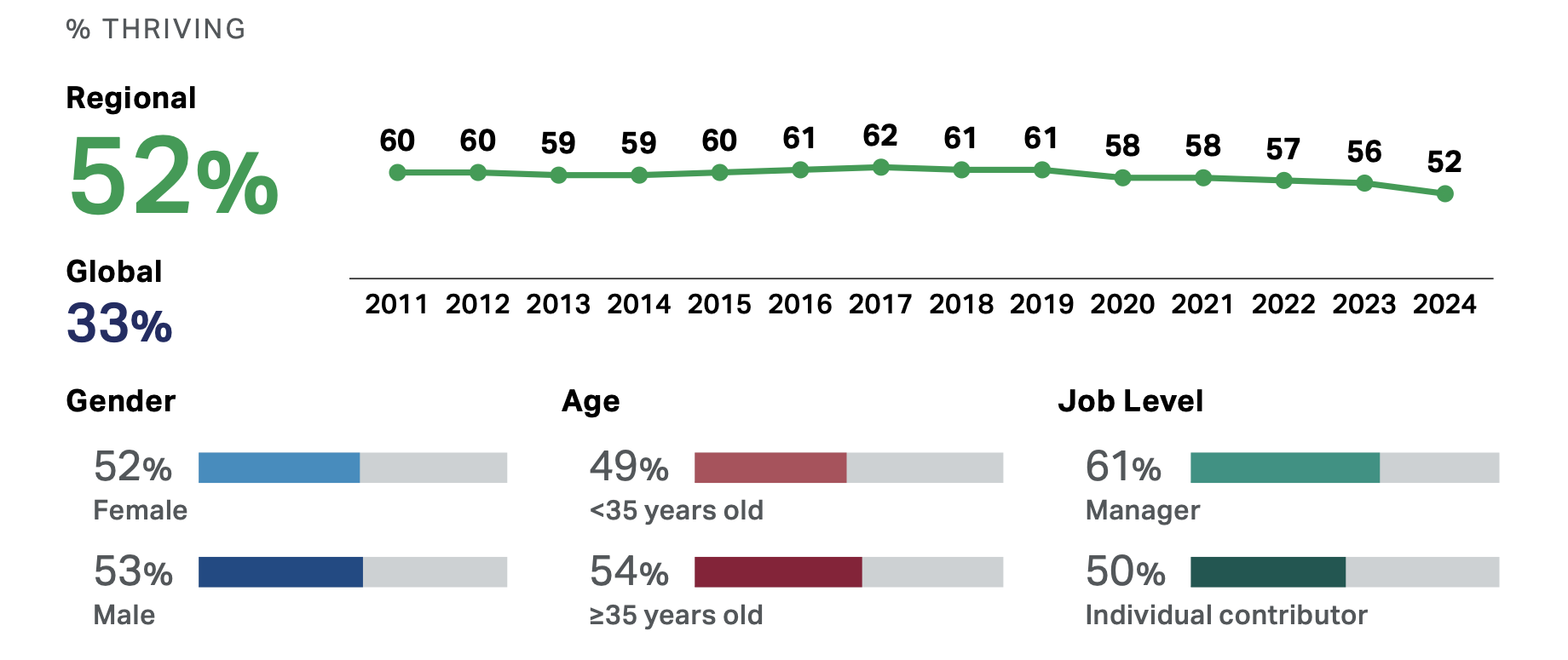
Figure 2: Life evaluation (% thriving) in the US and Canada region is on the fall—and affecting managers disproportionately.
Gallup points to inflation and housing costs as likely culprits, but given how much time we spend at work it’s not surprising that engagement and life satisfaction can move in tandem. Consider that half of engaged employees report thriving in life overall, but only about a third of the unengaged ones can say the same.
The emotional temperature of the workforce is also very telling. 40% of global employees experience stress, with the highest levels observed in the US and Canada region (50%). Anger hovers at 21% globally, with spikes up to 34% in South Asia. Sadness affects 23% of workers, peaking at 39% in South Asia as well. Loneliness—an unspoken workplace reality—affects 22% globally and a striking 30% in Sub-Saharan Africa. These figures aren’t just statistics; they reflect how millions of individual days are negatively affected in the workforce.
One more signal from the report: 51% of workers say it’s a good time to find a job globally (down 3 points), while 50% are watching for or actively seeking a new job—literally half the workforce has at least one eye on the exit. The phenomenon often called “quiet quitting”—doing the bare minimum without formally resigning—helps explain why so many are watching for a new role while staying put.

According to Gallup, 70% of team engagement is attributable to the manager. What type of manager do you have? Photo by Vitaly Gariev on Unsplash.
Remote Work, Age & Region: How Engagement Differs Around the World
A hotly debated question since the pandemic is where employees should work—should they be allowed to continue partially remote or return to the office instead?Interestingly,Gallup’s data gives both sides something to chew on. Exclusively remote workers show the highest engagement at 31%, ahead of hybrid (23%), and fully on-site roles (19%).
That looks, at first glance, like compelling evidence against blanket return-to-office mandates. That said, correlation isn’t causation—fully remote jobs tend to cluster in higher-skill, office-based roles that already score better on engagement.
But, as individual workers, keep in mind that engagement is only part of the story. When you look at life evaluation—the percentage reporting to be thriving—hybrid and on-site (but remote-capable) workers lead the pack at 42%, compared to 36% for exclusively remote and 30% for those stuck on-site with no remote option. Stress and anger follow a similar pattern.
The takeaway is that a blend of home and office is likely the bestsolution to support overall engagement and life satisfaction. For individuals asking how to be more engaged in their job, negotiating flexible work where possible is a proven first step. Giving the freedom to the employee to decide likely is the best solution to maximize both metrics—engagement at work and overall life satisfaction.
Interestingly, age offers little comfort to those hoping work gets naturally “better” over time. Young employees may initially attribute their stress or lack of engagement in the workplace to age. Perhaps they say to themselves, “once I gain more experience in the job/sector, my daily experience at the workplace will surely improve”. Unfortunately, the data shows that the key metrics assessed don’t necessarily improve with time—if anything, Gallup finds slight drops in engagement with age.
Regional contrasts are strong. Latin America and the Caribbean region top charts for thriving (54%), while Europe presents a mere 13% engagement rate—dead last globally. Sub-Saharan Africa shows the highest intent to leave (72% of workers are looking or watching for a new job), while the US and Canada, despite higher engagement than the global average (31% vs 21%), also rank second-highest for daily stress.
These numbers remind us that the “global workplace” is anything but monolithic, and that cultural and economic context shape strongly how work is experienced.
One subtle but striking pattern Gallup hints at—but does not report on—is the long-term upwards trend in both engagement and life evaluation across Southeast Asia—in countries like Indonesia, the Philippines and Vietnam. This raises an interesting possibility: in developing economies, modern formal work may initially lift life satisfaction as it raises income and improves basic material needs.
Yet the picture from wealthier regions—where engagement stagnates or falls despite higher living standards—suggests that once basic needs are met, work itself could become a smaller and sometimes frustrating contributor to happiness.
One final observation: Europe pairs the lowest engagement (13%) with the lowest intent to leave (30%)—suggesting disengagement doesn’t always translate into mobility. In mature labor markets with strong protections and higher costs of switching, people can feel stuck even when unhappy. That’s a different policy and culture problem than in fast-growing regions.
These regional contrasts set the stage for what employers everywhere must grapple with next—how to improve employee engagement.
How to Increase Employee Engagement: Lessons for Managers & Companies
For employers—the main audience of this report—the stakes couldn’t be larger. The US$438 billion in lost productivity from falling engagement translates to missed sales targets, higher absenteeism, and teams that consistently underdeliver. It also means less dynamism, innovative thinking, and problem solving. What if your competitors do get the employee satisfaction and engagement right and you don’t?
According to the report, manager burnout is a key pressure point. When managers are disengaged, their teams follow suit, and the spiral leads to higher turnover and ultimately affects company results. In Gallup’s own words, “the productivity of the world’s workplace is at risk.”
But there is also some positive news and paths forward. Gallup highlights “best-practice” organizations where engagement approaches 70%—more than three times the global average. These tend to be companies that build a culture of coaching and provide real manager development. Less than half (44%) of global managers report having received any form of training, and those who do are far less likely to be actively disengaged.
When managers are trained and someone at work actively encourages their development, their odds of “thriving” jump from 28% to a staggering 50%. That’s a lot of team engagement and satisfaction to leave on the table—training managers is not just good HR practice—it’s an economic growth strategy and can emotionally improve employees experience in the workplace.
That is the most immediate lever companies can pull today. But leaders also need to prepare for the next structural shift—artificial intelligence. As we explored in a previous piece on AI and Financial Independence, AI is a double-edged force. Used well, it can automate routine work and create space for human judgment, creativity, more free time, and relationship-building—the very qualities Gallup identifies as drivers of engagement.
Used poorly, though, AI could also become another cost-cutting tool that erodes trust and heightens job insecurity. The coming years will test whether companies can harness AI to elevate human potential rather than simply accelerate a race to the bottom.

Best-practice” organizations’ engagement approaches 70%—more than 3 times the global average. These companies build a culture of coaching and provide real manager development. Photo by Austin Distel on Unsplash.
How to Be More Engaged in Your Job—and Build a Life Beyond It
Until now we’ve focused on the company perspective—but more importantly, what are the lessons for individuals? For me, the main lesson is equally clear: given the consistently downbeat data on workplace engagement and life satisfaction, don’t let your job become your identity or count on it to deliver on a happy life.
Gallup’s global numbers make it clear that most people are not finding engagement—let alone any sense of deep fulfillment—in their work. Only one in five report being truly engaged. To take your sense of worth on a corporate role is to build on very shaky ground. We all know people who chased titles and promotions only to feel empty once they arrived, or to look back with regret over life opportunities missed. When your identity is wrapped up in a job, just one bad manager, a layoff, or a boring project can feel like an existential threat.
Breaking the “earn-spend-status” treadmill is the first step towards more freedom. I know this first-hand: recently leaving my corporate role after years of creeping burnout was terrifying at first, but it opened space for entrepreneurial projects that feel genuinely rewarding. From my own burnout-to-freedom journey, I’ve learned that redefining status—away from job title or salary toward health, relationships, and creative projects—is far more sustainable.
Many of us work to buy things to impress people we barely know (or even don’t like), and it’s partially that spending which is locking us in jobs we dislike for longer than needed. Pursuing Financial Independence opens the door to designing a life aligned with your unique values and lifestyle preferences. And despite what critics of FIRE sometimes argue, four out of five workers feeling disengaged is precisely the context that makes pursuing FI a rational choice.
It gives you the power to work on what genuinely excites you, take periodic sabbaticals or mini-retirements, or work part-time while exploring other interests. The Gallup data on life evaluation shows just how closely wellbeing is tied to engagement at work. But going beyond the narrow focus of this report we should see the bigger picture: people with diversified sources of meaning are less vulnerable to the ups and downs of their employer’s—or manager’s—fortunes.
This is exactly the kind of life-design work we talk about throughout The Good Life Journey: intentionally building a portfolio of meaning—family and friends, Financial Independence, community, health, creativity—so that no single employer or paycheck controls your sense of meaning and purpose.
There are other ways to build identity and purpose—through relationships, volunteering, creative expression, or building something on your own terms. If you’ve spent years introducing yourself by your job title—common in some countries—try instead describing yourself by your interests, the problems you love solving, or the communities you play an active role in. It may seem like a small linguistic shift, but it can spark a bigger reorientation towards a life that is yours, not your company’s.

For some, entrepreneurship can overcome some of the obstacles to low engagement. Working for yourself can be exhilarating, but comes also with risks. Photo by Austin Distel on Unsplash.
Why Work Often Feels Unfulfilling—and What That Means for Society
A bigger question is why, as a society, do we continue to create so many unfulfilling jobs.
Before jumping to answers, though, it’s worth noting some limitations of the Gallup report itself. Although the dataset is large, its analysis and interpretation is surprisingly thin. For instance, remote workers may show the highest levels of engagement, but that could also simply reflect the kind of jobs that can be done remotely—mostly higher-skill office roles—rather than any magic of the location.
Similarly, Latin America and the Caribbean top the world for “thriving” life evaluation (54%), but Gallup offers little on what’s driving it—very likely a mix of non-work factors (income gains, social ties, culture, safety nets, etc). The takeaway is that there is little discussion of how other variables interact with engagement or life evaluation. So, while Gallup’s numbers are often eye-opening, we should likely take them with a pinch of salt.
Despite this caution, the overarching message here is unmistakable: for most people, work is simply not delivering deep fulfillment—delivering stress and dread instead—what many call the ‘Sunday scaries’. Gallup’s numbers—13% engagement in Europe, global stress stubbornly at 40%—suggest we haven’t moved far from David Graeber’s “bullshit jobs” critique: many modern jobs simply feel pointless even if they pay well.
Ultimately, we’re still designing organizations that drain employees rather than make them flourish. We’ve covered this at length in previous posts: why do we continue to work so hard, despite the extraordinary gains in technological productivity and economic growth experienced over recent decades?
Moments of technological upheaval can also be moments of possibility. AI is reshaping industries at remarkable speed, and that chaos creates openings for those willing to think entrepreneurially. Periods of disruption breed new business opportunities for those who embrace an antifragile mindset—people who are not afraid, but open to grow and gain from disorder.
Whether it’s starting a new niche online service, building tools that use AI or help others adapt to it, or whatever your new creative idea is, the next decade will likely reward those who see opportunity in change, and financially punish those who are scared or shy away from it.
The takeaways are simple for both companies and individuals: companies need to focus more efforts in improving wellbeing in their workforce—because ultimately that will give them an edge over competitors. That edge comes from better managers, smarter use of flexibility, and real growth paths. But for individuals, it comes from reducing financial dependence, diversified identity, and the courage to design work around life—not the other way around.
As a society, we should stop confusing the appearance of productivity with genuine progress. The Gallup 2025 report is a warning, but it’s also an invitation: to break the cycle, to build resilience and antifragility, and to create a world where work supports—not undermines—a good life. This is something worth remembering, given that one of the deepest regrets people voice at the end of life is having worked too much and lived too little.
If you want to translate this into action:
👉 Want the complete framework for using FI to redesign your relationship with work? See our complete guide to work, purpose, and Financial Independence
👉 New to Financial Independence? Start with our complete guide to FI and FIRE
👉 Use our free FI Calculator to assess your timeline to early retirement
👉 Subscribe to get free FI tools and the weekly newsletter (one-click unsubscribe anytime)
💬 What’s your own experience with job engagement? Do you feel energized by your work or more like you’re “quiet quitting”? What have you tried—personally or as a manager—to boost engagement or protect your wellbeing? Share your thoughts in the comments below!
🌿 Thanks for reading The Good Life Journey. I share weekly insights on personal finance, financial independence (FIRE), and long-term investing—with work, health, and philosophy explored through the FI lens.
Disclaimer: I’m not a financial adviser, and this is not financial advice. The posts on this website are for informational purposes only; please consult a qualified adviser for personalized advice.
Check out other recent articles




























About the author:
Written by David, a former academic scientist with a PhD and over a decade of experience in data analysis, modeling, and market-based financial systems, including work related to carbon markets. I apply a research-driven, evidence-based approach to personal finance and FIRE, focusing on long-term investing, retirement planning, and financial decision-making under uncertainty.
This site documents my own journey toward financial independence, with related topics like work, health, and philosophy explored through a financial independence lens, as they influence saving, investing, and retirement planning decisions.
Frequently Asked Questions (FAQs)
-
Not really. Gallup’s 2025 State of the Global Workplace report finds that only 21% of employees across all sectors worldwide describe themselves as “engaged,” meaning they feel emotionally connected to their work and willing to go the extra mile. Four-fifths of the global workforce therefore feel either indifferent or actively disconnected.
-
Quiet quitting is when employees do the bare minimum required—fulfilling their job description but deliberately avoiding extra effort or discretionary tasks. It is often a response to burnout, poor management, or a lack of recognition. Workers who quietly quit are not formally resigning, but they are mentally disengaged, and Gallup’s findings of widespread low engagement help explain why this trend has become a global talking point.
-
Managers play an outsized role. Gallup estimates that about 70% of team engagement can be traced directly to the manager’s influence—from how they communicate goals to how they give feedback and support career development. When manager engagement itself falls—as it did from 30% to 27% globally in 2025—entire teams feel the impact through lower morale, higher stress and, ultimately, lower productivity.
-
Poor mental health directly reduces productivity and engagement. Gallup reports that 40% of workers experienced significant stress the previous day, and high levels of anger, sadness and loneliness are widespread. According to the World Health Organization, workplace stress is now a major global health challenge that increases absenteeism, raises healthcare costs, and erodes overall job performance.
-
A well-designed role with a supportive manager can certainly boost life satisfaction, but work alone rarely guarantees happiness. Gallup finds that even employees in higher-engagement regions still need strong relationships, financial stability and a sense of purpose beyond their employer. A good job can contribute to wellbeing, but it must be paired with a balanced life outside work.
-
Start by seeking clarity and feedback. Ask your manager for clear goals and regular check-ins, request opportunities to learn new skills, and, where possible, negotiate flexible or hybrid working arrangements. Gallup’s data show that workers who feel heard and have growth opportunities report higher engagement and lower stress. Personal initiative—communicating needs and taking on projects you care about—can significantly increase your day-to-day energy.
-
Organizations can lift engagement by investing in manager training and building a coaching culture. Gallup highlights that “best-practice” companies—where managers are developed and supported—reach engagement levels near 70%, more than triple the global average. Providing clear career paths, recognising good work, and offering flexibility are proven ways to raise both employee satisfaction and overall productivity.
Join readers from more than 100 countries, subscribe below!
Didn't Find What You Were After? Try Searching Here For Other Topics Or Articles: