
Some workers pursuing FIRE (Financial Independence, Retire Early) reach FI early, yet find themselves unable to do so for non-financial reasons. We explore them in this article. Photo by Israel Andrade on Unsplash.
Reading time: 9 minutes
Quick answer:
One-more-year syndrome (OMY) is the tendency for people who have already reached FI (Financial Independence) to keep delaying retirement, one year at a time. There’s always one more reason to stay another year. It usually has little to do with the money and more with loss aversion, identity, fear of uncertainty, and how tempting it is to keep a large portfolio compounding a bit longer. The solution isn’t a bigger portfolio. It’s flexibility, a clear sense of what your post-work life will look like, and remembering that time and health don’t compound the way money does.
What you’ll get from this article:
✔ Why OMY syndrome occurs even when the math says you’re ready to retire
✔ Why walking away can feel irrational even though you’ve made it
✔ The psychology behind loss aversion, identity, and uncertainty
✔ Why spreadsheet paralysis keeps the goalpost moving
✔ A practical framework for deciding whether to retire now or wait
✔ How flexibility and dynamic spending strategies can break the OMY loop
🚀 TL;DR: One-More-Year Syndrome
🧠 Fear beats math. Loss aversion, identity, and uncertainty keep people working past their FI number
📈 Late compounding is seductive. Six figures added per year makes walking away feel difficult
❤️ Time doesn’t compound. Healthy, active years are the finite resource you won’t recover
🛠️ Flexibility is part of the solution. Guardrails, semi-retirement, and dynamic spending all take the pressure off
🧭 You don’t need certainty to retire. You need adaptability and something to move toward
Why You Can’t Retire: Understanding the One-More-Year Syndrome
If you’ve spent any time in online FI communities, you’ve seen it: people who are already Financially Independent (FI), who have reached their long-awaited FI number, yet can’t bring themselves to retire. This is the classic “one-more-year syndrome” (OMY), often a mix of financial FOMO, psychological fear, uncertainty, identity loss, or the pull of a portfolio’s late-stage compounding.
It’s also a commonly cited criticisms of the FIRE movement; that the finish line always keeps moving, and the sprint never really ends.
In this article, we break down what one-more-year (OMY) syndrome is, why it happens, and how to recognize it in yourself. We’ll also look at how the math of late-stage compounding feeds the hesitation, and how to decide whether to retire now or wait one more year.

Some people find themselves working much longer to reach higher portfolios than they had originally aimed for. Often the perception of “easy money” keeps them in the game longer than they had anticipated. Photo by Alexander Grey on Unsplash.
The Compounding Trap: Why Your Portfolio Grows Fastest Right Before Retirement
People often underestimate how emotionally powerful the later-stages of the FI journey are, especially when they hit their FI number in the middle of a bull market. You can have a fully funded FI portfolio, a conservative withdrawal rate, and years of careful planning behind you, and yet the temptation to “stay just one more year” becomes intense. Why does that happen?
Firstly, because at the exact moment your portfolio is the largest it has ever been, the markets starts “handing out” its biggest gains. Imagine you reached your $1.5M Financial Independence portfolio, capable of granting $70,000 per year in retirement spending as per the updated 4.7% rule of thumb.
This also means that if the market moves up 7% (in real terms) in the following year, that’s $105,000 extra per year added to your portfolio (without including your annual savings from your salary). That’s an incredible amount of money; after all, you remember that it took you years to save and invest this amount in the earlier stages of your career. Now it all seems too easy.
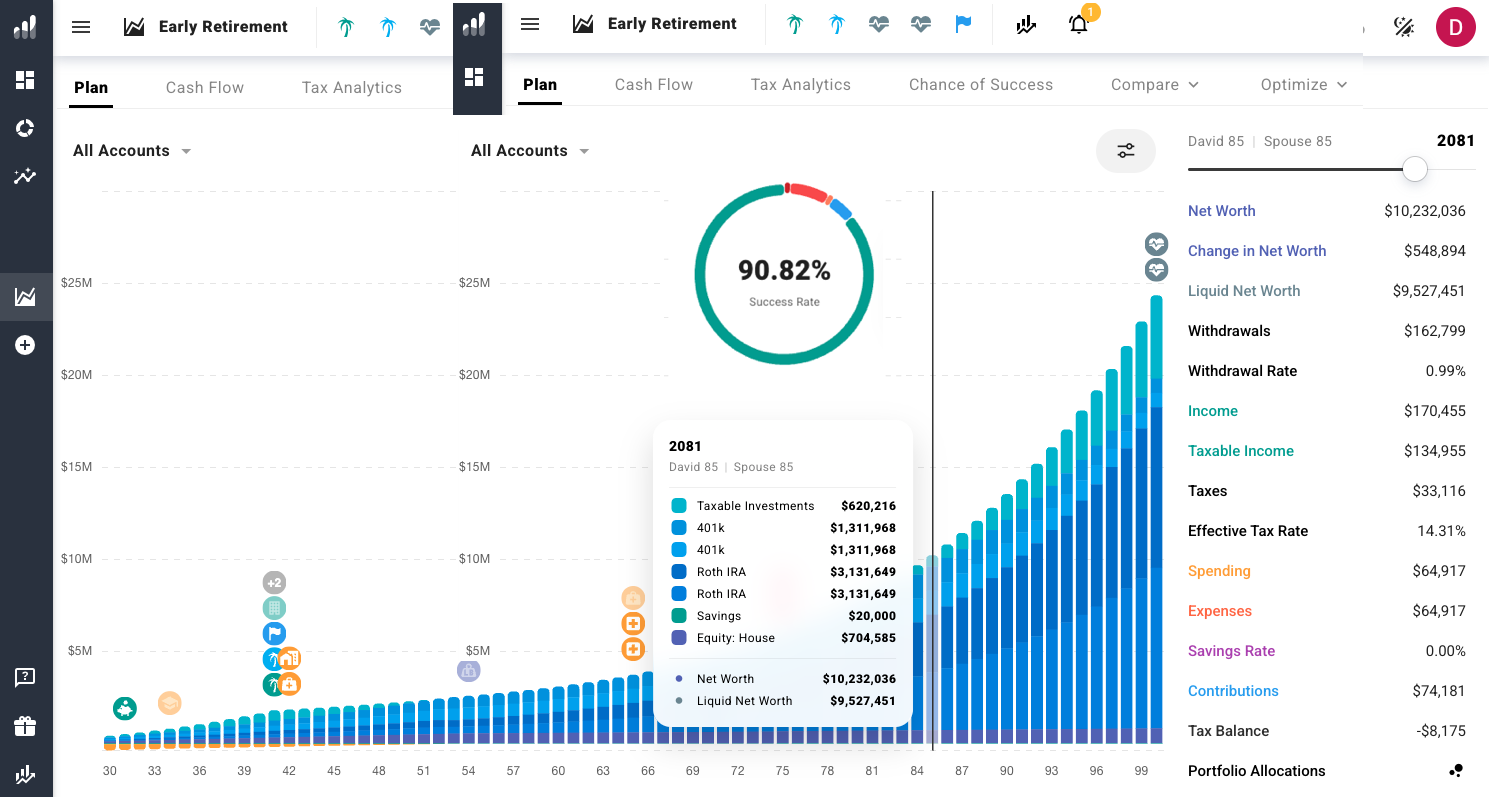
After “only” three more years of OMY syndrome, your $1.5M portfolio could easily jump to a $2M portfolio, or much more if you were in the middle of a bull market. By staying in the game a bit longer, your annual retirement withdrawals could go from $70,000 per year to at least $95,000, a substantial jump.

Figure 1: Screenshot of our free Financial Independence Calculator (email unlock). As observed, a $1.5M portfolio at age 43 might increase—after just three more years of one-more-year syndrome—to a $2M portfolio. Your annual retirement withdrawals would go from $70,000 per year to $95,000, a substantial jump. This scenario assumes average real returns of 7%.
In the mind of someone already stressed out or exhausted by work, this creates a paradox: walking away now feels like you’re walking away from the “easiest” money of your life. In the example, around $500,000 in three years or $1M after 6 years. Of course, the exact amount also depends on your savings rate and the level of your salary, but you get it. The amounts can be very large.
This financial FOMO also becomes strong because many FIRE folks tend to hold strict interpretations of what withdrawal rates should look like. A specific spreadsheet may suggest a 4% safe withdrawal rate (SWR), so they anchor to it. Or a model says they only have 100% certainty in the modeled scenarios if they adopt a 3.3% SWR. Ultimately, they convince themselves they cannot leave until everything is absolutely perfect.
Of course, often they ignore that retirees in the real world can be flexible and adjust spending during severe market downturns, and that research suggests expenses will go down as they age. We simply don’t spend the same amount in our 40s-60s as we do in our 70-90s.
By ignoring flexibility, they treat retirement math as static, when in reality humans are highly adaptable and we can use dynamic spending strategies. Most FIRE households have tons of levers available—think temporary geo-arbitrage, cutting back on discretionary categories, earning part-time income, or skipping a car replacement—that make running out of money far less likely than the fearful mind would suggest.
And yes, markets can fall right after you retire, but that risk exists no matter when you leave, and dynamic spending rules and bond tents are designed precisely for this scenario.
Another trap is the illusion of perfect timing, when in reality it will always feel like it’s not the right time to pull the trigger. If you hit your FI number during a market boom (think 10-30% annual return), quitting the race feels irresponsible: you’re leaving so much money on the table. In contrast, if you hit FI during a downturn or the market is going sideways, it equally feels dangerous to leave when things look so uncertain. And so, the perfect moment never arrives.
The risk is that what looks like a rational desire to “optimize”—to squeeze out a bit more portfolio growth—can come at the expense of time with the people you love and years of good health.
But money is only part of it. The stronger forces behind OMY are psychological.

Analytical-minded FIRE individuals often over-emphasize perfection over flexibility. They try to pursue the most optimal early-retirement strategy to eliminate all sources of uncertainty, forgetting that uncertainty is a feature of life. Sometimes, an overly-conservative plan comes at the cost of time and health. Photo by Campaign Creators on Unsplash.
Fear, Uncertainty, and Loss Aversion: The Psychology Behind Delaying Retirement
Loss aversion is one of the strongest psychological forces behind the one-more-year syndrome. Even when someone is FI, the fear of running out of money can dominate the fear of wasting years of life. Behavioral research shows that humans feel losses more intensely than gains, so the idea of a shrinking portfolio creates more emotional weight than the promise of more free time.
In addition, many FIRE folks grew up with scarcity mindsets, underpinned by financial instability during their childhood, modest beginnings, or parents who constantly worried about money. Often, these financial worries can seamlessly transfer to the next generation via money scripts, even when objectively the situation warrants no worry.
This is one of the reasons it’s so difficult for many people to retire early, even when the math says they could. Those scripts and childhood stories don’t magically disappear when a FI calculator says they’ve made it. As Morgan Housel reminds us, money is more emotional than it is rational.
Uncertainty often amplifies this fear, especially uncertainty around healthcare costs, job markets, and longevity. US readers in particular will agree here; healthcare costs can be both high and unpredictable. Even high-income earners in the FIRE space admit they would retire earlier if they felt more clarity around their healthcare situation.
Of course, there are as many fears as there are people. Other common fears are recessions, sequence-of-return risk (SORR), inflation, technological breakthroughs, or geopolitical instability. Many of these global uncertainties naturally feel completely out of one’s control. The irony is that waiting to eliminate all uncertainty before retiring is a good way to never retire at all.
This leads to the emotional paradox of the OMY syndrome: people fear running out of money more than they fear running out of time. Yet the math on time is far more unforgiving: the average healthy retirement years in the US is 8.1 years for men and 9.6 for women. That should give pause to anyone considering another 5-10 years in a high-stress job, especially if they’re already in their 50s.
Also consider that health doesn’t work like a portfolio: it’s not compounding in the background while you’re busy. The other way around. It’s slowly eroding, and stress, poor sleep and diet, and too little exercise speed that up.
In my view, the greatest loss aversion of all should be losing one’s health. Unfortunately, since that loss tends to be gradual and abstract, people often discount this risk until it’s too late.
Work Identity, Status, and the Fear of Retiring Early
Work identity is another massive driver of the OMY syndrome, especially for high achievers in prestige-driven fields (think doctors, lawyers, researchers, engineers, consultants). Walking away from high-status professions and fancy job titles can be difficult. The transition period can be difficult to manage, because it often involves partially reinventing oneself and reflecting on how we tie our identity to a certain social class.
Having recently left my research and consulting career, I’m very aware of the mixed emotions you experience when transitioning away from something you had tied your identity around for such a long time. It’s complicated. Indeed, writing regularly for The Good Life Journey has become part of rebuilding that identity. It has reminded me that life outside a traditional career can still be meaningful, creative, and more aligned with your values and lifestyle preferences.
Many people on the verge of FI feel like they could lose relevance, community, or validation. They’re not being held back by the math, but by identity and, perhaps, a lack of imagination of the millions of endeavours they could engage in early retirement.
Of course, some people delay retirement simply because they genuinely enjoy their work. That’s a perfectly valid reason to stay on after reaching Financial Independence, as long as it’s the real reason, and not just habit or a fear of leaving.
The harder cases are where what looks like enjoyment is really attachment: workplaces where social ties get mistaken for real friendships, where belonging depends on what you produce, or where self-worth is anchored to output.
Status anxiety also shows up as fear of judgement. What will others think if I stop my career this young? Even when someone has mathematically outgrown the need to work, the (perceived) social pressure to appear successful still persists. Some worry colleagues, friends, or family will see them as lazy, or think they’re being irresponsible.
Others may fear losing the status that came from a prestigious email signature: “Michael Brown, PhD, Senior Research Consultant at XXXX.” Perhaps it’s a big and impressive project, or a team that depends on them. We are social animals and social loss can feel dangerous, even if it’s within the artificial social structures that are set up by your employer.
This makes staying “one more year” feel safer. But think back on the hundreds of colleagues you’ve interacted with over the last decade/s in previous jobs (don’t count your current one). How many of them truly remain your friends?
Finally, there’s also the deeper fear of figuring out what will fill the space once work disappears. For some, who haven’t lived for work and have cultivated a myriad of interests and hobbies, this may not be a problem. But many others on the verge of FI discover that they haven’t built enough hobbies, friendships, or a sense of meaning beyond productivity.
For some, an open calendar with nothing on it can feels daunting, not freeing. Without a pre-built identity for life after work, pulling the trigger can feel like stepping off a cliff. This is why rehearsing retirement before the time comes—through mini-retirements, sabbaticals, or long vacations—can be so powerful. It allows people to experience that life doesn’t fall apart when they step away from work. If anything, it opens up and becomes richer.
Even if you manage the identity shift, another trap often appears: the desire to mathematically optimize your retirement plan.

Many careers become a strong part of our identity. It’s hard to step away if you’ve over-emphasized work over other dimensions of life. Photo by Accuray on Unsplash.
Spreadsheet Paralysis and the Moving Goalpost Problem in FIRE
It’s not a secret that Financial Independence tends to attract analytical thinkers, the same type of thinkers that often fall into spreadsheet paralysis. They run model after model, obsess over market conditions and historical performance, optimize every cell, and constantly tweak projected withdrawal rates.
Perfect can be the enemy of good. Often, the quest for portfolio perfection can bring anxiety instead of clarity, and the spreadsheet can become a tool for avoiding some of the more emotional questions: How much is enough? What would I actually do with my time? What am I afraid of losing?
Perfectionism compounds the OMY syndrome: people convince themselves they must have a flawless plan before quitting. This often leads to hyper-optimization and to changing the goal posts over time: “I’ll retire when I hit 1.5M” turns into 1.7M turns into $2M. Or another classic: “I’ll wait until the markets stabilize,” until inflation cools, the next election, or perhaps the next promotion.
The goalpost usually moves for a simpler reason than a flawed plan: the fears underneath never got dealt with, and chasing the perfect plan just gives those fears a respectable cover story. You’re not being responsible; you’re just scared.
Underneath it all is thinking in absolute terms—the belief that retirement must be permanent and rigid—when in reality, it can be flexible. Semi-retirement, Barista FIRE, part-time, or bridge jobs are not failures to the plan, but can be tools to make it work if needed.
A person who hits Lean FIRE in her early 40s doesn’t need to burnout another decade to reach Fat FIRE. She can also shift careers, reduce hours substantially, or work in lower-paying passion projects that allow her portfolio to compound in the background.
For many, a hybrid approach offers the best of both worlds: meaningful work and meaningful time. You don’t actually have to pick just one.
👉 There’s a difference between endlessly tweaking an Excel spreadsheet and running a more robust stress-test. If uncertainty is what’s keeping you at your desk, our ProjectionLab walkthrough shows how to check whether your plan would have survived nearly a century of market history.

Life is uncertainty, and taking a step into the unknown is not easy. Adopting a mindset of flexibility, resilience, and antifragility can help you make bolder moves. Photo by Andres Molina on Unsplash
Should You Retire Now or Wait One More Year? A Framework for Deciding “Enough”
Many FIRE folks forget Financial Independence is not just a number, but the ability to reclaim time. Yet they act as if their FI number is sacred and the time expendable. The most important question in the OMY syndrome is simple: Which risk matters more to you: running out of money or running out of time?
Most people overestimate the first and underestimate the second. While portfolios can recover from market dips, lost years with children, lost years of mobility, and lost years of youth can’t be reclaimed. Healthspan research shows that physical resilience declines sharply in midlife. Every extra year in a stressful job chips away at your future freedom more than you realize.
A better approach is to not chase perfection and certainty, but to adopt a resilient and antifragile mindset. Instead of obsessing over a single, fixed withdrawal rate, people can focus on designing retirement spending guardrails, lifestyle flexibility, optionality, and contingency plans. Spending can be adjusted, travel can be paused during market downturns. Even a temporary small income stream can extend portfolio longevity dramatically.
And, again, many retirees find they naturally spend less in their 70s and 80s (the famous Retirement Spending Smile). If you’ve followed the 4% rule of thumb and are willing to be a bit flexible in spending, in all likelihood you’ll end up with more money than you started your early retirement with.
Uncertainty in finances—and in life—will never disappear, but your ability to navigate it may actually grow once you’re not chronically exhausted by full-time work in a job you dislike. The goal here isn’t certainty, but optionality and adaptability. This flexible mindset is one of the most effective ways to overcome the OMY syndrome, because it reduces the pressure of needing a perfectly predictable retirement.
Ultimately, the solution to the OMY syndrome is not just mathematical, but psychological. We need to build a vision of life after work that excites us more than our fear of the unknown. We need to develop interests, nurture friendships, and cultivate routines that make stepping away feel like moving towards something, not away from something.
We need to release the inherited narratives around scarcity, productivity, worthiness, and identity, and trust that we’ll cope with whatever comes. When the fear of wasting life becomes stronger than the fear of losing money or facing uncertainty, the pull of OMY goes away, and the decision gets much easier to make.
💬 If you had to choose today: would you take one more year of income, or one more year of health, freedom, and energy? How do you weigh time versus money in your FI journey? Share your thoughts in the comments below.
If you enjoyed this article, here are some next steps:
👉 Replace fear & uncertainty with data; stress-test your plan: our ProjectionLab walkthrough
👉 New to Financial Independence? Start with our complete guide to FI and early retirement
👉 Ready to calculate how close you actually are? Try our free FI Calculator (email unlock)
👉 Browse 130+ articles on FI, investing, work, and health at The Good Life Journey
👉 Subscribe to get free FI tools and the weekly newsletter (one-click unsubscribe anytime).
🌿 Thanks for reading The Good Life Journey. I share weekly insights on personal finance, financial independence (FIRE), and long-term investing — with work, health, and philosophy explored through the FI lens.
Disclaimers: I’m not a financial adviser, and this is not financial advice. The posts on this website are for informational purposes only; please consult a qualified adviser for personalized advice.
Check out other recent articles




























About the author:
Written by David, a former academic scientist with a PhD and over a decade of experience in data analysis, modeling, and market-based financial systems, including work related to carbon markets. I apply a research-driven, evidence-based approach to personal finance and FIRE, focusing on long-term investing, retirement planning, and financial decision-making under uncertainty.
This site documents my own journey toward financial independence, with related topics like work, health, and philosophy explored through a financial independence lens, as they influence saving, investing, and retirement planning decisions.
Frequently Asked Questions (FAQs)
-
The one-more-year syndrome is when someone who is financially independent keeps delaying retirement, convincing themselves they need “just one more year” of income. It’s driven by fear, loss aversion, financial FOMO, and identity issues. Even people with large portfolios struggle with this because the emotional side of retirement often outweighs the math.
-
Retiring early requires giving up identity, routine, status, and predictable income. Many FI followers underestimate the psychological transition and overestimate financial danger. Fear of market uncertainty, healthcare costs, and losing purpose often keeps people working longer than necessary.
-
If you’re financially independent, the decision hinges on two risks: running out of money versus running out of time and health. Waiting one more year increases your portfolio, but it also reduces your healthy years of life. Use spending guardrails, flexibility, and part-time options to assess your comfort with leaving.
-
Signs include constantly updating your FI number upward, saying “I’ll quit once the market stabilizes,” or feeling anxious when imagining life without work. If the math says you’re FI but the emotions say you’re not ready, you’re likely facing OMY syndrome.
-
Build a realistic retirement identity, rehearse retirement with sabbaticals or mini-retirements, use guardrail spending rules, and explore part-time or bridge jobs. Most importantly, redefine “enough” and accept that uncertainty will always remain. Flexibility protects you more than waiting endlessly.
-
Loss aversion, scarcity mindsets, healthcare worries, and identity loss are major drivers. High earners also struggle because late-stage compounding makes the final years feel incredibly lucrative. The fear isn’t irrational—it just needs to be understood and balanced.
-
Your portfolio grows fastest when it’s largest. A 7% gain on $1.5M feels very different from a 7% gain on $300k. This “easy money” creates powerful FOMO, making people feel like retiring now means walking away from massive gains.
-
Healthy retirement years are limited—often 8–10 years for the average American. Stressful work erodes healthspan faster than people expect. Many regret trading peak health years for small increases in their portfolio.
-
Yes. Semi-retirement or part-time work gives the psychological security of income with the lifestyle freedom of FIRE. It’s one of the most effective tools for transitioning away from full-time work without feeling financial or emotional shock.
-
Use withdrawal guardrails (e.g., Guyton-Klinger), test your budget, track real spending, and model scenarios. Confidence comes from understanding flexibility—not from hitting one “perfect” number. You don’t need certainty; you need resilience.
Join readers from more than 100 countries, subscribe below!
Didn't Find What You Were After? Try Searching Here For Other Topics Or Articles:

<script>
  ezstandalone.cmd.push(function() {
      ezstandalone.showAds(102,109,110,111,112,113,114,115,119,120,122,124,125,103);
  });
</script>