Rising Nursing-Home Costs in Europe: What They Mean for FIRE

Many investors in the US oversave for FIRE because they worry about health care and end-of-life care costs. Should this be a major concern in other countries too? Photo by Dominik Lange on Unsplash.
Reading time: 9 minutes
Quick answer:
The retirement spending smile—where retirees spend more early on, less in mid-retirement, then more again in late life due to healthcare costs—is largely a US phenomenon. In Europe, where healthcare is broadly socialised, late-life medical costs are more predictable and often replace rather than add to earlier spending. For most European FIRE (Financial Independence, Retire Early) households, the pattern looks more like a gradual smirk than a smile—spending declines steadily over time, with a modest bump in the final 2–3 years of nursing care. The main exception is Lean FIRE retirees, who may face a meaningful gap at the nursing-home stage.
What you'll get from this article:
✔ What the retirement spending smile is and why it matters for withdrawal planning
✔ How European healthcare and LTC systems change the picture
✔ Real German nursing-home cost data and what it means for your plan
✔ How long nursing-home stays typically last—and why it matters
✔ Practical planning anchors for LeanFIRE to RegularFIRE portfolios
TL;DR — Retirement Spending Smile in Europe 😏
🇺🇸 The classic smile pattern is US-specific—driven by high, unpredictable healthcare costs
🇪🇺 In Europe, late-life costs are more predictable and partly socialised
🏥 German nursing-home copays average ~€3,248/month—but stays average only 25 months
💶 For most FIRE budgets, nursing-home costs replace earlier spending rather than adding to it
📐 Lean FIRE exception: consider a dedicated €24k–€110k LTC sleeve for the gap
✅ Bottom line: European retirees can justify less conservative withdrawal rates than US models suggest
👉 This article is part of our Health & Longevity pillar—the complete guide to healthspan, longevity science, and how it connects to your FIRE plan.
Does the Retirement Spending Smile Hold Up in Europe’s Aging Societies?
Does the “Retirement Spending Smile” apply outside of the US? In today’s post I stress-test the US “retirement spending smile” for Europe—especially Germany—using current long-term cost (LTC) copay figures, typical length of stay, and how facility costs replace earlier spending. You’ll see how to budget for nursing-home expenses, size a small LTC sleeve, and set a flexible withdrawal rate. This back-of-the-envelope estimate can be further refined to account for your location and unique circumstances.
What the “Spending Smile” Is—and Why Europe Often Looks Like a “Smirk”
The “Retirement Spending smile” refers to how real spending tends to change across a retiree’s timeline: it tends to be higher early on when we’re still relatively young and healthy (the “Go-Go” years); it slows down a bit after some years—typically mid-70s onwards (the "Slow-Go” years), and finally we might experience an uptick late in life due to increasing healthcare and long-term care needs (the “No-Go” years).
As we explained in a dedicated post, there is empirical research that backs this pattern. Using US government data, David Blanchett consistently observed this pattern—hence the “smile”, which depicts the shape of the spending curve. But this raises the practical question for those living outside the US or wishing to retire abroad: does the retirement spending smile also apply in other countries too, even where healthcare and long-term care (LTC) are structured differently?
The pattern reflected by the Retirement Spending Smile is yet another reason why traditional retirees using the 4% rule of thumbtend to oversave and work longer careers than necessary—in most cases they pass away with much larger portfolios than the ones they started out with at the beginning of their retirement. For traditional retirees looking at a 30-year retirement period, the Retirement Spending Smile pattern provides a compelling argument for adopting a less conservative withdrawal strategy.
👉 Our complete guide to safe withdrawal rates for early retirees covers the full range of options—from the 4% rule through to dynamic strategies like guardrails and variable percentage withdrawal (VPW).
But there is another twist too. Most of what is written on this goes back to Blanchett’s research, which used US government data. I’m guessing that US readers were nodding in agreement earlier on when I presented the smile spending pattern. But what about European FIRE folk, retirees looking to retire outside of the US, or generally investors living in regions with more stable and low-cost health care and long-term care (LTC) systems in place?
In Europe, where most countries have some form of statutory health coverage and social LTC insurance, late-life medical shocks are less of a budget wildcard than they can be in the US. It doesn’t mean they are cheap, just that a much larger share is socialized and essential healthcare is covered.
With this in mind, my first reaction would be to expect more of a “Retirement Spending Smirk” rather than a smile outside of the US. Spending in early retirement would likely be high at first—just like in the US—but then would gradually decrease until the end.
I recently came across an alarm-sounding article that covered increasing nursing home costs in Germany, so let’s use some of the data they present and see whether our hypothesis holds. If it does, it would be an even stronger argument for considering a less conservative withdrawal rate than the commonly used 4% rule (of thumb)—especially for traditional retirees on a 30-year retirement timeline.
So how does this play out in a real European setting? Germany is a useful case study—a country with a rapidly aging population and rising nursing and LTC costs.

85% of elders in Germany receive care at home through a combination of family and outpatient care. But are they financially ready for their final years? Photo by Huy Phan on Unsplash.
Germany’s Long-Term Care Design: Who Pays What (and How Much)
Germany’s statutory long-term care insurance (Soziale Pflegeversicherung) does not fully cover nursing-home costs. According to the German Association of Nursing Homes (vdek), after benefits, average resident copays are reported around €3,248/month. This is the out-of-pocket share after the statutory benefits and state support are taken into account. Of course, the copay in practice varies by year of stay, state, and individual circumstances, including the level of care needed. But it’s still useful to use this as a ballpark estimate.
As reported by Deutsche Welle, care home residents have experienced a dramatic increase in costs in recent years, from about €1,800 in 2018 to €3,300 today—an incredible 80%+ increase (about 9% annually from 2018 to 2025). Wages in nursing have risen faster than other sectors due to the increasing demand for this profession in Germany.
But this only paints part of the picture. Remember that these costly stays usually take place towards the last few years of life. About 85% of elderly in Germany are cared for at home, by a combination of relatives and outpatient services. So, only a minority experience full residential costs—and typically for a limited time as we’ll see in the next section.
For your FIRE plan, the more relevant question may not be “What is the peak invoice?” but “How long do I face these high costs, and, crucially, how does it replace other previous spending?”

For many early retirees health care costs and long-term care seem decades away, but they should still have a place in their long-term retirement plan. Photo by Mesut Kaya on Unsplash.
How Long Do Late-Life Costs Last? The German Length-of-Stay Reality
Recent German data put average nursing-home stays at ~25 months, with about 30% of residents dying within the first year. Interestingly, nursing-home stays are declining due to numerous factors: among others, home-care options have expanded, long waiting lists delay entry to nursing homes, but also the actual high copayments are likely discouraging earlier admission.
Either way, this provides us with a rough planning anchor—it’s sensible to expect around ~2–3 years in full residential care as a base scenario—though it’s worth remembering that the number of healthy, active years before this stage is shorter than many expect, as shown in our data on how long people really live after retirement. If you’re asking how to prepare for nursing-home costs, the actionable step is to price your local copay (post-benefit) and multiply by 2–3 years as a base case. Very conservative folks could also consider a longer, 4-year stay.
We should also consider that, while the nursing-home invoice is big, it also replaces previous expenses. It’s now covering your housing and utility needs, food, and much else. Besides, it’s likely that your discretionary spending is pretty much gone by then. So, higher care costs may end up being not too different from previous overall expenses.
With duration and replacement effects in hand, we can translate what all this means for different types of retirees and their portfolio withdrawal strategy.
What This Means for a European/German Withdrawal Rate (vs. the 4% Rule)
Remember that the 4% rule (of thumb) can be used as a first rough estimate of your retirement needs, but that 1) it’s designed to survive the very worst of historical return sequences and 2) assumes rigid spending. Even the creator of the rule, Bill Bengen, now advocates for a 4.7% safe withdrawal rate. In practice, retirees willing to be flexible in their spending—for instance, by reducing discretionary spending when the market is underperforming—can do much better than the 4% rule.
The argument for a less conservative withdrawal rate is stronger after considering the Retirement Spending Smile and how even this may be too conservative if you’re based outside the US. For most retirees living outside the US, it’s unlikely that they’ll experience large and prolonged uptick in costs late in life.
Responding to today’s question on whether the Retirement Spending Smile holds in Europe—or whether it’s more like a sideways smirk instead—ultimately depends on your specific FIRE portfolio and budgeted expenses. For some, the €3,248 average nursing home expense will look wild, while for others it may be lower than their planned early retirement expenses. Let’s consider two different FIRE archetypes (and budgets) to understand this better.

LeanFIRE folk in particular should take a look at what their medical and long-term care costs look like where they live and whether they have properly budgeted for it. Photo by Clay Banks on Unsplash.
Examples in Practice: LeanFIRE to regularFIRE
Below are three different case studies—ranging from Lean FIRE to Regular FIRE retirees.
Case A: LeanFIRE up to €2,500/month. Under this scenario, which includes a fairly tight budget, many retirees will see a €3,100/month average bill as something scary. Remember that you’d be replacing your previous costs for the new ones upon entering the nursing home—but you still likely face a gap of €600-1,000 in your spending. Under this scenario, the European retiree does also experience the Retirement Spending Smile.
In my view, this uptake in costs is still relatively small, particularly considering it’s most likely limited to 2-3 years. Over a 30+ potential timeline, this shouldn’t seem too concerning. However, more conservative folks could consider reserving a dedicated €75k–€110k “LTC sleeve”.
This would represent 2-3 years worth of nursing care expenses covered for when the time comes (€3,100x12x3). Note that this is very conservative, since you could still withdraw from your portfolio too. An intermediate option could be to prepare separately only for the monthly shortfall (the €600-1,000 gap). For a €1,000 gap, this could be about €24,000-36,000.
Case B: Core FIRE €5,000/month. Let’s consider now more frequent FIRE portfolio budget. In the earlier years of retirement, you may spend more on travel and experiences, then gradually step down expenses naturally during the slow-go years. Eventually, when the 2-3 year nursing-care phase arrives, the €3,100/month bill represents an even lower run-rate than you’d budgeted for. So, in this scenario, it’s not a Retirement Spending Smile pattern, but indeed a sideways smirk—constantly going down over time.
Either way, potential retirees can plan for these specific expenses in advance—even when the math suggests they don’t really need to. For peace of mind, some may prefer to have the above-mentioned sleeve in place or even a portion of their portfolio converted into a simple annuity that pays them a fixed amount on a monthly basis until they pass.
Preparing for this expense and building the specific bucket brings psychological comfort and makes it less likely that you’ll use a withdrawal strategy that is too conservative. I think this is the main advantage. If you don’t prepare for the expense and conservatively go for a 3-4% safe withdrawal rate you’ll likely have to work a longer career than needed and leave a lot of money on the table.

Retirement Spending Smile in the US might be more like a Retirement Spending “Smirk” in other countries: higher costs at first when you’re still relatively young and healthy, followed by a steady decline over retirement.
Wrap-Up: Lessons, Caveats, and What to Watch Next
For most FIRE households outside of the US, the Retirement Spending Smile looks more like a smirk. At its core, the US simply has a very expensive health care system. Universal and social LTC coverage in other countries mute late-life medical shocks. Nursing-home stays are normally short and often replace earlier discretionary spending for FIRE portfolios.
As we saw in today’s article, though, whether the spending pattern is a smile or a smirk really depends also on your planned retirement budget and FI number—if you’re going for Lean FIRE, then you may want to pay special attention to these final year costs. Lean FIRE folks should consider ring-fencing a small portion of their investments—a long-term care (LTC) sleeve. If desired, you can later annuitize a slice in your 70s to guarantee a predictable spending floor that covers these costs.
Today’s math should be seen as a back-of-the-envelope stress test, not a full plan. We focused on nursing-home copays in Germany, since most healthcare is covered separately. But keep in mind that, as always, the final situation depends largely on the individual’s particular circumstances, including where they are based.
Treat these numbers as planning anchors, revisit regularly, and consider checking your plan with a fee-based advisor. Because care-cost inflation can run hotter than CPI (consumer price index), make sure the LTC sleeve is invested in a balanced way so it keeps pace in real terms.
Just as importantly, remember that the best hedge against future care costs is your own health—investing early in your healthspan pays compound dividends later by extending your healthy years and reducing the need for expensive care.
One of the key points is to provide yet another argument on why the 4% rule (of thumb) is overly conservative for the majority of retirees, even after accounting for headline-grabbing nursing-home expenses.
But, as always, tailor your plan to your risk tolerance profile. If you’re very conservative, in addition to the sleeve mentioned above, consider whether annuities covering some of these costs make sense for you and your peace of mind.
💬 What do healthcare and LTC costs look like in your chosen retirement location and how are you preparing for them? How do they affect your safe withdrawal rate and have you considered annuities after some age for some portion of your expenses? Please share with us in the comments below.
If you enjoyed this article, here are some next steps:
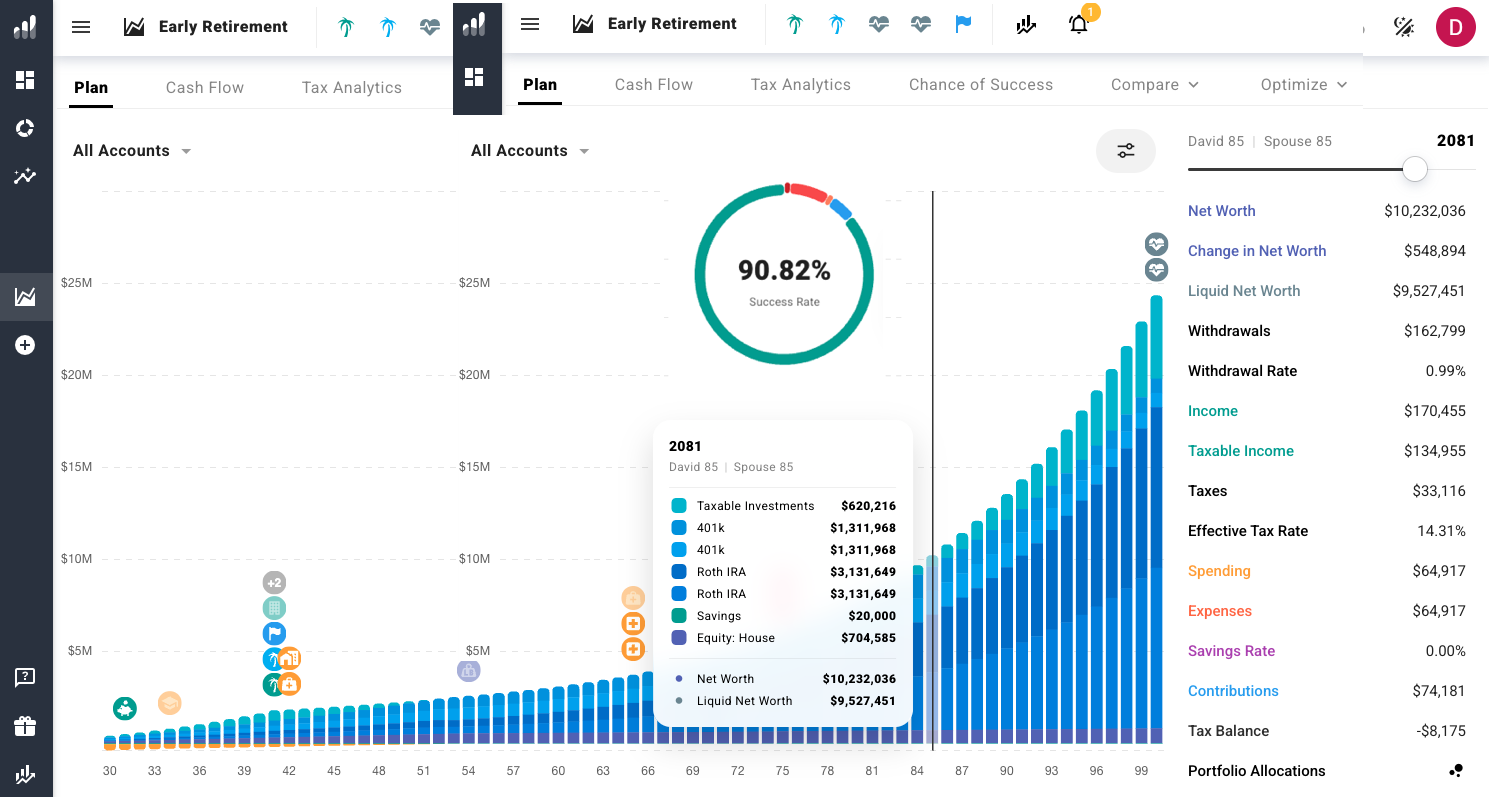
👉 Model late-life care costs in your retirement plan: see our ProjectionLab walkthrough
👉 New to Financial Independence? Start with our complete guide to FI and early retirement
👉 Want all withdrawal strategies in one place? See our complete guide to safe withdrawal rates
👉 Browse 130+ articles on FI, investing, work, and health at The Good Life Journey
👉 Subscribe to get free FI tools and the weekly newsletter (one-click unsubscribe anytime)
🌿 Thanks for reading The Good Life Journey. I share weekly insights on personal finance, financial independence (FIRE), and long-term investing — with work, health, and philosophy explored through the FI lens.
Disclaimer: I’m not a financial adviser, and this is not financial advice. The posts on this website are for informational purposes only; please consult a qualified adviser for personalized advice.
Check out other recent articles





























About the author:
Written by David, a former academic scientist with a PhD and over a decade of experience in data analysis, modeling, and market-based financial systems, including work related to carbon markets. I apply a research-driven, evidence-based approach to personal finance and FIRE, focusing on long-term investing, retirement planning, and financial decision-making under uncertainty.
This site documents my own journey toward financial independence, with related topics like work, health, and philosophy explored through a financial independence lens, as they influence saving, investing, and retirement planning decisions.
Frequently Asked Questions (FAQs)
-
In many European countries, universal healthcare and social LTC mean late-life medical shocks are smaller. Real spending often stays flat or drifts down until very late life—more a “smirk” than a deep smile. Germany’s co-pays matter, but stays are short (~25 months on average).
-
Focus on LTC co-pays, not core healthcare (usually covered). Price your local nursing-home co-pay after benefits, multiply by 2–3 years (stress-test 4–5), and invest that sleeve. Keep a flexible withdrawal plan for the rest.
-
Use the vdek figures for resident co-pays (vary by year of stay due to Leistungszuschlag). Build a small LTC sleeve and revisit every 2–3 years as prices and policy change.
-
Usually not for FIRE/FatFIRE budgets (€3k–€6k+). Facility bills often replace travel/transport/leisure rather than stack on top, and stays are typically short. LeanFIRE may feel a modest bump and should plan more carefully.
-
Recent Caritas data show an average ~25 months, with many residents dying within the first year; average stays have shortened in recent years due to several factors.
-
It can—staff shortages and demographics push costs faster than CPI. That’s why you invest the LTC sleeve (not cash) and re-price locally every few years.
-
Usually no. Spousal caregiving and late, short admissions make simultaneous institutionalization uncommon. Stress-test a brief overlap to be safe. (This aligns with German care patterns and observed short stays.)
Join readers from more than 100 countries, subscribe below!
Didn't Find What You Were After? Try Searching Here For Other Topics Or Articles: