
Before handing in your notice, it’s worth sitting down together and checking whether your plan really holds up. Photo by Docusign on Unsplash.
Reading time: 6 minutes
Are You Really Ready to Retire?
My father retired in his early 60s. He’d enjoyed a solid income throughout his whole career, and was psychologically more than ready to step down. Unfortunately, his portfolio was very undiversified, with a large share of his savings in a single stock: his own bank’s, recommended to him by that same bank.
When the stock fell shortly after retiring, my parents went through several years of stress that, with a bit of planning, could have been avoided. I don’t blame him. I think stories like his are far more common than we’d like to admit. Retirement is a big, abstract decision, and most people find it hard to think about it financially, let alone implement a detailed plan for it.
Unfortunately, it’s also one of the few money decisions that’s hard to undo. So, before handing in your notice, it’s worth checking for a few signs you’re not ready to retire yet. If any of these apply, you may want to postpone your decision, or, at least have a second opinion before pulling the plug.
7 Signs You Might Not Be Ready to Retire
1. You don’t know what you actually spend
Everything in your retirement plan depends on this number. Without knowing your real annual spending, you simply can’t know whether your portfolio, plus Social Security or a pension, will be able to support your desired lifestyle in retirement.
Track the last 12 months of spending before deciding on anything. Many people underestimate what they spend, because irregular costs like car repairs, gifts, or house maintenance don’t show up in a typical month.
2. Your withdrawal rate is too high
Your portfolio can only sustain so much spending. A simple test is to take your annual spending, subtract Social Security and any pension, and multiply that gap by 25. That’s roughly the portfolio you need to accumulate under the 4% rule, which assumes a 30-year retirement. If you’re retiring close to conventional retirement age, or your horizon is shorter, multiplying by 20 (a 5% safe withdrawal rate) can be defensible.
For example, if you spend $60,000 a year and Social Security will cover around $24,000, you need about $900,000 invested to cover the $36,000 gap ($36,000/0.04). With a 5% withdrawal rate, you would target $720,000 ($36,000/0.05).
It’s also important to consider the following items:
Taxes. Your withdrawal rate needs to include taxes too, not just your spending. This is very country-specific. In the US, money from a traditional 401(k) is taxed as income, while Roth withdrawals generally aren’t. In Germany, only the gains part of what you sell is taxed at a flat rate. Either way, figure out the details of your tax bill and make sure it’s included in your retirement portfolio target.
Bridge years. Many people retire a few years before Social Security starts. This changes the math, because during those years, the portfolio has to cover everything, so withdrawals are much higher at first and then drop later.
Treat these numbers as a ballpark check. If you’re close to the line, it’s worth modelling your situation properly. Bridge years, taxes, healthcare, changing expenses in retirement, or Social Security claiming ages are the type of plans I model for clients in my 1:1 sessions.

A storm in the first years of retirement can do far more damage than one later on. That’s sequence-of-returns risk, and why the order of returns matters. Photo by Giulia Veneziano on Unsplash.
3. Your savings aren’t diversified, or you have no buffer
Like with my father’s example, many people retire with their savings in a handful of stocks (sometimes including employer stock or their bank’s). But remember that individual companies come and go, and betting your retirement on a few of them is a risk you don’t need to take. Low-cost, internationally diversified index funds spread that risk across thousands of companies.
The timing of returns, which is also out of our control, matters too. Two retirees can earn the exact same average return over their 25-30 year retirement and still end up with very different portfolios, because what matters most is the order of those returns. If you’re unlucky and markets crash in year one or two of retirement, you have to sell more shares at low prices to cover the same spending; your portfolio may not fully recover to sustain your annual expenses, even if you do end up getting average returns over the long run. This is called sequence-of-returns risk (SORR). Most people deal with sequence risk by holding a few years of spending in bonds or cash, for example through a bond tent in the first years of retirement.
4. You’re carrying high-interest debt
Credit card debt at 20% interest costs far more than your portfolio is likely to earn (usually around 5-7% per year after inflation). It’s also a variable cost that can grow, unlike the fixed expenses you planned your retirement around. Credit card debt is often a sign that spending already runs ahead of income, which brings us back to point 1.
A mortgage is different. If your rate is low, carrying it into retirement is not unlike paying rent: it’s simply another expense your portfolio target covers. Paying it off early usually only makes sense at high rates. In the US, there’s one twist: lower withdrawals can help you stay under the income limit for ACA health insurance subsidies, so paying off the mortgage can be worth more than the interest maths suggest. We covered this in more detail in:
👉 Should You Pay Off Your Mortgage Before FIRE?
5. You haven’t planned for health insurance
This is the elephant in the room for many US retirees. Retiring before 65 means paying for your own coverage until Medicare starts. For a couple in their 50s, unsubsidised marketplace premiums can easily run to $15,000–20,000 a year, which can be one of the biggest costs of early retirement.
6. You haven’t worked out your Social Security strategy
Check your estimated benefit at ssa.gov. If you stop working early, the years with no earnings can lower your benefit, since it’s based on your 35 highest-earning years.
When you claim matters as well. Claiming at 62 gives you about 70% of your full benefit, while waiting until 70 gives you about 124%, for life and adjusted for inflation. For someone with a full benefit of $2,000 a month, that’s $1,400 versus $2,480. If your family tends to live long, or you’re investing in your health and longevity, delaying can work like insurance against outliving your money. Your life expectancy after retirement is worth factoring in this decision.
7. You’ve never stress-tested your plan
A retirement plan that only works if markets return 7% every year isn’t much of a plan. Imagine retiring in the mid-1960s, just before a decade of high inflation and poor returns, or in 2000, right before two crashes in a decade. Would your specific plan have survived?
What happens if the first five years of retirement are bad in terms of returns? Is your portfolio solid enough to withstand it or should you consider cutting spending by 10-15% for a few years? Would you need to pick up some part-time work under very specific circumstances? Having a plan B, like flexible spending rules that adjust to bad market years, often gives would-be retirees real peace of mind.
At the same time, it’s important to get the right balance, and not overdo it. Many folks in the FI community try to self-insure themselves against every possible scenario and end up working many more years than they need to, a pattern known as the one-more-year syndrome. Getting this balance right and weighing the different tradeoffs is where a second pair of eyes can help before you make a decision that’s hard to reverse.
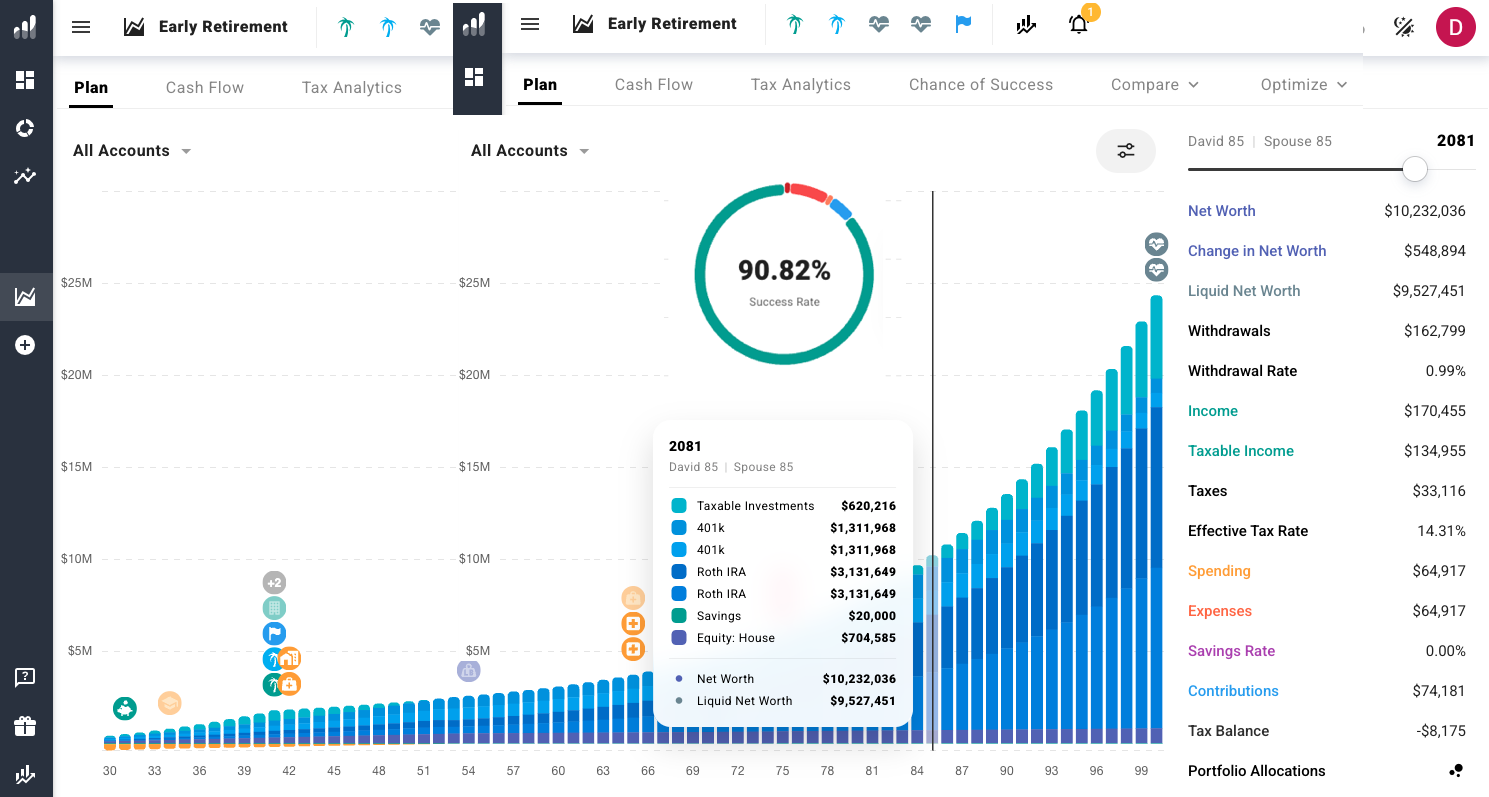
Figure 1: Testing a sample plan in ProjectionLab against 100+ years of market history. This example returned a 90.82% success rate, which is good but means there is still room for improvement.
What to Do If You See These Signs
If some of these red flags apply, working a couple more years can make a bigger difference than you’d expect. That’s because three things happen at once: you add more savings, your existing portfolio keeps compounding for longer, and, perhaps most importantly, you have fewer years of withdrawals to fund.
Imagine you have $800,000 and your target is $900,000. Work two more years, saving $30,000 a year with a 5% real return, and you’d have about $943,000. You’d be past your target, with two fewer years to fund.
That said, if you’re close but tired of your job, consider a middle path: part-time or lower-stress work that covers most of your living expenses. This still allows your portfolio to keep growing in the background for a few more years.
See the Whole Picture Before You Decide
Of course, these red flags don’t exist in isolation. Your spending, taxes, Social Security timing, health insurance, changing expenses over time, and investment portfolio composition all interact with each other: together, they decide whether your plan will hold up. A simple FI Calculator can’t capture all that complexity.
In my 1:1 FI Strategy Sessions, we model your individual situation using ProjectionLab, a professional retirement planning software, and stress-test your plan against 100 years of market history. Once we set up the baseline plan, we look at the different levers that make the biggest difference: working one more year, going part-time, claiming Social Security later, retiring in a lower cost of living area, or dynamically aligning your spending with market returns. These are educational sessions that will allow you to have a clear picture of the tradeoffs and make informed decisions.
Next steps:
👉 Safe Withdrawal Rates Explained: From the 4% Rule to Dynamic Strategies
👉 Browse 150+ articles on FI, investing, work, and health at The Good Life Journey
👉 Subscribe to get free FI tools and the weekly newsletter (one-click unsubscribe anytime)
👉 Work with me: 1:1 FI Strategy Sessions
Disclaimer: I’m not a financial, tax, legal or investment adviser, and nothing here is financial, tax, legal or investment advice. This article and my 1:1 sessions are educational and for informational purposes only. All modeling (including any tax scenarios) is illustrative and informed by software, not a substitute for professional advice. All decisions are your own.
Frequently Asked Questions (FAQs)
-
A simple check: subtract Social Security and any pension from your annual spending, then multiply the gap by 25 (or by 20 if you’re retiring later in life). If your invested savings are well below that number, and you have little flexibility to cut spending, it’s a sign to wait or to get your plan checked.
-
Sequence-of-returns risk: a market crash early in retirement forces you to sell investments at low prices to cover spending, which can permanently weaken your portfolio. Holding a few years of spending in bonds or cash helps.
-
Often, yes. Each extra year adds savings, gives your portfolio more time to compound, and removes a year of withdrawals. Two extra years can turn a portfolio just short of its target into one comfortably above it.
-
Not necessarily. At low interest rates, a mortgage is just another expense your portfolio covers. In the US, though, lower withdrawals can help you qualify for ACA health subsidies, which can make paying it off more attractive.
-
It depends on your health, other income, and life expectancy. Claiming at 62 gives about 70% of your full benefit, while waiting until 70 gives about 124% for life, which works like insurance against outliving your savings.
Join readers from more than 100 countries, subscribe below!
Didn't Find What You Were After? Try Searching Here For Other Topics Or Articles: