Should You Pay Off Your Mortgage Before FIRE?

The mortgage decision is rarely just about numbers—it sits at the intersection of maths, risk tolerance, and beliefs about what financial security means. Photo by Vitaly Gariev on Unsplash.
Reading time: 7 minutes
Quick answer:
If your mortgage rate is below 4% (real, after tax), investing surplus capital almost always wins—the return gap is too large to justify overpaying. Between 4–6%, the decision is genuinely closer and risk tolerance legitimately enters the decision. Above 6% real, paying down becomes competitive.
The psychological desire to own the house outright before going into early retirement is real and understandable—but it often reflects doubt about the withdrawal plan rather than a financial gap. If your withdrawal strategy is sound at your current spending level including the mortgage, the mortgage is just another expense.
What you'll get from this article:
✔ A clear framework for comparing your mortgage rate to expected investment returns
✔ Real numbers for US, UK, and German mortgage holders in 2026
✔ How the decision changes—or doesn't—at each stage of the FIRE journey
✔ The psychology behind the “pay it off first” instinct—and what it usually means
✔ Why carrying a mortgage into retirement is structurally identical to renting
✔ A practical decision guide for your specific situation
TL;DR — Mortgage vs Investing for FIRE 🏠📈
🧮 The core question: does your mortgage rate exceed your expected investment return?
📉 Below 4% real: invest any additional savings—overpaying mortgage is usually a mistake
⚖️ 4–6% real: genuinely closer—risk tolerance can be considered
🏠 Above 6% real: paying down becomes competitive on a risk-adjusted basis
🇩🇪 Germany (3.8%): invest | 🇺🇸 US (5% effective): lean invest | 🇬🇧 UK (5.7%): break-even
💡 Overpaying early saves more interest—but investing early builds more wealth
🧠 The desire to pay off before FIRE often signals doubt about the withdrawal plan
🔁 In early retirement, the mortgage is just another expense—like rent, funded by withdrawals
✍️ Treat each fixed-rate period as its own decision window and revisit at every reset
Should You Pay Off Your Mortgage or Keep Investing?
This question is one I see repeatedly in personal finance and FIRE (Financial Independence, Retire Early) forums. The reason why it’s such a common question is that, for many on the path to FI, it’s not only math that’s involved in the decision. The mortgage is at the intersection of numbers, risk tolerance, and deeply held beliefs—sometimes irrational or inherited—about what financial security means.
This article works through the evidence and the FIRE-specific considerations—including whether the answer shifts depending on where you are on your path to Financial Independence.
Note: We won’t cover in this article the actual decision of whether to buy or rent in the first place; we’ve covered already how to make an apples-to-apples comparison of renting and buying or whether one could consider adding REITs (Real Estate Investment Trusts) in their investment portfolio. This article is specifically for investors who already have a mortgage and are deciding whether to overpay it or not. The core framework applies globally, but US-based readers should be aware that there are important tax and healthcare subsidy considerations that can significantly affect the optimal strategy—we cover these specifically at the end of the article.

The core calculation is simpler than it looks: compare what the mortgage costs you to what investing that same money is expected to return. Photo by Jakub Żerdzicki on Unsplash.
The Core Framework: Mortgage Rate vs. Expected Investment Return
The baseline for the invest versus overpay your mortgage decision is quite simple: compare what your mortgage costs you to what your investments are expected to return. If your investments earn more than your mortgage costs, then investing any additional money saved is the mathematically superior choice. But if your mortgage rate exceeds your expected investment return or is not very different from it, paying down the mortgage can make more sense.
Using real (inflation-adjusted) numbers throughout this article, expected global stocks have historically run at around 5-7% per year over long time frames. Your effective mortgage rate is the comparison point here, not the headline rate. In the US, mortgage interest on a primary residence is tax-deductible, reducing the real cost of debt: for example, a 6.4% US mortgage with a 22% marginal tax rate would have an effective tax rate of roughly 5% (6.4 × 0.78).
In many other countries, e.g., Germany and most of the EU, no such deduction exists for primary residences, meaning the headline rate is the effective rate. But it’s still worth double-checking what the situation is in your home country to properly make the comparison. For US investors: mortgage interest is only deductible if you itemise deductions—and with the standard deduction at $16,100 (single) or $30,000 for married couples filing jointly in 2026, many homeowners no longer benefit from it. Check before assuming the deduction applies to your effective rate calculation.
The US has an average 30-year fixed mortgage rate of approximately 6.4%, as of May 2026—again, representing a 5% effective rate. German mortgage rates for 10-year fixed periods are around 3.8% currently, having risen sharply from the sub-1% levels seen during 2020-2021. In contrast, the UK offers a 5-year fixed rate of ~5.7%.
Table 1 below maps the decision across different mortgage rate scenarios. Below 4% (again, in real terms), the math strongly favors investing—the gap in returns is large enough that overpaying is almost always a mistake. Between 4-6%, the gap narrows and it’s legitimate to consider individual risk tolerance. But above 6%, paying down the mortgage starts to be competitive because the guaranteed return of eliminating debt might approach or exceed expected equity returns.
To put these numbers in context: my parents in a southern European country had a mortgage in the 1990s when rates were above 15%. At that level, overpaying was almost certainly the right call—no investment reliably returned more after tax, and the guaranteed interest saving was enormous. That generation—and many of their descendants—developed a strong intuition that if you can afford to overpay, you should. But today that old intuition no longer applies.
Table 1: How mortgage rate compares to expected equity returns—and what it means for your decision. The right answer depends on your rate, your country, and your risk tolerance: use this as a starting point, not a final decision.
| Mortgage rate (real, after tax) | Expected equity return (real) | Gap | Verdict |
|---|---|---|---|
| Below 2% (e.g. 2020 COVID era) | 5–7% | 3–5% | Invest strongly — overpaying is almost certainly a mistake |
| 2–4% | 5–7% | 1–3% | Invest — maths clearly favours it |
| 4–5% | 5–7% | 0–1% | Lean toward investing — but genuinely closer |
| 5–6% | 5–7% | Roughly break-even | Personal risk tolerance legitimately enters |
| Above 6% real | 5–7% | Negative gap | Paying down becomes competitive on a risk-adjusted basis |
The German case (3.8%) leans strongly towards investing, whereas the US (5%) and the UK (5.7%) lean slightly toward investing and breaking even, respectively. But none of these cases are straightforward situations that would completely make the case for overpaying, especially when you factor in the time horizon advantages of investing during the accumulation phase of FIRE.
Risk tolerance enters the equation most meaningfully in the 4–6% range, where the mathematical gap is small enough that personal circumstances can be taken into account. An investor who would lose sleep over market volatility while carrying a mortgage may rationally accept a slightly lower expected return in exchange for the certainty of debt reduction. But an investor who is comfortable with volatility and trusts their withdrawal plan has less reason to deviate from the mathematically superior choice.
One practical point you may be asking yourself here: how does the length of the fixed-rate period interact with our choice to overpay or not? In short, treat each fixed rate period as its own decision window, and then revisit your decision when the rates change. For instance, a German investor locked into a 3.8% has a decade of clarity—the maths strongly favours investing throughout that window. The decision would have to be revisited in 10 years depending on the evolving conditions.
How Overpayments Actually Work — and a Common Misconception
Before discussing when it makes sense to overpay, it’s worth clarifying how overpayment works. One practical note before going further: in some countries, mortgage contracts limit how much you can overpay annually without penalty. To illustrate a few examples:
German mortgages cap voluntary extra payments at 5–10% of the original loan per year; exceeding that typically triggers a prepayment fee,
UK mortgages usually allow up to 10% of the outstanding balance per year penalty-free,
US mortgages are generally more flexible with no prepayment penalties.
Check your contract before assuming you can overpay freely—and more broadly, the framework in this article is intended as a starting point: tax rules, deductibility, and overpayment limits vary enough by country that it's worth verifying what applies to your specific situation.
When you make an overpayment, the full amount goes towards reducing the outstanding principal. This reduces the balance against which future interest is calculated.
The implication is that overpaying early in a mortgage saves significantly more in total interest than overpaying late, because the principal reduction prevents decades of future interest charges rather than just a few years of them.
Taken separately, this sounds like a convincing argument for paying early. But it’s important to not confuse two separate issues at play here. The amortization point only tells you that if you’ve already decided to overpay, then doing so earlier is ideally better than doing so later. But it doesn’t tell you whether overpaying beats investing the additional savings in the first place.
The opportunity cost of not investing that same capital is also highest when you’re early in your FI journey—because that capital has the most time ahead to compound in your favor. The two effects don't cancel each other out: the investment return advantage generally dominates at low-to-moderate mortgage rates regardless of where you are in the mortgage term.
The fixed vs variable dimension is also important to address. With a US 30-year fixed mortgage at 5%, you have locked-in certainty on both sides of the equation—you know your mortgage cost, you can estimate your expected investment return, and make a long-term decision.
In contrast, UK investors on 2- or 5-year fixed terms face a reset into an unknown future rate—their mortgage cost is only certain for the fixed window. If rates rise at renewal, the higher rate applies to whatever principal remains outstanding. Reducing that principal now limits the damage—a legitimate, if modest, argument for some overpayment as interest rate insurance. It could make sense particularly for investors within a few years of their FIRE date where a payment spike could meaningfully affect their withdrawal plan.

The intuition to overpay whenever you can made perfect sense when mortgage rates were >10%. At today's rates, some deep-held beliefs of older generations may not apply. Photo by Jakub Żerdzicki on Unsplash.
How Your Stage on the FIRE Journey Affects the Decision
The decision to overpay your mortgage or invest can feel different depending on where you are on your FI journey—though as we'll see, the underlying maths stays the same throughout.
Early on in the accumulation phase, say, 10-15+ years from your FIRE target—the case for investing any surplus savings over overpaying is at its strongest. Compounding has the most time to work, and the opportunity cost of overpaying is at its highest.
Consider the German example, with a 3.8% mortgage rate and 7% expected real equity returns. Directing $500 per month into investments rather than overpaying the mortgage produces roughly $262,000 in invested wealth after 20 years, compared to approximately $160,000 in interest saved and principal reduced—a gap of around $102,000. Double the monthly surplus invested and the gap doubles too.
These are not marginal differences—they illustrate clearly how overpaying can extend your FI timeline and your working career.
As you approach your FIRE date, the mathematical case doesn't actually change—the same comparison between mortgage rate and expected return applies regardless of how close you are. But what does tend to change is the psychology around the decision.
Many FIRE investors feel more comfortable retiring with a smaller mortgage balance or none at all—a lower fixed monthly spend feels less daunting when they’ve stopped working. While that's a legitimate feeling, it's worth being clear that it comes at a cost: money directed at the mortgage in the final years of accumulation is money not compounding in the portfolio, leaving you with a lower payment but also a smaller nest egg in retirement.
Some argue that a lower mortgage payment means a lower FI number—which is true, but the portfolio you'd have built by investing the surplus instead would typically exceed what you need by a wider margin than the payment reduction provides. If the math favoured investing throughout accumulation, it still does now in the final stretch.
That said, if a modest regular overpayment genuinely reduces anxiety without materially extending your FI timeline, that's probably a reasonable trade-off to make—as long as it's made consciously rather than by default. As Morgan Housel argues in The Psychology of Money, a strategy you can stick to beats a theoretically optimal one you abandon—sometimes reasonable enough beats rational.
The Mortgage in Retirement Is Just Another Expense
If you struggle with the idea of carrying the mortgage into early retirement consider this reframing: if many people FIRE as renters—and you can, because rent is simply a monthly expense funded by portfolio withdrawals—then carrying a mortgage into retirement is structurally identical. It’s a fixed monthly outgoing covered by the portfolio, with the added feature that, at this point, you're building equity in an asset rather than paying a landlord.
Your withdrawal strategy doesn't distinguish between grocery bills, rent, and a mortgage payment. If your plan is sound at your current spending level, including the mortgage, there is no financial imperative to accelerate repayment before retiring. The capital used to pay off the mortgage early could instead remain invested, generating returns that in most rate environments exceed the interest cost.
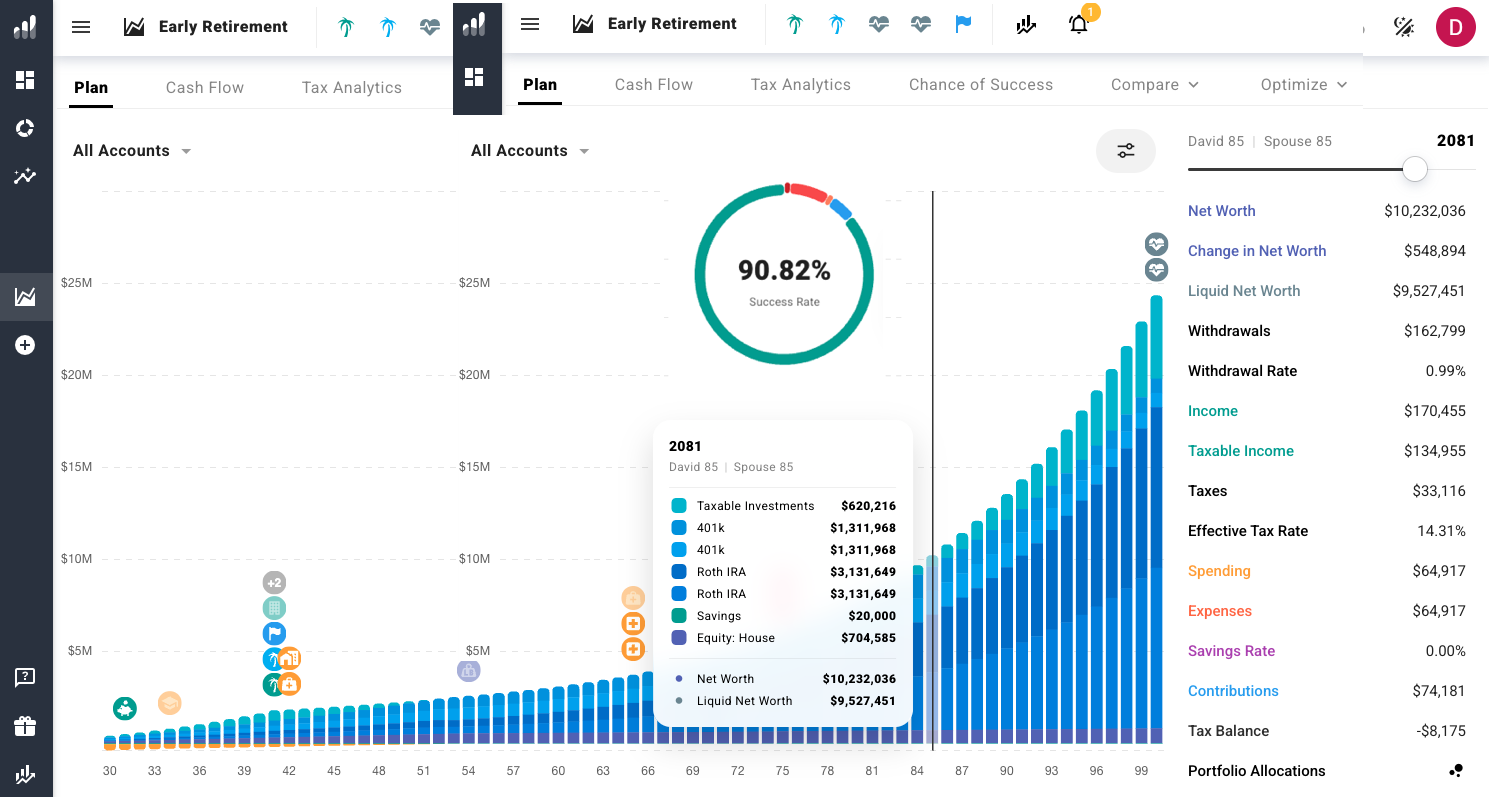
👉 This is exactly the kind of trade-off ProjectionLab lets you model—pay off early vs. invest the difference, side by side, stress-tested against real market history.

A few variables—your effective mortgage rate, your expected return, and your risk tolerance—are enough to navigate this decision with confidence. Photo by Anastasia Petrova on Unsplash.
A US-Specific Note: When the Maths Gets More Complicated
As hinted earlier, the invest-versus-overpay decision has an additional layer for US investors that Europeans don't face: one must consider the interaction between the mortgage debt, retirement income levels, and several tax and healthcare subsidy thresholds. They don’t change the overarching core principle—mortgage rate vs expected return is still the right framework—but they can meaningfully shift whether carrying a mortgage into early retirement is optimal.
The most significant consideration is ACA (Affordable Care Act) health insurance subsidies. For early retirees without employer-sponsored health coverage, federal subsidies on the ACA marketplace are tied to Modified Adjusted Gross Income (MAGI). As of 2026, the “subsidy cliff” sits at approximately $81,760 in MAGI—exceed it by $1 and you lose the entire premium tax credit. For a couple in their 50s, the difference between a subsidised and unsubsidised Silver plan can run to $15,000–22,000 per year.
How does this tie in with your decision to pay off your mortgage or not? A paid-off mortgage reduces mandatory monthly withdrawals from the portfolio, which reduces MAGI, which can preserve subsidy eligibility. For US investors, this effect can be worth considerably more annually than the return difference between investing and paying down the mortgage—especially for a very low-rate mortgage that the core framework would otherwise say to hold indefinitely.
Beyond ACA subsidies, carrying a mortgage also affects your capacity for Roth conversions—strategies that can be highly valuable for US early retirees managing taxable income before Medicare eligibility at 65. The BridgeToFI guide to Roth conversions and ACA subsidies covers how these interact in detail with 2026 numbers.
The bottom line for US investors: at very low mortgage rates, the case for carrying the mortgage into early retirement is weaker than the core framework suggests—not because the return maths changes, but because higher mandatory withdrawals can cascade into ACA subsidy loss and reduced Roth conversion capacity. A fee-only advisor familiar with FIRE planning is worth the cost for modelling your specific numbers.
These ACA subsidy considerations are most relevant for US early retirees targeting modest spending—roughly below $80,000/year for a couple. If your planned withdrawals already exceed the ACA cliff, the subsidy question is no longer a factor and the core invest-versus-overpay framework applies without that layer. Roth conversion planning remains relevant at higher income levels too, but the interaction with the mortgage becomes less urgent.
A Practical Framework for Your Situation
In the end, the decision for most investors reduces to a handful of variables: your effective mortgage rate, your expected real investment return, and your genuine risk tolerance.
At current rates—US around 5% effective, UK 5.7%, Germany 3.8%—the situations differ meaningfully. A German FIRE investor with a 3.8% fixed mortgage is firmly in invest-the-surplus territory. A US investor at roughly 5% effective sits in a greyer zone where personal risk tolerance can also be considered and a modest hybrid approach could be defensible. A UK investor at 5.7% on a 2- or 5-year fix is near break-even on the maths, and the uncertainty of the next rate reset adds a reasonable argument for modest overpayment as interest rate insurance—particularly if the reset could coincide with a period of higher rates.
For most investors outside the US, the framework is relatively clean: compare your effective mortgage rate to expected returns, consult the table above, and invest the surplus where the maths supports it. However, a single article cannot capture every personal circumstance: use this as a starting framework, and verify what applies to your situation and country before acting on it.
For US investors, the additional layer of ACA subsidies and Roth conversion windows means your specific income level and tax situation matter—the principle is the same but the optimal implementation may differ.
But if you feel you cannot pull the trigger on FIRE until the mortgage is paid off, the most useful question is probably not “should I pay off the mortgage?” but “why don't I trust my withdrawal plan?” That doubt is often what's behind the one-more-year syndrome—the tendency to delay retiring based on anxiety rather than a genuine problem with the numbers.
Either way, it's a question worth answering directly. If you suspect your plan has a genuine gap, our guide to safe withdrawal rates is the right place to start.
💬 Have you struggled with this question before? Where do you stand on this one—investing the surplus or paying down the mortgage? Please share with us your story in the comments below.
If you enjoyed this article, here are some next steps:
👉 Model mortgage payoff vs. investing with your own numbers: see our ProjectionLab walkthrough
👉 For the full FI investing framework, see our complete guide to investing for FI
👉 Use our FI Calculator to see how your savings rate affects your FI date (email unlock)
👉 Browse 130+ articles on FI, investing, work, and lifestyle at The Good Life Journey
👉 Subscribe for weekly insights—one-click unsubscribe
🌿 Thanks for reading The Good Life Journey. I share weekly insights on personal finance, financial independence (FIRE), and long-term investing — with work, health, and philosophy explored through the FI lens.
Disclaimer: I am not a financial adviser, and this content is for informational and educational purposes only. Please consult a qualified financial adviser for personalized advice tailored to your situation.
Check out other recent articles





























About the author:
Written by David, a former academic scientist with a PhD and over a decade of experience in data analysis, modeling, and market-based financial systems, including work related to carbon markets. I apply a research-driven, evidence-based approach to personal finance and FIRE, focusing on long-term investing, retirement planning, and financial decision-making under uncertainty.
This site documents my own journey toward financial independence, with related topics like work, health, and philosophy explored through a financial independence lens, as they influence saving, investing, and retirement planning decisions.
Frequently Asked Questions (FAQs)
-
Not necessarily — and for most FIRE investors, the maths argues against it. If your mortgage rate is below your expected investment return, the surplus capital grows faster in the market than it saves in interest. The more relevant question is whether your withdrawal strategy is sound at your current spending level, including the mortgage payment. If it is, the mortgage is just another expense — there's no financial imperative to clear it before firing. US investors should also consider the interaction with ACA health insurance subsidies and Roth conversion strategies — a paid-off mortgage reduces mandatory withdrawals, which can help manage taxable income below key thresholds. See the US-specific section above for detail.
-
At low-to-moderate mortgage rates — below 5% real — investing the surplus almost always produces more wealth over a 15-20 year accumulation period. At a 3.8% mortgage rate with 7% expected real equity returns, directing $500/month to investments rather than overpayments produces roughly $102,000 more in wealth after 20 years. The opportunity cost of overpaying is highest during accumulation because capital has the most time to compound.
-
Yes — a lower mortgage payment means lower expenses, which reduces the portfolio size needed under the 4% rule. But this argument has two problems. First, the portfolio you would have built by investing that surplus instead typically exceeds the lower FI number anyway — so the reduction in target is outpaced by the reduction in portfolio growth. Second, and more fundamentally, overpaying means less capital compounding in the market throughout accumulation — which extends the time to reach any FI number, lower or not. Overpaying to reduce the FI number is often a slower route to financial independence than staying invested and reaching the original target sooner.
-
At 5% (real, after tax), the decision is genuinely close. Expected global equity returns of 5-7% real mean the return gap is roughly 0-2 percentage points — meaningful but not overwhelming. At this rate, personal risk tolerance legitimately enters the equation: an investor comfortable with volatility should lean toward investing; one who would lose sleep over market exposure while carrying debt may rationally accept a slightly lower expected return for the certainty of debt reduction.
-
Yes — carrying a mortgage into early retirement is structurally identical to retiring as a renter. In both cases, you have a fixed monthly outgoing funded by portfolio withdrawals. Your withdrawal strategy doesn't distinguish between a grocery bill, rent, and a mortgage payment. If your plan is sound at your current total spending level, there is no financial reason to accelerate repayment before firing.
-
With a long-term fixed mortgage — like a US 30-year fix — you have locked-in certainty on both sides: you know your cost and can estimate your investment return. The invest-vs-overpay decision is essentially settled for the duration of the fix. With a shorter fix — common in the UK at 2 or 5 years — you face rate reset uncertainty, which adds a nuance particularly relevant when you're already in the break-even zone (around 5–6% effective rate). If rates rise at renewal, a higher rate applies to whatever principal remains outstanding. In that grey zone, the uncertainty of the next reset is a legitimate if modest argument for some overpayment as a hedge — whereas a US borrower at the same rate, locked in for 30 years, faces no such uncertainty and the invest case is cleaner.
-
If you've decided to overpay, doing so earlier saves significantly more total interest — because reducing the principal early prevents decades of future interest charges rather than just a few years. However, this doesn't mean overpaying early is better than investing early. The opportunity cost of not investing is also highest when you're furthest from retirement. The two effects don't cancel: at low-to-moderate rates, the investment return advantage dominates regardless of where you are in the mortgage term.
-
The effective mortgage rate is the real cost of your debt after any tax deductibility. In the US, mortgage interest on a primary residence is tax-deductible, so a 6.4% headline rate at a 22% marginal tax bracket has an effective rate of roughly 5% (6.4 × 0.78). In Germany and most EU countries, no such deduction exists for primary residences — the headline rate is the effective rate. This distinction matters because it changes where your mortgage sits on the invest-vs-overpay spectrum.
-
The decision framework is: calculate your effective mortgage rate, compare it to expected real equity returns (5-7% historically), and identify where you sit on the spectrum. Below 4% — invest the surplus. Between 4-5% — lean toward investing, though the gap is narrowing. Between 5-6% — genuinely break-even, where risk tolerance and rate reset uncertainty legitimately tip the balance. Above 6% — paying down becomes competitive. Most importantly, if the desire to pay off the mortgage comes from anxiety about FIRE rather than a rate calculation, address the withdrawal plan first — paying off the house won't resolve a confidence gap in the retirement strategy
Join readers from more than 100 countries, subscribe below!
Didn't Find What You Were After? Try Searching Here For Other Topics Or Articles: