How We're Using German Parental Leave as Annual Mini-Retirements

The Financial Independence journey doesn't have to be a sprint. With three young kids, we chose to design this journey carefully—more time together now, not deferred to some future retirement date. Photo by Jessica Rockowitz on Unsplash.
Reading time: 7 minutes
Quick answer:
Germany gives each parent up to 3 years of job-protected parental leave per child, usable in chunks until the child turns 8. Most parents use the paid component once around birth and forget the rest. We're already working part-time to enjoy more of the journey—and now we're taking it a step further: using our 7 remaining rounds of parental leave as annual one-month mini-retirements, starting this summer in France. It’s reframing how we approach the rest of our Financial Independence journey.
What You'll Get From This Article
✔ How parental leave in Germany (Elternzeit) works—including the deferred window parents don’t use
✔ Our family’s situation: 3 kids, 7 remaining rounds, and a concrete plan until 2031
✔ The financial logic for why mid-journey is the right time to take unpaid leave
✔ Our first mini-retirement: a month in rural Dordogne this summer
✔ How this applies if you’re not in Germany—and what to do if you’re in the US
TL;DR — Elternzeit as Mini-Retirements
🌿 Most parents use Elternzeit once around birth and forget the deferred window exists
📋 Parents get up to 3 years job-protected leave per child, usable until the child's 8th birthday
⏰ Up to 24 of those months can be deferred to age 3-8
🔒 Job protection is absolute—your employer cannot terminate you during leave
👨👩👧 We have 7 remaining rounds across 3 kids—we plan on one month per year until 2031
💶 Our remaining parental leave is unpaid, but at 60% of FI the financial impact is modest
🏡 This year: rural Dordogne, France—near-zero accommodation cost and slower pace of life
🌍 Use parental leave strategically during your FI journey—they're a tool combatting “the boring middle”
Why We Slowed Down Our FIRE Journey
Like many in the FI space, we started our FIRE (Financial Independence, Retire Early) journey very motivated—optimizing for savings rates up to 50–60% and watching our net worth climb steadily, fully focused on our numbers. But after seven or eight years on the path, we’ve made a deliberate choice to slow down and rethink our relationship with work.
In theory, if we both ploughed through in our full-time jobs, we'd reach FI in about 4-5 years. But as parents with 3 young kids, grinding ahead and missing out on this special time with them made less and less sense. For us, the journey itself deserved as much attention and conscious design as the destination.
And then there’s a second dimension beyond family: health. Sprinting to FI at maximum intensity is unlikely to produce a very healthy lifestyle along the way—and we’ve become increasingly aware that the length of our retirement will ultimately be determined far more by our health than by any portfolio number.
The third factor is timing: arriving at FI in 4-5 years means our kids would still be 8-11, and our schedules largely locked into their school routines anyway. So the case for slowing down and designing the journey more intentionally became very compelling in our situation.
This article is about one specific tool we’re leveraging to do that: Germany’s parental leave system (“Elternzeit”). Most parents tend to use it once around birth and move on. Instead, we’re using our remaining rounds as annual one-month mini-retirements—starting this summer in rural France. Below we explain exactly how it works, why the timing makes sense for us financially, and whether something similar could apply to you.
We still continue to add to our investments, but have eased off the savings rate accelerator a bit. We’re designing the FI journey so that we can look back on it with zero regrets, rather than just reaching an arbitrary number while postponing these key life experiences as a trade-off.
The more formal concept—memory dividends—comes from Bill Perkins’ Die With Zero. Essentially, most experiences have an expiry date and and have an optimal place in everyone’s life. The experience of backpacking in Europe in your twenties with your friends will be very different than a comparable trip in your 40s alone or with kids. Taking your parents on a trip while they’re still healthy, mobile, and can enjoy their grandkids is a different experience than waiting until they are in their 80s or missing the chance altogether.
And most relevant to our article today: being present with young kids when they actively want and need your attention has a very finite window. By the time they’re teenagers, they’ll have their own friends, interests, and perhaps will be less keen to hang out with us. If we sprint to FI too fast, we risk looking back in regret.
So, here is the plan moving forward: in addition to the roughly 40+ days we enjoy yearly of vacation plus public holidays, we aim to leverage annual parental leave to take off an additional 4 to 6 weeks per year. That means the second half of our FI journey will have about 2.5 months off each year. We’ll test this concept for the first time this summer with a 4-week slow travel to southwestern France.

Slow travel means living somewhere rather than visiting it. The routine, the fresh air, the unhurried pace—these are the things a one-week holiday doesn’t always deliver. Photo by Land O'Lakes, Inc. on Unsplash.
Elternzeit — What It Is and How to Make the Most of It
Elternzeit—literally “parental time”—is Germany's statutory parental leave system. At its core, each parent gets up to 3 years of job-protected leave per child, which can be split into 3 separate periods. The employer cannot refuse Elternzeit—it is something that is notified, not requested, and culturally very common and accepted.
The part that some people overlook is that up to 24 months of that entitlement can be deferred to the period between the child’s 3rd and 9th birthday. Although this period does require employer consent—the employer must refuse in writing with specific operational reasons within 4 weeks, and in practice consent is routinely given for well-planned, advance-notice requests. My wife works in the public sector and I’m self-employed as a freelancer, so our flexibility depends mostly on her.
Elterngeld—the paid parental allowance at roughly 65% of net income—covers only the first 14 months after birth. These 14 months form a shared pool that both parents draw from: each parent is entitled to a minimum of 2 and a maximum of 12 months, with the remaining 2 “partner bonus” months unlocked only if both parents take at least 2 months each. So, in practice you could split it 7/7, or 12/2, or any combination in between, as long as the total pot is 14. Afterwards, Elternzeit continues as unpaid leave, with job protection unchanged.
A simple example to make the maths clear: each parent has 36 months of Elternzeit per child. If you took 12 months around birth (the paid window), that leaves 24 months of remaining entitlement per parent, per child—all of which can be deferred to the age 3-8 window.
With two children, that’s up to 48 months of deferred entitlement per parent in total. Taken as one-month break per year, you’d only be using about 7 of those months of entitlement.
Our Specific Situation: 3 Kids, 7 Remaining Rounds
Let’s look at our specific situation as an example: we have three children—one older child and twins (which counts as one birth event). Both of us already took the paid Elternzeit twice (once per birth event), using roughly a year each time. Given that you have 3 rounds of parental leave per child, that leaves us with 7 remaining rounds that we can theoretically take by 2031, when our twins turn 8.
Including 2026, there are 6 years until 2031, hence why we plan to take 1 parental leave each year (with the possibility of taking 2 one year, if needed). In practice, the two first years, we’re flexible as to when to take it (in 2026 parts of August and September), but as the older one starts school it will make sense to take the extended break in summer and use our remaining 40+ vacation days scattered throughout the different two-week breaks you find in the German school calendar system.
For many public sector employees, the practice of taking deferred Elternzeit is not unusual. Many colleagues are working part-time (including 50% or less), and parental-related leave is culturally accepted in a way that might raise eyebrows in other countries. If employed in the private sector, it’s worth discussing earlier and framing the request clearly: given that operational disruption is the grounds for refusal, a well-planned 4-week absence in summer is unlikely to count as an “urgent operational reason” for most employers.
The mechanics are fairly straightforward once you know them. The harder question is whether taking unpaid leave makes financial sense—and when in the FI journey to consider it.

Some of the best memories cost very little—if you plan ahead and choose the right place. Photo by Mattias Helge on Unsplash.
The Financial Logic — Why Now Is the Right Time
Obviously, taking unpaid parental leave has a real cost. A single month without earnings represents about 8% of your annual salary. For someone at the start of their FI/FIRE journey, with a small portfolio and high dependence on their savings rate, that loss is meaningful.
But the further on the FI path, the less important salary becomes relative to total net worth increase, because your portfolio starts to do more of the heavy lifting. Hence, the impact of one month of foregone savings for us now is small relative to what it would have been in the first couple years of accumulation.
This concept is well understood in the FI space. Taken to the extreme, it is the concept of Coast FIRE, where, after reaching a given net worth level, some folks decide to take their foot off the savings pedal altogether and just let their portfolio grow slowly in the background until retirement while enjoying a higher lifestyle in the meantime. In our specific situation, I’d say we’re semi-coasting: we still want to get to FI fast, but want to be sure to enjoy the journey.
We’re still trying to plan the trip smartly from a financial perspective. A full month without salary, combined with a full month of high spending, would start to strain the budget. In our first trip this year, we are staying in my in-laws tinny house in Dordogne. It’s essentially a cabin (not winterized), but the emotional attachment is strong; it’s a place my wife grew up in summers and that we both know well.
Accommodation costs will be near zero, and the COL in rural Dordogne is generally lower than here in Germany, so the main expense difference compared to a regular month where we live is the cost of hiring a car. I’m very curious to see what our monthly spend will turn out to be. Another idea for the future could be to leverage geoarbitrage for mini-retirements and spend time in very cheap locations relative to where we live.
Nothing is decided yet, but we also envision future mini-retirements in places where we have family or friendship ties (e.g., in the UK and Spain), and are excited about at least one Nordic summer stay. My wife has a strong pull toward Thailand too, which we’re earmarking for when the kids are a bit older and more robust travellers.
Our First Mini-Retirement: One Month in Rural Dordogne, Summer 2026
Southwestern France in Dordogne is a great place to start. Some of its more rural areas have hosted northern European families for decades—British expats have settled there in enough numbers that some locals jokingly call it “Dordogneshire.” But, of course, it’s far from being a touristy place, it’s a very rural area with a lot of charm.
The infrastructure for longer family stays fits our needs well. It’s full of rivers and lakes to swim in, medieval villages and towns to explore, local markets and brocantes to treasure hunt, genuinely good (and locally produced) food, and close enough to the sea to make one or several day-trips possible.
Most importantly, it’s the kind of place where the pace of living slows down compared to city life. It also allows you to truly unwind in a way that a one-week break wouldn’t quite allow. I really enjoy the feeling when you start to feel like you live there rather than just being a visitor. And for us, the cherry on top is having a full month to brush-up and practice our rusty French.
Some parents might read “a month in rural France with three children under 5 and no childcare” and think we’re crazy. And honestly, that thought has crossed our minds too. But our experience travelling with them in the past has been overwhelmingly positive. It was consistently more relaxing than the normal routine at home, even without childcare. The kids are excited about the road trip aspect (we don’t drive when at home) and tend to settle in quickly to their new favorite spots and routines.

The experiences worth having rarely require much money, but they usually require time. Photo by Chris Montgomery on Unsplash.
What Could a mini-retirement Look Like for You?
If you’re in Germany and have kids, the same framework we’re using applies directly. Check out how many Elternzeit rounds you have remaining per child, when each child’s deadline falls (8th birthday), and how much of it can be deferred to the 3-8 age window. If you’re in the public sector or a larger employer, the consent question is unlikely to be a significant barrier. Either way, plan in advance, give as much notice as possible (at least 13 weeks for deferred rounds), and frame the request around operational workability.
If you’re elsewhere in Europe, many EU countries have some version of extended unpaid parental leave with job protection, though the generosity and flexibility of the deferred window will of course vary.
For readers in the US, the contrast is significant: 12 weeks of unpaid, job-protected leave—no paid component, no extension to age 8, no flexibility for later use. Many American families get nothing at all in practice in terms of work-life balance. But you can still see this article as motivation and get creative on what’s possible there: like in many other countries, you may not have access to this type of leave, but you could still try to engineer a sabbatical at work, or try to time mini-retirements between job changes (which usually will increase your salary anyway).
If you’re self-employed (like myself), the Elternzeit as a legal mechanism doesn’t apply—but the underlying logic does. You even have arguably more flexibility to plan in advance, and the question could become purely financial: is your portfolio and income stable enough to absorb a month without billable work? Or assuming a 1–2 month mini-retirement, is it possible to enjoy it while still working very reduced hours while there?
The Bigger Picture: Designing the FI Journey, Not Just the Destination
Folks in the FI/FIRE space like to talk about “the boring middle.” It’s the long stretch of accumulation after the first couple of years where the novelty of the FIRE concept has worn off. For many, years of saving, investing, and waiting to reach your FI number often feels like deferred living, and so the instinct for many is to plough through it as fast as possible.
We’ve chosen a different approach: use whatever tools available to make the middle genuinely enjoyable—maybe even the best years of our life so far, when we’re still young and can fully enjoy free time with our kids. Parental leave is one of those tools; after this year, with our remaining six rounds, this represents six more summers of structured, intentional family time in places we like or want to explore—at least a month each time, slow enough to feel like we live there, and cheap enough to manage comfortably without derailing our FI trajectory.
As we’ve argued before, FIRE isn’t a finish line you cross before life begins. It’s something you design now, with whatever time and resources you currently have.
If you enjoyed this article, here are some next steps:
👉 Model sabbaticals and variable spending in your FI plan: see our ProjectionLab walkthrough
👉 For the full framework on intentional breaks, see our Mini-Retirements guide
👉 Splitting your time across countries in retirement: see our Seasonal Geoarbitrage guide
👉 Raising kids on the FI path? Here’s how we’re teaching ours about money
👉 Use our free FI Calculator to model how a slower path affects your timeline (email unlock)
👉 Subscribe for weekly insights—one-click unsubscribe
🌿 Thanks for reading The Good Life Journey. I share weekly insights on personal finance, financial independence (FIRE), and long-term investing — with work, health, and philosophy explored through the FI lens.
Disclaimer: I am not a financial or legal adviser, and this content is for informational and educational purposes only. Please consult a qualified financial adviser for personalized advice tailored to your situation.
Check out other recent articles




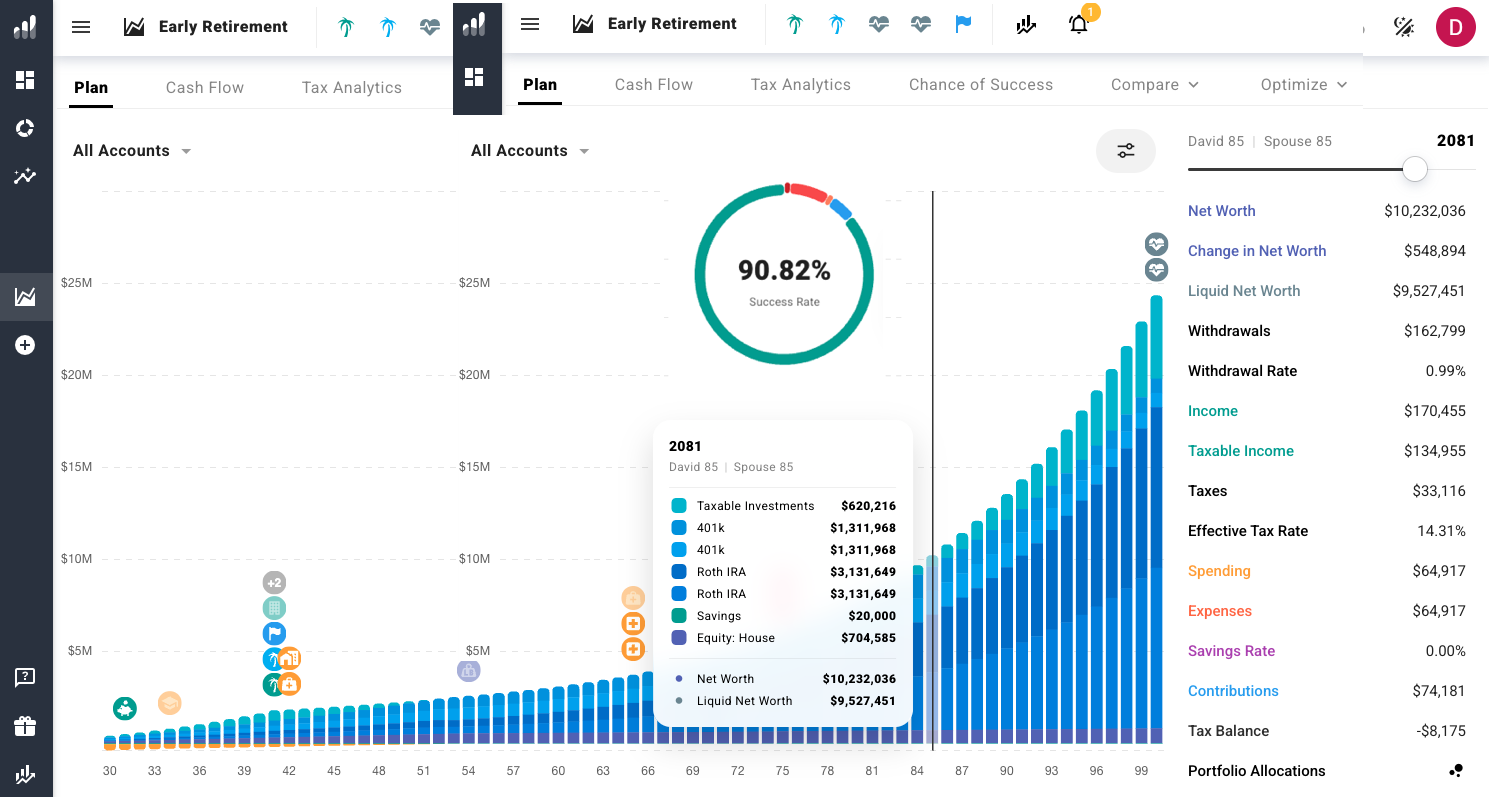
























About the author:
Written by David, a former academic scientist with a PhD and over a decade of experience in data analysis, modeling, and market-based financial systems, including work related to carbon markets. I apply a research-driven, evidence-based approach to personal finance and FIRE, focusing on long-term investing, retirement planning, and financial decision-making under uncertainty.
This site documents my own journey toward financial independence, with related topics like work, health, and philosophy explored through a financial independence lens, as they influence saving, investing, and retirement planning decisions.
Frequently Asked Questions (FAQs)
-
Yes — up to 24 months of your Elternzeit entitlement can be deferred to the period between your child’s 3rd and 8th birthday. This deferred window requires employer consent, but the employer must refuse in writing within 4 weeks with specific operational justification. In practice, particularly in the public sector, well-planned requests with sufficient notice are routinely approved.
-
No. Elterngeld — the paid allowance of roughly 65% of net income — covers only the first 14 months after birth, shared across both parents. Any Elternzeit taken after that window, including all deferred rounds, is unpaid. Job protection remains fully in place throughout, but you will not receive Elterngeld for later rounds.
-
For the deferred window (age 3-8), the employer can object — but only in writing, within 4 weeks of your notice, and only on grounds of urgent operational necessity. They cannot simply decline; they must justify refusal. For most desk-based roles, a well-planned 4-week summer absence is unlikely to meet that threshold. The employer cannot refuse Elternzeit taken in the first 3 years at all — that window is notification only.
-
A month of unpaid leave represents roughly 8% of annual salary in foregone income. Early in the FI journey, when savings contributions are the primary engine of wealth building, this impact can be meaningful, especially if you do it multiple times. Later — once your portfolio is generating returns that rival or exceed monthly contributions — the impact on your overall timeline shrinks considerably.
-
Elternzeit is the legal right to job-protected leave — up to 3 years per parent per child. Elterngeld is the financial allowance paid during the first 14 months, equivalent to roughly 65% of your pre-leave net income. You can take Elternzeit without receiving Elterngeld (in deferred rounds), but you cannot receive Elterngeld without being on Elternzeit. The two are related but distinct.
-
The legal Elternzeit mechanism — with its job protection and employer notification requirements — applies to employees only. Self-employed parents are not covered by BEEG in the same way. However, self-employed parents can still apply for Elterngeld during the paid window, and the underlying financial logic of taking intentional unpaid breaks applies regardless — it becomes a purely financial rather than legal question.
Join readers from more than 100 countries, subscribe below!
Didn't Find What You Were After? Try Searching Here For Other Topics Or Articles: