
Moving abroad comes with a long checklist. Sorting out the money side early can save you thousands. Photo by JESHOOTS.com on Pexels.
Advertising disclosure: This article contains affiliate links, marked with an asterisk (*). If you open an account through one of them, The Good Life Journey may earn a commission from the provider, at no extra cost to you. This doesn't influence what we recommend: I've been a Wise customer myself for over a decade, and rather than promoting any single product, this guide explains which option fits which situation—pros and cons included. More in our full affiliate disclosure.
Reading time: 9 minutes
Quick Answer:
One of the most expensive mistakes people make when moving abroad is one they’re not even aware of: letting their bank convert their money and unknowingly paying hundreds or thousands of dollars annually.
Instead, the setup that works in most situations is having three accounts with three different jobs: keep your brokerage (and home bank) where they are, open a local bank account in your new country for everyday life, and put a multi-currency account like Wise* between them to do all the currency conversion at a much more favorable rate.
Banks typically embed 2–3% in their exchange rates without showing you a fee in your statement. Considering the large sums involved when moving abroad—including pensions, portfolio withdrawals, sometimes a house deposit—that can easily add up to thousands per year for an expat retiree.
In this article, we detail the exact setup to implement to avoid this conversion pitfall—whether you’re retiring abroad, moving for work, splitting the year between countries, freelancing across borders, or simply traveling.
What You'll Get From This Article
💸 What bank currency conversion really costs—including two recent mistakes of my own
🏦 The three-account system for money across borders (plus a two-account version for seasonal movers)
🇺🇸➡️🇪🇺 How a US retiree in Europe can receive dollars and spend euros minimizing monthly losses
💳 When a no-foreign-fee credit card is enough—and the three problems it doesn’t solve
🏛️ Why you still need a local bank account abroad (residency, credit history, direct debits)
✅ A pre-move setup checklist, step by step
1. How I Learned the Hard Way: Two recent Currency Conversion Mistakes
Let’s start with some of my own recent mistakes, because I think they illustrate well some of the most common mistakes people make when considering (or ignoring) currency exchange fees.
Mistake #1: Letting my bank convert between my own accounts.
Long story short, I hold both a dollar and a euro account at a large European bank. Every time I buy or sell US-listed ETFs, and move the funds to my euro account, my bank does the currency conversion. For a long time, I thought there was a cost involved but assumed it was minor, since no official fees appeared to take place in the transaction.
Just recently, I learned that the conversion rate applied by my bank is hidden away in a pdf you have to look up—it’s not presented on the screen as part of the two-click process it takes to make the conversion. Of course, they could present this important piece of information to their clients—they simply choose not to.
The mid-market rate is the real exchange rate—essentially the rate banks use when trading with each other, and the one you see on Google or xe.com. As of the 10th of July 2026, the mid-market rate shown on Google was 0.87 EUR to USD. In contrast, for the same day, my bank showed 0.8448. The difference looks like pocket change, and one could be forgiven for simply ignoring it and moving forward. But if you do the math, it represents a 2.9% markup, hidden entirely inside the exchange rate.
Say you need to convert $25,000 and you receive €21,120 instead of the €21,750 the mid-market rate would suggest. That’s €630 over the mid-market price for a two-click transaction simply for not paying attention! Worse still, you won’t even know you lost money. This was quite literally what happened to me—and with a similar amount—before I knew there was a better way.
Mistake #2: The Scandinavian supermarket.
On a recent trip through Sweden, I withdrew cash at a local supermarket and used my credit card as I normally would. Yes, this one I really do feel embarrassed about, but I was in a hurry and with hungry kids waiting in the car. Thankfully, I didn’t withdraw much money, since in Sweden you can pay nearly everywhere with your debit or credit card. But they do have their famous Loppis (garage sales and flea markets) all over the place, so we wanted to have some cash at hand.
We wanted to take out 1,500 Swedish kronor, and somewhere in the button sequence the machine offered to charge me in euros instead of kronor, and I stupidly accepted. At the mid-market rate, 1,500 SEK was around €137.24, while my bank statement shows €154.82. That’s €17.58—a 12.8% markup—just for pressing “next, next, next” and withdrawing money without thinking.
The trick is called dynamic currency conversion (DCC): the ATM or card terminal offers to charge you in your home currency, converts at its own inflated rate, and pockets the margin. Because the charge arrives at your bank already in your home currency, no exchange rate ever appears on your statement—the markup is invisible.
Of course, this was a less costly mistake than my previous one, but I knew immediately I had made a rookie mistake and vowed then and there to never let it happen again. These silly mistakes do accumulate over time if you don’t address them.
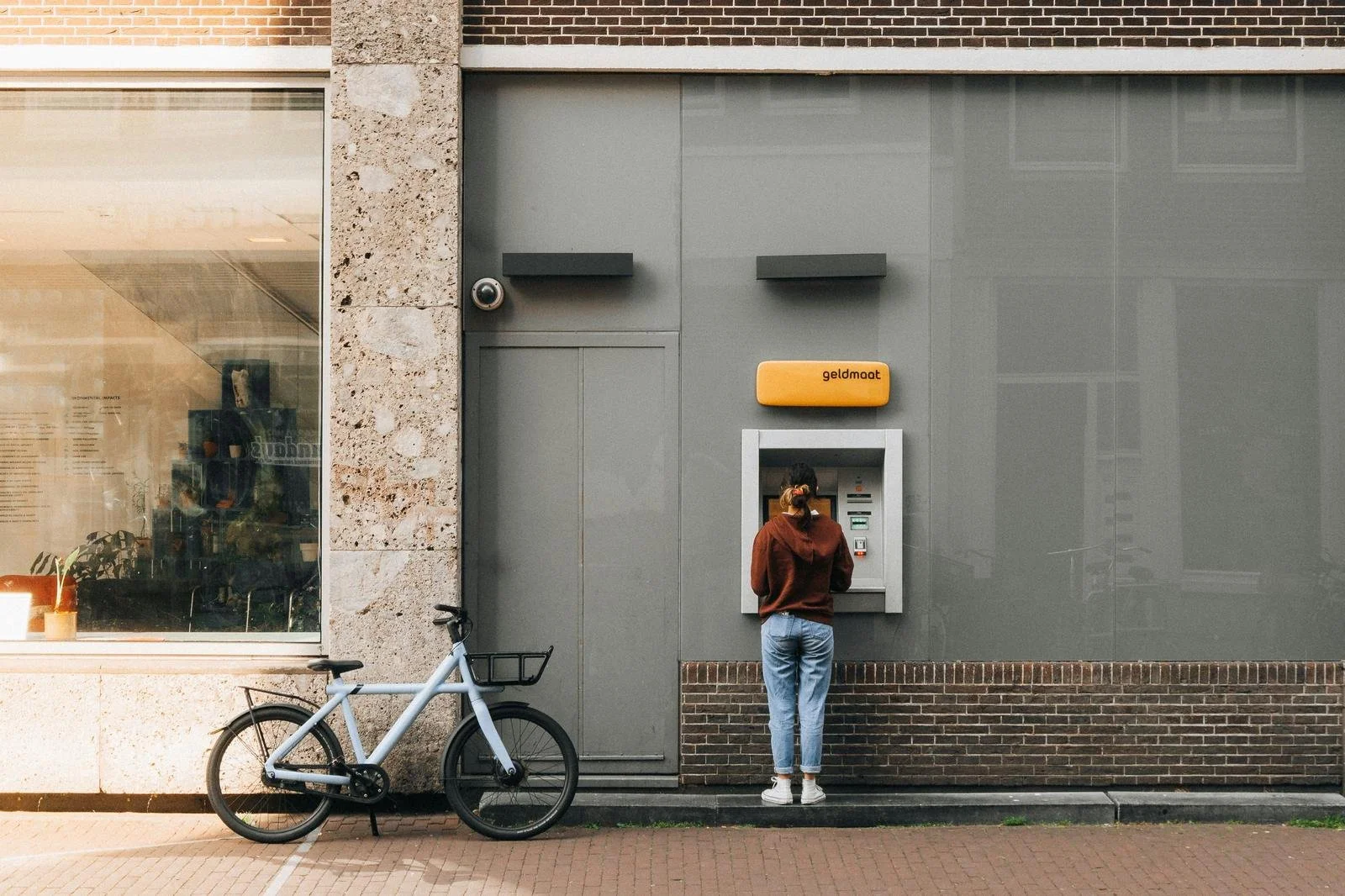
The most expensive button abroad: when the ATM offers to charge you in your home currency, always decline. My recent mistake cost me 12.8%. Photo by Julian on Unsplash.
Now scale it up to a life abroad
These were one-off mistakes, but imagine a US expat retiree in Spain or France whose income arrives in dollars—perhaps a combination of Social Security, dividends, and portfolio withdrawals—and who spends €60,000 a year. At my bank’s hidden 2.9% markup, converting that costs around €1,700 every year. Do the same through a low-fee conversion provider at roughly 0.5%, and it’s about €300. That’s €1,400 a year just for routing the money differently—every year, for the rest of a retirement.
Even at a more forgiving 1.5–2% spread—which is what many traditional banks charge—you’re still paying €900–1,200 a year, versus about €300 through a low-fee provider. That’s still €600–900 a year given away, and over a 30-year retirement, somewhere between €18,000 and €27,000. If you retire early (as we advocate at The Good Life Journey), the damage runs longer still. And that’s before opportunity cost is considered: invest those €600–900 each year at a 5% real return instead, and after three decades you’re looking at roughly €40,000–60,000 that could have stayed in your pocket.
The frustrating part is that many people simply never find out, because no statement anywhere prints a line saying: you could have kept €1,400 this year by not letting us convert your money.
Alright, how can we fix this?
2. Which Setup Do You Need? Find Your Situation
Whatever your version of the cross-border money problem—from a one-off move to full geographic arbitrage—the goal is usually the same—convert currency at a fair rate and stop overpaying. However, the right tool depends on your situation: find yourself in the table below to see what applies to you.
| Your situation | Your money problem | Section (§) where it's covered |
|---|---|---|
| One-time mover relocating and converting savings once | One large conversion at the best possible rate | §3, §4 (Transfers) |
| Retiree abroad For example, US pension/portfolio income, European life | Recurring dollar income, euro spending, forever | §3, §4 (Account) |
| Seasonal geoarbitrageur 3–5 months a year in another country | Two currencies, no desire for a second bank | §3, §4 (Card) |
| Expat worker / Barista FIRE earning in one currency, investing or spending in another | Regular conversions in either direction | §3, §4 (Account) |
| Freelancer / digital nomad clients in one country, life in another | Getting paid like a local, cross-border invoicing | §6 (Business) |
| Student / traveling months abroad, no local roots | Spending cheaply without local banking | §4 (Card) |
Depending on which row applies, you’ll need one, two, or all three of these: a multi-currency account, a local bank account, and the right card. Here’s each, and whether it applies to you.
3. The Three-Account System for Managing Money Abroad
Everything about money across borders reduces to one principle: never let the wrong account convert your currency. Each account in this system has exactly one job.
Layer #1: your brokerage (and home bank) stay where they are
If you’re moving abroad, your investment portfolio doesn’t necessarily need to emigrate with you. Taxes follow where you live, not where your account is based, so moving your brokerage from one jurisdiction to another changes nothing about what you owe.
Of course, what does matter is when you realize gains relative to your move—selling before or after a change of tax residence can produce very different outcomes in terms of tax bills. But in most situations, keeping the home brokerage means familiar tools, perhaps lower costs, and no painful in-kind transfers.
One important check to do before you go: some brokers restrict accounts for non-resident customers, so confirm your broker’s policy—or move to one that explicitly serves expats—before the move, not after.
In most situations, your home bank account is worth keeping too: old direct debits, credit history, and useful in case you plan to return.
Layer #2: a local bank in your new country
Some would argue you can skip the local bank entirely: modern multi-currency providers now come with their own account details and debit card, covering most of what a local account does.
However, there are some important practical reasons to have a local bank account:
Residency paperwork. Some countries’ visa and residency processes ask for a local account as evidence you’re established.
Credit history. A future mortgage, car financing, and other applications run through local banking history, and the currency layer (Layer #3, described next) doesn’t provide that.
Local payment rails. Depending on the country, landlords, utilities, gyms, tax offices—you name it—often want a local direct debit.
Deposit protection for your cash buffer. It’s preferable to keep your emergency fund somewhere a government guarantees it—that’s €100,000 per person per bank in the EU or $250,000 under FDIC in the US. Although your home bank qualifies, the multi-currency layer (Layer #3) does not (your money there is safeguarded—held segregated at major banks—but not deposit-insured). Many expats prefer their cash buffer to be in the local bank anyway: it’s in the currency you will spend it, so a genuine emergency doesn’t come with a conversion attached.
Layer #3, The Bridge: the currency layer, where every conversion happens
Between your home bank and your local one abroad, there’s a piece many expats are missing: a multi-currency account that converts at the mid-market rate for a small transparent fee (typically around half a percent), instead of the 2–3% hidden spread we showed above.
Here’s how it works in practice, using the US-retiree-in-Europe example: your pension or brokerage pays out in dollars, and those dollars land in your multi-currency account—where they simply sit, still as dollars, with nothing charged and nothing converted (receiving is free for most transfer types). The conversion happens only when you choose, at the mid-market rate, on your schedule: monthly, quarterly, or when the rate looks good—and you see the exact fee before you confirm. Then you send the resulting euros to your local bank as a normal domestic transfer (free in our Europe example), and from that account you pay rent, groceries, and everything else like any local.
To simplify the flow, in one picture:
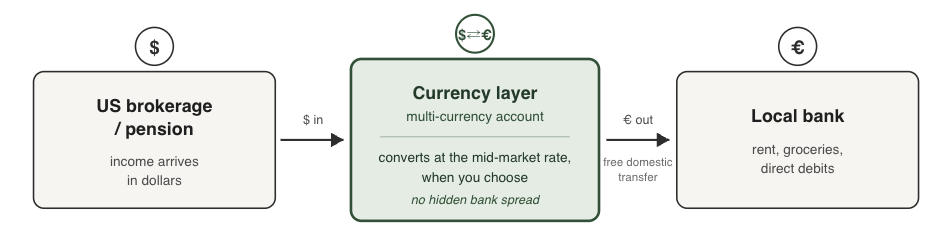
Figure 1: The three-layer setup. Money arrives in your home currency from pensions, brokerages, or your home bank (Layer 1) into the multi-currency account (Layer 3), then moves to your local bank abroad (Layer 2) as a normal domestic transfer. The only real cost in the whole chain is the transparent conversion in the middle (around 0.5%)—the transfers on either side are typically free.
The seasonal variant: if you’re just spending a few winter months in Thailand or Portugal, drop the local bank entirely and run on Layers #1 and #3 (home setup + currency account). The currency account comes with its own debit card: top the account up from your home bank before (or during) the trip, then simply pay—the card spends from your balance and converts whatever you don’t hold locally at the mid-market rate, automatically, at the moment of purchase. This works just as well for ordinary travel, since it means no local account and no airport exchange desk fees.
“But my credit card has no foreign fees”
This is a fair point. Assuming you genuinely hold a no-foreign-transaction-fee card (many premium US cards qualify), it’s a fine spending tool for travel. Still, three issues remain. First, check the fine print: plenty of cards that feel premium still charge 1.75–3% on foreign currency. Second, no card protects you from the terminal’s offer to “charge you in your home currency” (the supermarket story I shared earlier).
But third, and most decisively: a card only solves spending. A great travel card makes you a well-equipped tourist. It doesn’t make you a resident—residents need income received, rent paid, and deposits moved, and that’s what the other two layers are for in our three-layer system.
4. The Currency Layer in Practice
I recommend using Wise* for the multi-currency layer. Their products map onto the situations we covered in Table 1. Let’s look at each one separately.
One-time transfers: moving day (Product 1)
This was their original product (some may remember it as TransferWise): you send money from a bank account in one currency to an account in another, at mid-market plus a small disclosed fee. I first used it more than a decade ago, when I had to move all my savings from Swiss francs to euros as I relocated from Switzerland to Germany.
Setting this up was literally a few clicks and done—hundreds or thousands of euros saved, depending on the size of the transfer. You can set this up in minutes*—no currency account needed—which is all a one-time transfer requires. In my case, I was not planning to return to Switzerland (it’s not my home country), so I needed to move everything with me.
The multi-currency account: for ongoing cross-border income (Product 2)
This is the product built for the retiree-abroad problem. The Wise account holds 40+ currencies side by side—dollars, euros, pounds, francs, kronor (yes, the Swedish currency that stung me at the supermarket), baht, pesos, and probably most currencies your relocation shortlist involves.
For around nine or ten major currencies—dollars, euros, and pounds among them—the account goes a step further and gives you your own local account details in that country’s banking system: a real US account and routing number, a UK sort code, a European IBAN.
This is the feature that matters most here. Your US pension administrator or brokerage pays “a US account”, so there is no international wire and no unusual friction on their end. The dollars land and sit as dollars in the Wise account. You then convert to euros when you choose at mid-market plus roughly half a percent, then send them, for example, to your Portuguese or Spanish local bank account as a free domestic transfer.
If your income arrives from a less common currency, check the current list* of local-details currencies before building your plan around it.
The debit card: for travel and the gap before your local account opens (Product 3)
The third piece is a debit card* you can add to the account—Visa or Mastercard, depending on your country, for a small one-time fee. It’s pleasantly straightforward to use: pay in whatever currency the terminal asks for, and the card either spends from your matching balance or converts from another balance you hold, at the same mid-market rate, automatically. Cash withdrawals are free up to a monthly allowance; beyond that, small fees apply—fine for most trips, but worth knowing about if you’re a heavy cash user.
This is the tool you could use for the gap before your local account opens, for the seasonal mover who never opens one, and for travelers generally. One thing no card can do, though, is protect you from the ATM screen offering to charge you in your home currency. Remember to select local currency, always.
One thing to remember: it’s a conversion account, not a bank
A multi-currency account is an e-money institution, not a bank. This means your money is safeguarded—held segregated from the company’s own funds at major banks—but it is not officially covered by deposit insurances like the EU's €100,000 guarantee.
Remember, this is your conversion account (Layer 3): there’s no lending service, no overdraft, and no interest—it’s not trying to be a bank. The right mental model is an operating account, not a savings account. It holds your money in motion—the next transfer you’re waiting on, plus a small buffer. Your emergency fund or larger cash buffer belongs in an insured bank, and the bulk of your wealth stays in your brokerage. Used that way, it does the one job that matters here: getting your money across borders without losing thousands along the way.
Passport, tickets, camera—all set for the big move. The three-account setup belongs on the to-do list too. Photo by Kit (formerly ConvertKit) on Unsplash.
5. The Setup Checklist (Before You Move)
Open a multi-currency account while you’re still at your current address. Account opening requires identity verification—the “know your customer” checks every financial institution runs—and it goes smoothest with a stable address and local documents. Avoid doing this from a hotel in your new country. If you decide you need the debit card (Product 3), order it now too: it arrives by post, and your current address is the most reliable one.
Test your new account details with a small transfer from your existing bank before anything important depends on them. Send €50/$50, watch it arrive, and you confirm you’re all set.
Check your broker’s expat policy—confirm they’ll keep serving you as a non-resident so you can continue using it as Layer #1, or plan the switch before you leave, not after.
On arrival: open the local bank account (Layer #2). Expect to need proof of address and residency paperwork, then redirect your domestic life—rent, utilities, gym, direct debits—to it.
Redirect your income—pension, brokerage payouts, employer—to the currency account. Treat it as passing-through money, not a parking spot: at your monthly conversion, send everything onward—spending money goes to the local bank, any surplus to your brokerage or an insured savings account. (Of course, if your income is portfolio withdrawals, you control this at the source anyway: sell what you need, convert, forward.)
Set the conversion habit: once a month, convert what you need and send it onward. Same date every month, done in two minutes. And then stop checking exchange rates—timing the currency market is as futile as timing the stock market, and the whole point of this system is that the rate you get is always fair (mid-market plus small, transparent fee).
Leave the buffer insured: your emergency fund stays at a deposit-guaranteed bank—home country or new one, but a real bank, not at the currency layer.
And everywhere you go: local currency, always. When any terminal or ATM offers to charge you in your home currency, decline. You’ve already seen me make that mistake.
6. Working or Freelancing Abroad?
If your version of life abroad includes invoicing clients, the same three-layer architecture applies, with one upgrade: the business version of the multi-currency account* (the last row of our table above). It lets you invoice US or UK clients with local account details, receive payment without international-wire friction, hold the income in its original currency, and pay yourself across borders at the same mid-market rates.
The one-person business abroad has some needs of its own—invoicing tools, expense cards, multi-user access—and deserves a separate article. But the core currency logic and main principle is identical to what we’ve covered above: never let the wrong account convert your money.
The Bottom Line
Moving abroad is complicated enough and it’s easy to see different ways you may be overpaying without knowing it. Fixing the currency conversion problem takes just a few minutes to set up and can save you hundreds or thousands of dollars. Keep your brokerage and home bank where they are, open a local bank for your daily life, and put a multi-currency account layer like Wise* between them to do every conversion at the mid-market rate. That’s it in a nutshell.
One practical tip: do the setup before you need it. Opening the account takes a few minutes now, and identity verification clears while you get on with life—so the first time you actually need to move money, it’s a two-minute task instead of a scramble.
I recently paid my bank €630 over the mid-market price on a single conversion for being unaware of this, and an ATM in Sweden recently charged me 12.8% for one careless button press. A retiree abroad making those mistakes on autopilot can lose in the order of €40,000–60,000 over a retirement—without even becoming aware of the problem.
Set the system up once, before you move, and that money stays where it belongs: funding your life abroad, not your bank’s margins. Here are the four tools from this guide in one place—take the one your situation calls for:
| Tool | Best for | |
|---|---|---|
| One-time transfer | Moving your savings once, at the mid-market rate — including large amounts | See transfers* |
| Multi-currency account | Ongoing cross-border income: pension, dividends, salary (Layer #3) | See the account* |
| Debit card | Travel, seasonal stays, or the gap before your local bank opens | See the card* |
| Business account | Freelancers and one-person businesses invoicing across borders | See Business* |
🌿 Thanks for reading The Good Life Journey. I share weekly insights on personal finance, financial independence (FIRE), and long-term investing — with work, health, and philosophy explored through the FI lens.
Disclaimer: I am not a financial or legal adviser, and this content is for informational and educational purposes only. Please consult a qualified financial adviser for personalized advice tailored to your situation.
Check out other recent articles




























About the author:
Written by David, a former academic scientist with a PhD and over a decade of experience in data analysis, modeling, and market-based financial systems, including work related to carbon markets. I apply a research-driven, evidence-based approach to personal finance and FIRE, focusing on long-term investing, retirement planning, and financial decision-making under uncertainty.
This site documents my own journey toward financial independence, with related topics like work, health, and philosophy explored through a financial independence lens, as they influence saving, investing, and retirement planning decisions.
Frequently Asked Questions (FAQs)
-
The mid-market rate is the midpoint between the buy and sell prices of two currencies on the global market — the rate banks use when trading with each other, and the one you see on Google or xe.com. It’s the only “honest” benchmark for a currency conversion: any difference between it and the rate you’re offered is a hidden margin, even when no fee appears on your statement.
-
Traditional banks typically embed a 1–3% markup inside their exchange rate rather than showing a fee. In my own case, I measured a 2.9% spread at a large European bank—€630 lost on a single $25,000 conversion. On a retirement abroad with €60,000 of yearly spending, that scale of markup could mean roughly €900–1,700 lost every year.
-
In most cases yes, if you’re settling somewhere long-term. Residency paperwork often requires one, local direct debits (rent, utilities, tax office) usually work best from a domestic account, and only local banking activity builds the credit history you’ll need for a future mortgage or car financing. For stays of a few months, a multi-currency account with a debit card is usually enough.
-
Often yes — taxes follow where you live, not where your account sits, so keeping your home brokerage changes nothing about what you owe. But some brokers restrict or close accounts for non-residents, so confirm your broker’s policy before you move, and pay attention to when you realize capital gains relative to a change of tax residence, as the timing can change your tax bill considerably.
-
It’s safeguarded, but differently from a bank: Wise is an e-money institution, so customer funds are held segregated from the company’s own money at major banks, but they’re not covered by deposit insurance like the EU’s €100,000 guarantee or the FDIC’s $250,000. The practical rule: use it for money in transit and conversions, keep your emergency fund at an insured bank.
-
Dynamic currency conversion (DCC) is when a foreign ATM or card terminal offers to charge you in your home currency instead of the local one, applying its own inflated exchange rate. Never accept it. In my case, one accepted DCC offer at a Swedish ATM cost 12.8% over the mid-market rate. Always choose to pay in the local currency — the machine’s "helpful" option is the single worst rate you’ll be offered abroad.
-
The cheapest route is a multi-currency account with US receiving details — a real account and routing number — so the pension administrator or brokerage pays it like any domestic US account, with no international wire. The dollars sit as dollars until you convert to euros at the mid-market rate, then move to your local European bank as a free domestic transfer.
-
Since a multi-currency account charges a small proportional fee, converting monthly costs the same in total as converting in larger, less frequent batches — so batch for convenience, not savings. Trying to time exchange rates is as unreliable as timing the stock market; a fixed monthly conversion habit gets you a fair rate every time without the stress of rate-watching.
-
It’s a good spending tool, but it only solves one of three problems. A card can’t receive your pension or salary, can’t pay rent by bank transfer, and can’t move a house deposit. It also doesn’t protect you from dynamic currency conversion at terminals and ATMs. For a trip, a good card is enough; for a life abroad, it’s one piece of a three-account system.
-
Usually not. For a season abroad — a few winter months in Thailand or Portugal — you can skip the local bank entirely: a multi-currency account plus its debit card covers spending and cash at mid-market rates, topped up from your home bank. Local accounts start to matter when you have local obligations: a lease with direct debit, residency paperwork, or plans to build credit history.
Join readers from more than 100 countries, subscribe below!
Didn't Find What You Were After? Try Searching Here For Other Topics Or Articles: