FIRE in Europe vs the US: Slower, Cheaper, Safer?
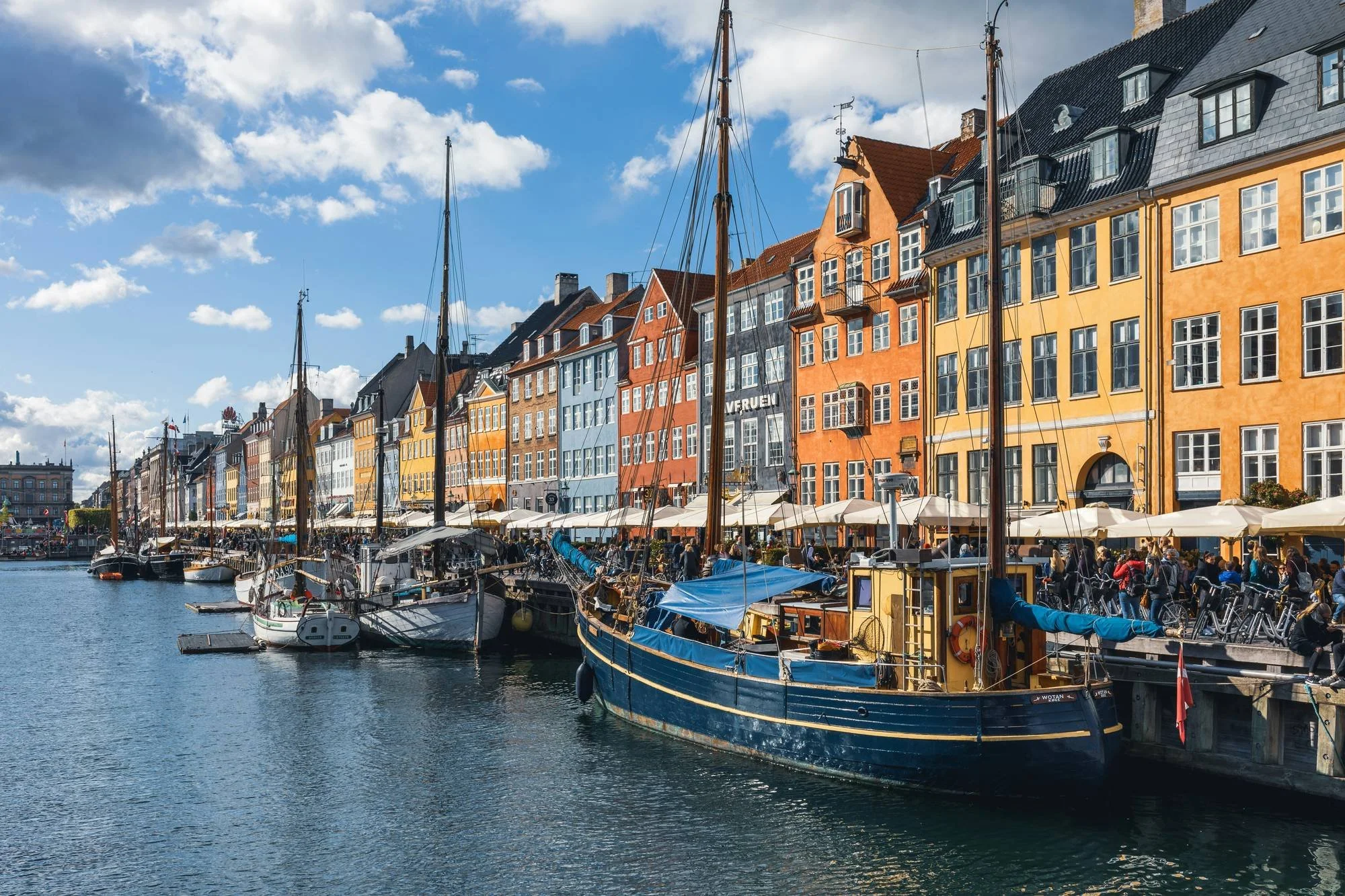
Copenhagen, Denmark. Europe often asks for a smaller FI number, and, arguably, offers a more liveable journey to reach it. Photo by Peter Lloyd on Unsplash.
Reading time: 7 minutes
Quick answer: Is FIRE harder in Europe than in America?
The general mechanics of pursuing FIRE (Financial Independence, Retire Early) are nearly identical on both sides of the Atlantic: save a large percentage of your income, invest it (in most cases) in globally diversified index funds, and eventually live off roughly 4% of your portfolio.
In the US, though, you are generally able to accumulate faster thanks to higher salaries, lower income taxes, and better tax shelters for your investments. In contrast, in Europe you are often able to target a substantially lower FI number, and, importantly, the journey itself tends to be more liveable with better work-life balance, more holiday, and stronger safety nets.
Although extremely early retirement—walking away in your 30s—is much harder in Europe, a moderately early exit is still achievable. This article focuses on mapping the differences across these two geographies, discussing the pros, cons, and nuances in between.
What You’ll Get From This Article
✔ Whether FIRE is genuinely harder in Europe than the US
✔ How salaries, taxes, and housing really compare in relation to FIRE
✔ Why your FI number is usually smaller in Europe, and what else is included
✔ How European healthcare and safety-nets lower the risk of retiring early
✔ Where the US wins (speed) and where Europe wins (a softer, safer path)
✔ The policy and job-market risks a European FIRE plan should consider
📊 TL;DR: FIRE in Europe vs the US
🇺🇸 The US accumulates faster: higher pay, lower taxes, better shelters
🇪🇺 Europe needs a smaller FI number and carries less risk
💸 US long-term capital gains can be taxed at 0%; most of Europe is taxed more heavily
🏥 Healthcare: a major US early-retirement obstacle, but a manageable budget line in Europe
🏠 Housing is more affordable in the US (home-price-to-income ~4.5) than in most of Europe
⚖️ Extreme early retirement in your 30s is much harder in Europe
🧭 Verdict: it’s a trade-off; the US optimises for speed, Europe for a safer, more liveable path
How FIRE Really Differs in Europe vs the US
This post was prompted by a reader who pointed out, entirely fairly, that too many of our articles and case studies assume US salaries and costs. She’s right, and it’s something I want to fix, and in future, providing articles for readers on both sides of the Atlantic. (Notice above this article’s title I’ve now added a “Europe” tag, so readers can more easily find European-relevant content.)
Before starting, though, a caveat is in order, which also explains why it’s more difficult to write for a European audience. Firstly, it’s simply not one place, but the EU’s 27 member states—and over 40 countries if you count the rest of Europe (the UK, Switzerland, Norway, the Balkans, and more)—each with wildly different tax codes, pension systems, and property markets. What’s true for the Netherlands often simply doesn’t hold for Italy or France.
With this disclosure in mind, this article is a first exploration of the differences and similarities across the US and Europe when it comes to pursuing FIRE. The goal, ultimately, is to make sure the steady drumbeat of US success stories on Reddit doesn’t leave you thinking the whole idea is out of reach in Europe. It isn’t. But the path to get there looks quite different depending on where you live.

Prague, Czechia. A reminder that “Europe” is really 40+ very different countries: Czechia has one of the continent’s steepest home-price-to-income ratios. Photo by Anthony Delanoix on Unsplash.
The Money Math: A Bigger Engine, but a Smaller Target
Let’s begin with the obvious advantage: salaries. Top US compensation, especially in tech and finance, but also across other sectors, has no real European equivalent. There is no Bay Area of Europe. Pay is not only higher on average in the US, but the distribution is more unequal at the top. That’s why the “save a million in five years” stories are almost always American.
It’s worth mentioning, though, that these stories tend to be louder than the more conventional, median salary story that most US FIRE folks pursue. So, the frustration many European FIRE folks feel when they hear about these stories is probably not dissimilar to what other FIRE folks experience in the US. This is availability bias at work.
Still, headline salaries make the US look better than it is, because they ignore what earning that money costs you. What happens if you correct these high salaries for many of the things Europeans take for granted, say, a minimum of 20 paid holidays (in addition to the public holidays), paid parental leave, generous sick leave, protected unemployment, a shorter working day, or more likely access to part-time work?
As part of a thought experiment, divide these high salaries by the stress, number of hours, and insecurity that are required to earn them. For lack of a better term, on that “grindiness-adjusted” basis, the gap between the US and Europe might narrow down considerably. For European readers feeling behind, and as we’ll explore further on, remember that you’re not making an apples-to-apples comparison when you compare your salary to those in the US.
Secondly, consider that Europeans are usually chasing a much smaller target. A lot of costs are lower or socialized—think healthcare or university—but there’s also less cultural pressure to spend in the first place. In addition, if you live in or near a city, transport tends to be structured in such a way that you can live well without missing a car in your daily commute. All of this combined can substantially lower your FI number in relation to what might be needed by an analogous US counterpart.
One of the biggest swing factors, though, is housing. Here the US is genuinely more affordable than Europe: it has the 7th-lowest home-price-to-income ratio in the world at about 4.5, far better than Spain (7.8), the UK (8.3), or Germany (10.7). Portugal and Czechia face ratios of 12.6 and 14.9, respectively. The best European country globally is Belgium, and even it sits 34th globally.
What does this mean in relation to FI journeys? While an ill-timed or ill-thought-out home purchase can derail a FI plan on either continent, the downside can be far larger in Europe, where prices relative to income are higher, and where renting generally beats buying across major cities.
All things considered, the money math alone is a genuine trade-off: the US gives you a bigger savings engine via higher salaries and lower taxes, while Europe offers a smaller target. But salaries and housing are only part of the picture. As we’ll see, once you factor in healthcare, education, and everything Europeans don’t have to self-insure, the gap narrows more than headline salaries suggest.
Taxes and Investing: Where Europe Falls Behind
Taxes are the clearest structural disadvantage for European FIRE. Long-term capital gains (CGT) in the US are taxed at 0/15/20%. A US couple with modest income can realize around $98,900 of long-term gains tax-free every year (the “0% bracket”).
Remember that these are the gains, not what is sold from investments. Add on top that they can do tax-gain harvesting, and for most Europeans this sounds just too good to be true. This more favourable treatment of investment gains means many US FIRE folks don’t need to add a tax line item in their retirement budget, which lowers substantially their FIRE number.
In contrast, Figure 1 displays the headline CGT across Europe. These are headline rates and hide a lot of nuance. For instance, some countries like Germany have that as a flat rate (i.e., there is no 0% bracket), while others have several tax brackets. Nevertheless, a quick glance at the numbers may give you an idea not only of the variation of tax regimes within Europe, but also compared to the US.
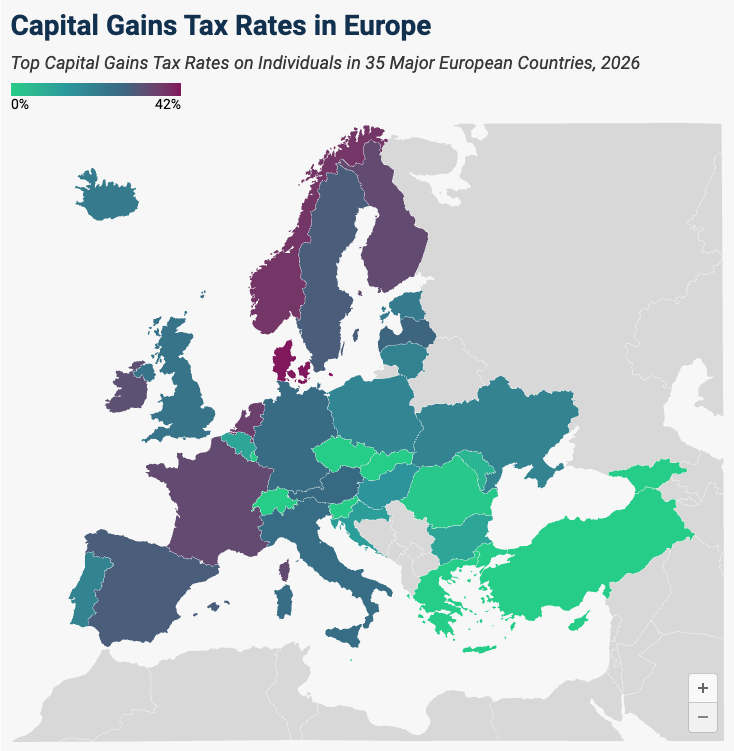
Figure 1: Headline capital gains tax (CGT) in Europe. Source: Tax Foundation (2026)
The even bigger long-run tax drag, though, is in the lack of tax-advantaged accounts in which to grow your portfolio on your path to FI. While some countries do have tax-wrapper instruments that are comparable to the 401k (e.g., UK’s ISA or France’s PEA), many European countries simply lack these instruments.
Large economies like Germany, Spain, and the Netherlands offer little to nothing for ordinary index investing. Germany’s Riester and Rürup pensions feel designed for another era and are largely useless for FIRE, and on top of that your portfolio is taxed yearly via the Vorabpauschale (modest, but still a drag). The Netherlands has no 401(k)-style equivalent at all, plus its Box 3 system taxes a “deemed return” on your wealth every year, whether or not you’ve sold or even made money. In practice, Box 3 can act like a 1.5–2 percentage-point annual drag on returns.
Some European readers may be sighing at this point, but it’s worth reminding US readers that these investments are made with already-taxed income. So, although, again, taxing varies enormously across Europe, your money can be hit up to three times in some places: once as salary, again on the portfolio year after year, and a third time when you sell. To an American sheltering the same money in 401(k) or Roth, that’s hard to imagine.
The direction of travel isn’t reassuring either. Across many European countries, tighter government budgets have made investment portfolios and “idle savings” an increasingly common political target. It’s impossible to predict, really, but it wouldn’t be surprising if the tax picture for European FIRE got tougher, not easier, in the future. There is also some light at the end of the tunnel, though, which we’ll cover in a later section.
Inheritance is the last item. In the US, federal estate-tax exemption is now $15 million per person ($30 million per couple). In contrast, the majority of Europe has some form of meaningful inheritance tax (Figure 2). In any case, for most would-be early retirees, inheritance doesn’t play a major role, either because they don’t expect to inherit anything meaningful or because that hypothetical inheritance would take place too late for it to push your retirement forwards. It’s still relevant though; it may matter less as an accumulation tool but more as a form of late-life insurance.
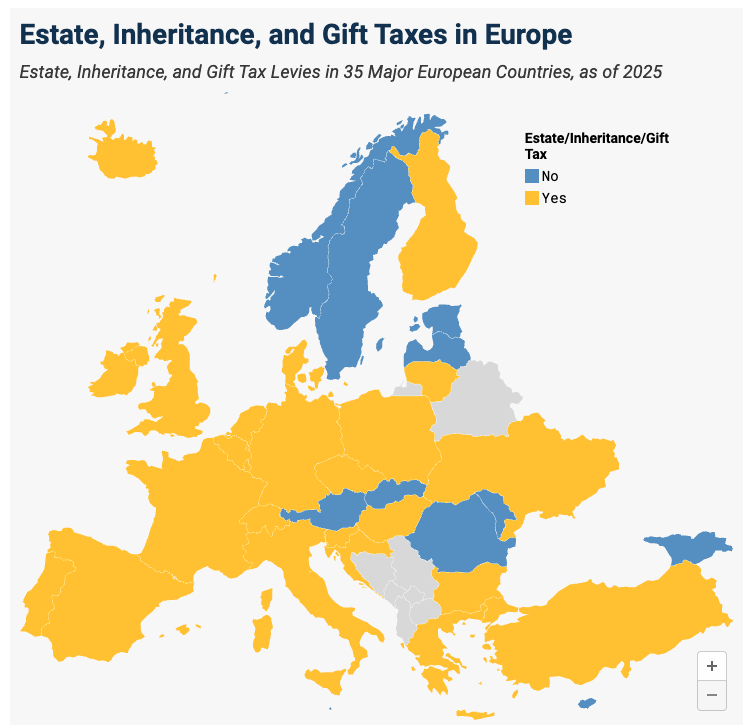
Figure 2: Estate/Inheritance/Gift tax in Europe (2025). Source:Tax Foundation
The Safety Net: Why Europeans Have to Self-Insure Less
While the tax situation clearly disincentivizes FIRE, at least compared to the US, there is some upside: Europeans have to self-insure far less than Americans do. A large part of what a US FIRE plan must privately fund is, in Europe, provided already via taxes.
It not only lowers the number you need, but also lowers the risk your plan may blow up. Healthcare is the most important example to illustrate this. In the US, pre-Medicare health coverage is often cited as the largest obstacle to early retirement; it’s easily a five-figure annual cost that can also swing with policy changes.
In Europe, this doesn’t really change the maths, but it can change the risk profile. Healthcare becomes just another budget line, not a potential catastrophe that could bankrupt you or leave you without cover. I think that matters psychologically as much as financially, because it can make the leap into the uncertainty of early retirement less frightening. Many US FIRE folks with one-more-year (OMY) syndrome cite concerns over healthcare coverage.
Again, this is something that will vary a lot across Europe, but do budget for it honestly, because it usually isn’t free. In Germany, for instance, an early retiree (before pension age, and so a voluntary member of the public system) pays the full contribution themselves. This is calculated on worldwide income up to a ceiling, which in practice lands somewhere between a floor of around €300 and roughly €1,200 per month. I plan an in-depth article on this, but to simplify: a couple planning to FIRE on a €1.5M portfolio and a €60,000 yearly withdrawal is likely to pay—assuming about half of that withdrawal is investment gains— around €600 per month in healthcare insurance for both members of the household.
Education is another example where Europe generally wins. A US FIRE household wanting to support their children and avoid them entering an uncertain, AI-reshaped workforce with six figures of debt will have to budget accordingly. In contrast, across most of Europe, education is cheap or even free, so the benefit here is obvious.
The European pension helps, but it’s the most oversold part of the European safety net; the edge, I think, is more in healthcare and education costs. Like the US, most European state pensions are contributory and not means-tested: you need a minimum record (around 10 years in the US and UK, five in Germany), the amount scales with your history, and a short FIRE career leaves you with a reduced pension, not none. The exact formula varies a lot by country—the US uses best earning years, Germany a lifetime points system, and so on—but the general contributing principle is fairly similar.
There are a couple of differences worth flagging, though. Although pensions systems across Europe are changing in real time, European pensions often replace a higher share of prior income than US Social Security, so the “floor” tends to be somewhat larger. How early you can claim varies, with the trend clearly moving against early retirees: Germany, for instance, is tightening the rules to make drawing a pension before the official age harder and more expensive. Due to aging populations and associated budgetary concerns, expect most of Europe to go in this direction soon.
The upside is you still receive it however large your portfolio is. It acts as a deferred floor from pension age, shrinking how much of your later retirement the portfolio must cover; this is also the case in the US. But in my view, Europe’s real edge here isn’t a bigger pension, but—analogous to healthcare—the stronger means-tested backstop that catches you if your plan fails entirely. It wouldn’t be glamorous, but there is a safety net of last resort.

Porto, Portugal. Intra-European geoarbitrage—earning in the higher-cost north, spending in the lower-cost south—is one of the continent’s most underused FIRE levers. Photo by Matt Roskovec on Unsplash.
Lifestyle: Why the Journey to FIRE Is Easier in Europe
Numbers aside, some of the biggest differences are cultural, and they mostly favour the European saver.
Consider spending culture first. Status and keeping up with the Joneses is a real and expensive force, and, while it’s present in most societies, it’s certainly stronger in the US, where status is more often signalled through the house, the car, and the visible upgrades.
In much of Europe, it’s much more normal to live below your means without anyone caring very much. In many countries, like Germany, it’s normal to rent, to not own a car, to eat out sparingly, or take modest holidays. We were able to run a savings rate around 50% for years, and I doubt our friends ever noticed. People are simply less spendy in Europe, and lifestyle inflation is easier to resist when there is less social pressure to do so.
Then consider the journey itself. The whole appeal of pursuing FIRE, for many, is escaping a toxic work culture they dislike, and European work culture tends to be far gentler: as we mentioned earlier, more holidays, real sick leave that is easy to take, paid and unpaid parental leave, a normal working day, or the option of part-time work in an increasing number of countries.
This changes the framing of FIRE more deeply. If it’s possible to escape extreme corporate grind, then perhaps the FI destination—for most, living a good life—and the journey itself stop being quite so opposed to each other. Or, at least, there is more wiggle room for designing a softer path to FI that is not grinding your health into the ground.
Last, but not least, consider lifestyle and health. This is a generalization, but I think it’s fairly well supported: European cities are far more walkable (have you heard of US tourists in Europe coming back slimmer from vacation?); the food environment is healthier; and people generally live longer. You may reach FI a few years later in Europe, but you’re also likelier to enjoy an environment that enables healthier choices. US retirees can also live healthily, but generally they need to make concerted efforts to go against the grain and escape their unhealthier default.
While geoarbitrage works no matter where you’re based, in Europe you can move from a high-cost northern country to a low-cost southern one and cut your expenses dramatically while still staying inside a broadly familiar culture, a softer move perhaps than relocating for US folks abroad.
The Risks That Are Higher in Europe
Two risks are generally higher in Europe than in the US in regards to a FIRE journey. The first is policy: tax and regulatory regimes tend to change faster and reach further, and capital is more openly treated as something the state can direct. Talk of capital gains tax hikes surfaces regularly across countries and wealth taxes are increasingly debated in many countries, e.g., in the UK.
In August 2026, the EU Commission President von der Leyen pointed to the roughly €10 trillion of “lazy” household savings (i.e., not invested) and argued Europe must put these funds to work. To be fair, this is not about seizing savings, and the actual proposals are about incentives and retail investment accounts that could potentially deliver the EU-wide tax-advantaged accounts many European FIRE investors lack at the moment. But the point stands: plan on the rules being more likely to shift. We might get more 401(k)-style instruments, but we could also get more CGT.
The second risk is the job market: Europe generally has more protection once you’re in, but it’s far harder to re-enter. A rigid job market is a double-edged sword; if you’re in a job you enjoy or easily tolerate, then the path to FI may be bump free and easier to forecast. In contrast, if you’re miserable in your job, exiting and re-entering the job market can be much more difficult in Europe than in the US’s more dynamic market.
We’ve covered a lot of ground in this article: salaries, taxes, capital gains, tax-advantaged accounts, inheritance, housing, healthcare, education, pensions, safety nets, spending culture, work-life balance, and health. Underneath it all, though, the FIRE engine remains the same: live below your means, save aggressively, and invest in low-cost global index funds.
The US FIRE path optimizes more for speed (larger salaries and lower taxes), but often has to endure a harsher working life and FI journey to get there. In contrast, European FIRE can target a smaller FI number, has a stronger safety net, and arguably a more liveable path, at the cost of slower accumulation, and a genuinely tougher path if you want to retire extremely early.
Either way, and outlier salaries aside, on both sides of the Atlantic it still takes unconventional choices to make FI/FIRE possible. Every country is different and has a large range of trade-offs to consider. So, let’s focus on the things we can control and make the FI journey as enjoyable as possible wherever we happen to live.
💬 Today’s article was shaped by reader feedback, so I’d love to keep that going: what did I get right or wrong, and what are the strengths and weaknesses of pursuing FI/FIRE where you live? Please share with us in the comments below.
If you enjoyed this article, here are some next steps:
👉 Browse the new Europe tag to filter our homepage for European content
👉 Estimate your own FIRE timeline with the free FI Calculator
👉 Grab the free Financial Independence Checklist to make sure you’re on track
👉 Want to widen the gap between salary and costs? Compare net salary vs cost of living across countries
👉 Subscribe for weekly insights. One-click unsubscribe.
🌿 Thanks for reading The Good Life Journey. I share weekly insights on personal finance, financial independence (FIRE), and long-term investing — with work, health, and philosophy explored through the FI lens.
Disclaimer: I am not a financial adviser, and this content is for informational and educational purposes only. Please consult a qualified financial adviser for personalized advice tailored to your situation.
Check out other recent articles





























About the author:
Written by David, a former academic scientist with a PhD and over a decade of experience in data analysis, modeling, and market-based financial systems, including work related to carbon markets. I apply a research-driven, evidence-based approach to personal finance and FIRE, focusing on long-term investing, retirement planning, and financial decision-making under uncertainty.
This site documents my own journey toward financial independence, with related topics like work, health, and philosophy explored through a financial independence lens, as they influence saving, investing, and retirement planning decisions.
Frequently Asked Questions (FAQs)
-
In some ways, yes. Higher US salaries, lower income taxes, and better tax shelters mean Americans generally accumulate faster. But Europeans usually need a smaller FI number and carry less risk thanks to universal healthcare and stronger safety nets. Extreme early retirement is harder in Europe; a moderately early exit is very achievable.
-
Yes. The 4% (or safe withdrawal rate) principle is about portfolio returns, not geography, so a globally diversified European investor can use it as a starting point. The main adjustment is to include Europe's higher taxes as a spending line item, which raises your FI number rather than changing the withdrawal rate itself.
-
Usually. Socialized healthcare, cheap or free university, walkable cities that remove the need for a car, and a less consumerist culture all lower annual spending. Since your FI number is roughly 25× annual expenses, a lower spend means a smaller target than a comparable US household.
-
The US taxes long-term gains at 0/15/20%, and a couple with modest income can realise, in 2026, around $98,900 of gains tax-free each year. Most of Europe applies a flat rate in the high-20s to low-30s with no 0% band, so European investors typically must budget for capital gains tax in retirement.
-
You stay covered and can't be bankrupted or refused care, but it isn't free. In Germany, an early retiree pays voluntary public contributions on their investment income, often several hundred euros a month. It's a budget line, not the five-figure obstacle that pre-Medicare coverage represents in the US.
-
Headline salaries are higher, especially in tech and finance. But they look less dominant once you adjust for what Europeans get by default: 20+ paid holidays, paid parental leave, sick leave, employment protection, and shorter hours. On a "grindiness-adjusted" basis, the gap narrows considerably.
-
The US is more affordable by home-price-to-income ratio (~4.5, the 7th-lowest globally) than Spain (7.8), the UK (8.3), Germany (10.7), or Portugal (12.6). A poorly-timed home purchase can derail an FI plan on either continent, but the downside tends to be larger in Europe.
-
Usually a reduced one. Most European state pensions, like US Social Security, are contributory and not means-tested, so a shorter career means a smaller pension, not none, and you receive it regardless of portfolio size. Europe's real edge is a stronger means-tested backstop if a plan fails entirely.
Join readers from more than 100 countries, subscribe below!
Didn't Find What You Were After? Try Searching Here For Other Topics Or Articles: