The Boring Middle of Financial Independence: A Different Way Through It

If you’re on the path to Financial Independence and the goal still feels far away, you may find yourself in “the boring middle.” Read on to find out if this applies. Photo by Reed Naliboff on Unsplash.
Reading time: 7 minutes
Quick answer:
The boring middle is referred to the long stretch of the Financial Independence (FI) journey—typically years 3 through 10+—where the early optimization wins are gone, the finish line is still far away, and your motivation has started to fade even though you’re still on the right path. Most advice in the FIRE space treats this as something to cope with and to plough through.
I think that's the wrong framing entirely: the middle stages of the FI journey deserve the same deliberate design as your relationship with work or your post-FI thinking. The highest-leverage moves during this stage usually aren’t financial at all—they’re more about redesigning how you work, live, and take care of your body.
What You'll Get From This Article
✔ What is “the boring middle” and why it happens—the math and the psychology
✔ Why just waiting it out can be a costly strategy, especially if your job is draining you
✔ A different way to think about this phase—designing it, not just surviving it
✔ What I’m personally doing differently in this phase
✔ Why health, not further financial optimization, is currently the highest-leverage move
TL;DR — The Boring Middle of FI 🧭
📉 The early wins (cutting costs, raising savings rate) cluster early on—after that, gains tend to shrink fast
🧠 Hedonic adaptation is real: your brain stops rewarding financial progress that once felt exciting
🎯 Distant goals don’t motivate well—build smaller, concrete milestones along the way
📊 Once your portfolio is large enough, market swings dwarf your monthly contributions—the feeling of control disappears
⚠️ Waiting out a genuinely bad job for a decade or more has a real cost—to your life and health
🛠️ The fix is redirecting optimization energy toward health, relationships, and mini-retirements
🧬 Right now, my own priorities aren’t financial at all—but focusing on biological age and healthspan
Why the Middle Years Feel Different
The first few years of the FI (Financial Independence) journey are full of momentum. You cut the “unnecessary” expenses, raise your savings rate, optimize your investments, and watch your net worth climb in ways that feel very rewarding. After all, for many, this is the first time they’ve aggressively saved, and seeing the outcome of their effort materialize feels genuinely good.
But then, some time down the road, in some cases around year three or four, the excitement starts to fade. Your Financial Independence (FI) number is still far away, perhaps you still have 10 or 15 years to go. But the spreadsheets, expenses, and investments are already full optimized, so there is really little to do but wait. All that’s left for you to do is keep showing up at work, week after week, month after month, in many cases to a job that doesn’t excite you.
This is what the FIRE community calls “the boring middle.” If you search for it, you mostly find what it is and advice for how to cope with it. But I think this is the wrong approach entirely; if you need some elaborate coping strategy to mentally survive a decade or more of your life, and are just waiting for your post-FI life, then you are certainly doing something wrong.
It has nothing to do with your discipline, but about how you’re approaching the phase itself. This article is about why the boring middle happens, why I think the standard advice is incomplete, and what I’m doing differently after hitting this exact wall a few years ago.
Why the Boring Middle Happens
The first reason is simply structural. The largest wins in the FI journey take place early on. Many actions like cutting an oversized rent payment, negotiating a raise, switching your investment portfolio to low-cost index funds, or automating your savings are one-time structural changes that produce visible jumps in your numbers.
Optimizing your expenses and seeing how that affects your retirement timeline is a very exciting exercise for many on the FI journey. It turns out there is a non-linear relationship between how much you spend now and how fast you can retire: if you spend less, you’re not only adding more to your portfolio each month, but have also reduced the retirement timeline by targeting a smaller FI number. Either way, after some time, there is nothing left to optimize except patience.
The second reason is psychological, and has a name in behavioral economics: hedonic adaptation. Humans slowly adapt to almost anything (good or bad), and this includes also the “thrill” of watching a net worth chart climb over time. What felt exhilarating in years one and two becomes very routine in year three or four, even though the underlying mechanics haven’t changed at all—you’re still making good progress, but your brain is simply no longer rewarding you for it.
A third reason layers on top of the first two: most people are chasing a very abstract and distant goal. Pursuing a FI number that is 10 to 15 years away doesn’t motivate you in the same way as chasing something concrete in the next year or two. This is well documented; distant goals are processed abstractly, while near-term ones are what drive behavior day to day.
The solution for this one isn’t to abandon the long-term number or goal, but to deliberately build smaller, nearer milestones around it. It can be related to your savings rate or net worth targets, but it also can include other experiences like planned trips or other meaningful experiences you’re saving towards in the short term.
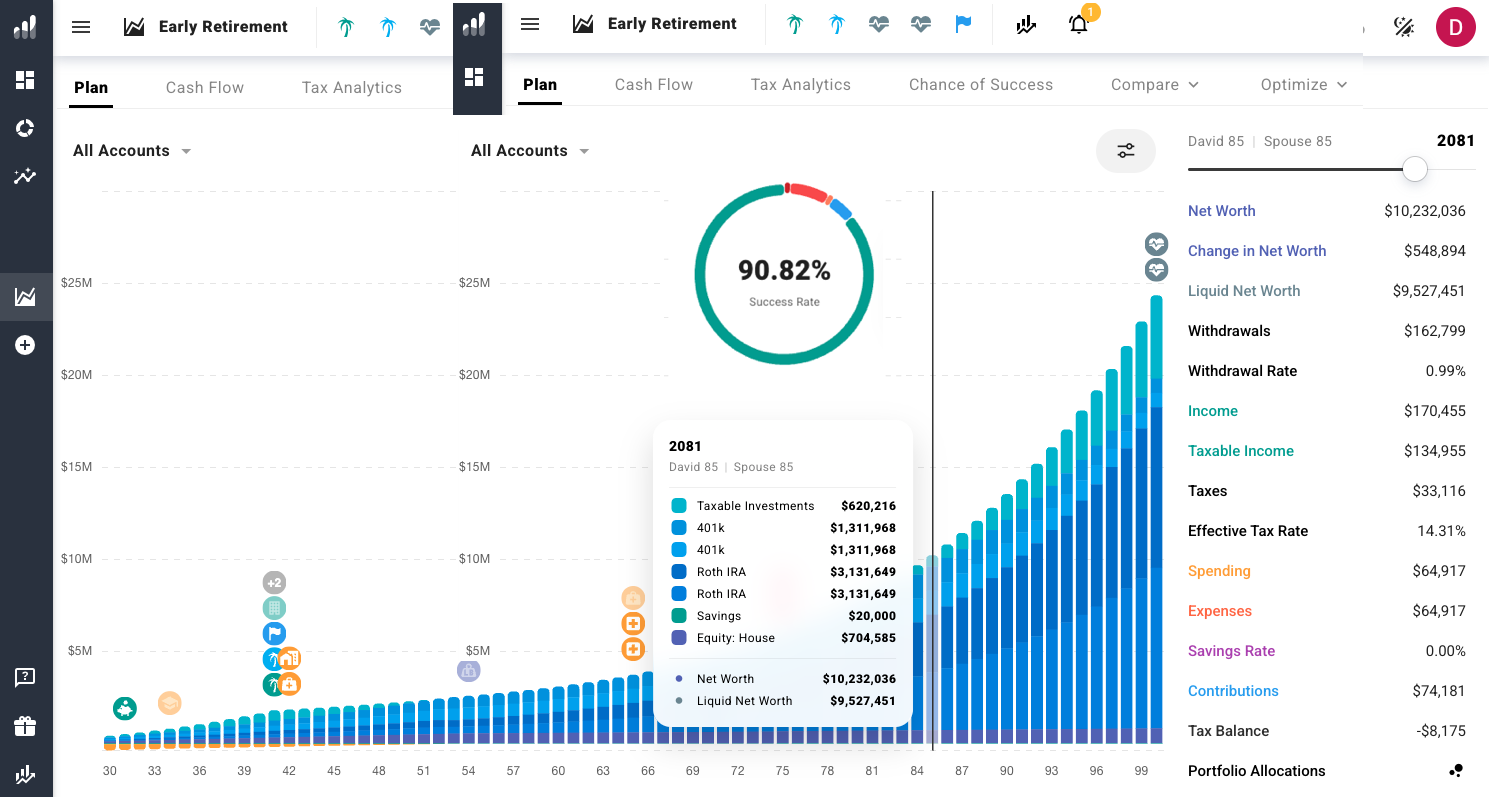
Finally, there’s another reason that kicks in once your portfolio reaches a certain size. Market returns start to dwarf your monthly contributions from your salary. A single week’s (or day’s) market swing can now move your net worth by more than an entire month of diligent saving. This is, of course, very good news—the portfolio is finally doing the heavy lifting—but it also means the sense of personal control you had earlier starts to disappear.

These days a lot of my “optimization energy” goes toward health rather than portfolio tweaking—exercise, sleep, diet, and recovery. Photo by Angelina Sarycheva on Unsplash.
The Real Cost of Just Waiting It Out
Many FI/FIRE folk just buckle down and stoically wait this period out, many times grinding in jobs in which they are unhappy in and which are negatively affecting their health. In my view, after going through this myself, the path to FI is too long to justify staying in an unhealthy or unhappy situation for the long term. Yes, you may be accelerating your early retirement timeline, but at what cost?
In other articles, I’ve made the case for grinding it out in the first years, while your portfolio is still small and your savings rate and monthly contributions are doing most of the work. But once you’re past that—for me it felt around 40-50% of the way to the FI target—the thinking changed. If a different job pays less and delays FI by a year or two, then fine, that’s a reasonable trade to make. The math may suggest waiting it out, but your life today and your health today (and in the future) suggests otherwise.
It’s not just a quality-of-life or work-life balance argument, which in itself would already be enough in my opinion. But it ties strongly to one of our main themes of the blog—health and longevity: if you’re grinding through a decade of chronic stress, anxiety, and burnout in jobs you dislike, you’re not only delaying gratification, you’re spending down your healthspan once you get there.
What the Spreadsheet Doesn't Show
FIRE folks are very aware that a percentage point more or less in their portfolio may give them a few extra years to enjoy their portfolio. But in my experience, they are much less aware that the lever that will determine most strongly the amount of retirement they end up enjoying is the quality of their health. Someone retiring in their early 50s may have a biological age of a 40-year-old or one of a 60-year-old if they are not taking care of themselves (or anything in between). Optimizing for health now has a much larger impact than the tiny financial variables FIRE folks love to over-optimize.
The whole point of FI is to buy years of freedom—it makes little sense to optimize the finances of that plan while ignoring the health you’ll need to actually enjoy it. The two need to be balanced, not traded off against each other. Let’s not forget that many people pursuing FIRE aggressively tend to cluster around high-paying, but high-stress jobs that leave little time and headspace for taking proper care of yourself.
To be fair, not everyone has the flexibility to simply change jobs. Some people are tied with visa sponsorship, specialized fields, or family circumstances that could make the switch far harder than it was for me. But even where a full job change isn’t realistic, the same logic could apply at a smaller scale: negotiating reduced hours, pushing for more autonomy in your role, or simply being honest with yourself about whether the trade-off is still worth it.
What I'm Actually Doing With the Middle
For me, the redesign came down to three concrete moves, not only a mindset shift. The first was actually changing jobs. I'd been treating a stressful, draining job as something to simply push through for another five or six years. But once I left and started actually looking forward to my days, the “boring middle” feeling disappeared almost immediately. I am no longer waiting, but just trying to enjoy my life as much as possible now.
It turns out that the boring part was not really about the length of the FI timeline but about the work and lifestyle I was implementing to get there. For me, it was about spending eight hours a day somewhere I preferred not to be.
The second move was letting the savings rate loosen a bit. After about seven years on the path to FI, the portfolio’s own returns started doing more of the heavy lifting than my monthly contributions, which gave us room to ease off the savings rate accelerator a bit without substantially derailing our timeline to FI.
This feels a bit like what the Coast FIRE crowd talks about, though we haven’t fully stopped contributing. We just preferred to slow down in comparison to how much we were saving before. Another important reason that fed into this thinking is that we have three young kids who won’t stay young for long; it doesn’t make sense for us to sprint to the finish line and not fully enjoy our time with them.
That’s also the thinking behind a major structural change to our remaining path to FI: we’re leveraging parental leave in Germany to use as one-month annual mini-retirements. This has been a very deliberate way to not only fight the boring middle—now with 2.5 months off per year including vacation—but to be very conscious about actively designing our very best life now.
The third shift was in where my optimization energy goes. Once your financial plan is solid, the marginal value of further fine-tuning drops fast anyway. So rather than squeezing another basis point out of the portfolio or some tweak to get to FI one month sooner, I've moved that same energy toward optimizing my health. I’ve realized that how healthy we are now—and after FI—will determine how many decades we actually get to enjoy the portfolio.

Nobody can sprint through a multi-year hike. The “boring middle” rewards the same thing a long trail does: consistent steps and commitment. Photo by Krisjanis Mezulis on Unsplash.
The Numbers Behind My Health Optimization
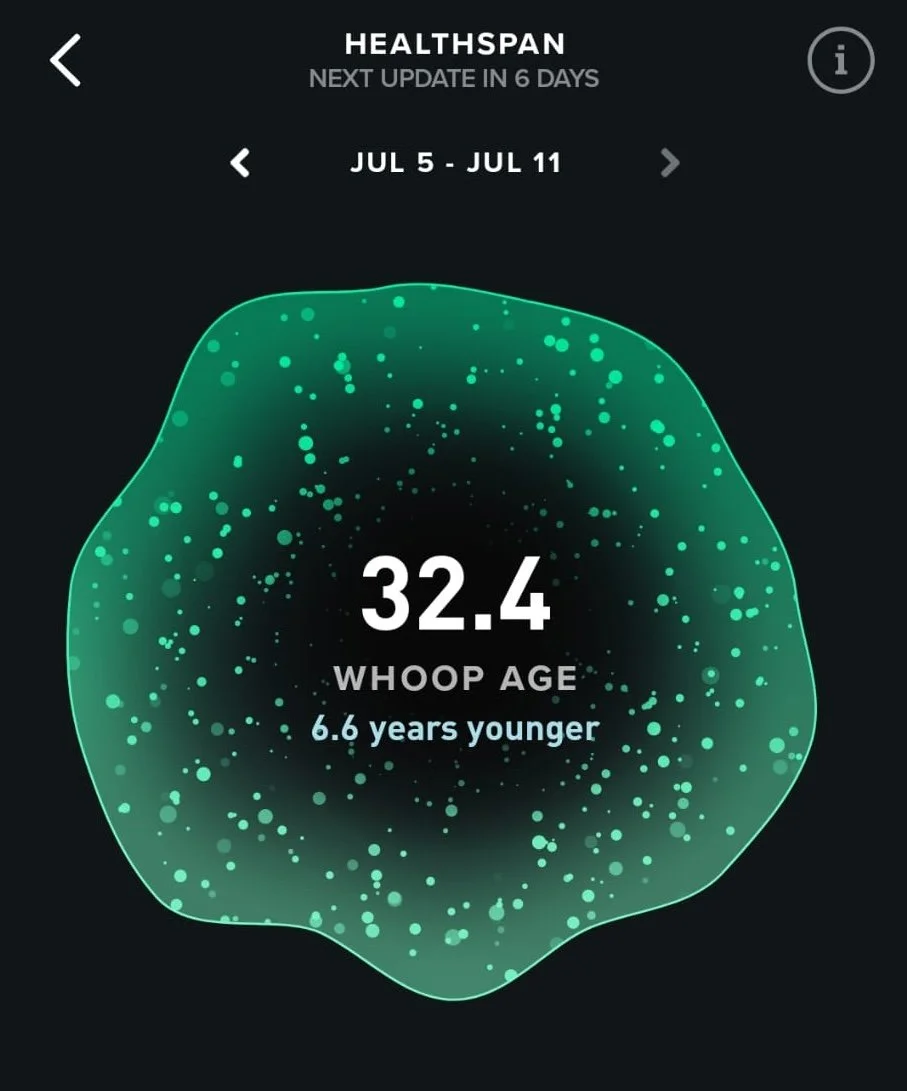
I’m tracking my health using one of the health and biological age apps that have become widely available (Whoop). My current physiological age is about 6.4 years younger than my chronological age, based on a combination of habits across sleep, diet, and excercise. I see this as starting point I’m trying to improve further, and this type of software allows you to see exactly what type of habits across these categories move the needle most and which ones I should focus more on.
So, these days I’m less focused on savings rate and net worth, and more on improving my strength training routine, optimizing my runs to get the best VO2max, or getting the evening routines right to get the best possible sleep in terms of consistency, quality, and duration.
The specific biological age or pace of aging numbers matters less than what they represent. Most people pursuing FI track their net worth monthly but forget about tracking their health—despite health being the bigger lever on how many good years your eventual FI number will actually buy you.
If you find yourself in the “boring middle” and prefer not to touch the work component, why not redirect that optimization energy toward a different kind of spreadsheet entirely. The same consistency that built your portfolio can build your biological resilience, if you point it in that direction. And unlike chasing another quarter-point of expected return, the payoff there isn’t a few basis points. It’s years more of life later and a higher quality of life now.
If you enjoyed this article, here are some next steps:
👉 Why grinding through burnout to FI isn't worth it: From Burnout to Freedom
👉 For the full framework on redesigning your relationship with work: Work, Purpose & FI
👉 Complete guide to healthspan and why it matters as much as your portfolio: Health & Longevity
👉 Use our free FI Calculator to see estimate your early retirement timeline (email unlock)
👉 For the psychology of slowing down once your portfolio is on track: The FIRE Balance
👉 Subscribe for weekly insights—one-click unsubscribe
👉 How we're using deferred parental leave as a structural break in the middle of our FI journey: Parental Leave as Mini-Retirements
🌿 Thanks for reading The Good Life Journey. I share weekly insights on personal finance, financial independence (FIRE), and long-term investing — with work, health, and philosophy explored through the FI lens.
Disclaimer: I am not a financial or legal adviser, and this content is for informational and educational purposes only. Please consult a qualified financial adviser for personalized advice tailored to your situation.
Check out other recent articles




























About the author:
Written by David, a former academic scientist with a PhD and over a decade of experience in data analysis, modeling, and market-based financial systems, including work related to carbon markets. I apply a research-driven, evidence-based approach to personal finance and FIRE, focusing on long-term investing, retirement planning, and financial decision-making under uncertainty.
This site documents my own journey toward financial independence, with related topics like work, health, and philosophy explored through a financial independence lens, as they influence saving, investing, and retirement planning decisions.
Frequently Asked Questions (FAQs)
-
The boring middle refers to the long stretch of the Financial Independence journey — typically years 3 through 10 or more — where the early optimization wins are gone, the finish line is still distant, and motivation fades even though your savings rate and investments are still working exactly as planned. It’s named for how it feels, not for any actual lack of progress.
-
Three things compound at once: the biggest structural wins (e.g., cutting expenses, switching to low-cost index funds, automating savings) happen early and aren't repeatable; hedonic adaptation means your brain stops rewarding progress that once felt exciting; and a FI number 10-15 years away is processed abstractly rather than driving day-to-day behavior the way a near-term goal would.
-
Yes, it's extremely common and has a name in the FIRE community — “the boring middle.” Most advice frames it as something to mentally push through. This article argues that if you need an elaborate coping strategy to survive a decade of your life, the problem usually isn’t your discipline, it’s how the phase itself is being approached.
-
Early in the journey, when your savings rate is doing most of the heavy lifting, there’s a reasonable case for pushing through a difficult job. But once your portfolio is large enough that its own returns start outpacing your monthly contributions — often somewhere around 40-50% of the way to your number — the maths matters less, and the cost to your health and quality of life starts to outweigh the time saved.
-
Coast FIRE is the idea that once your portfolio is large enough to grow to your target number on its own, you can stop actively contributing and simply let compounding finish the job. Easing off your savings rate once you’re well into the boring middle is a milder version of the same logic — you're not stopping entirely, just recognizing that further contributions matter less than they once did.
-
Once your savings rate, investment strategy, and timeline are dialed in, the marginal value of further financial fine-tuning drops fast. The highest-leverage area most people ignore at this stage is health — specifically biological age and healthspan — since it’s the bigger lever on how many good years your eventual FI number will actually buy you.
-
Yes — deliberately structured breaks during the accumulation phase, rather than waiting until full FI, directly counter the sense of stagnation that defines the boring middle. They also serve as a low-risk trial run for what life after FI might actually feel like, while costing relatively little time off the overall timeline.
-
Biological age is an estimate of how old your body actually is, based on physiological markers like sleep quality, heart rate variability, and activity levels, as opposed to your chronological age in years. For FIRE planning, it matters because two people who retire at the same age can have wildly different numbers of healthy years left, depending on how well they’ve maintained their bodies — making it arguably a bigger lever than portfolio size on how much retirement you actually get to enjoy.
-
Not necessarily, especially later in the journey. Once compounding returns are doing more work than your contributions, a moderate reduction in savings rate has a much smaller impact on your timeline than the same reduction would have had in year one or two — while potentially adding years of quality of life during the years you’re still working toward the number.
-
Common signs include: your budget and investment strategy are essentially optimized and there’s little left to tweak, your FI number still feels distant (often 10+ years away), and you find yourself simply waiting rather than actively building. If checking your net worth no longer produces the excitement it once did, that's hedonic adaptation, and it’s a strong signal you’re now in the middle phase.
Join readers from more than 100 countries, subscribe below!
Didn't Find What You Were After? Try Searching Here For Other Topics Or Articles: