I'm 39, But My Biological Age is 32. What I Changed and Why It Matters for FIRE
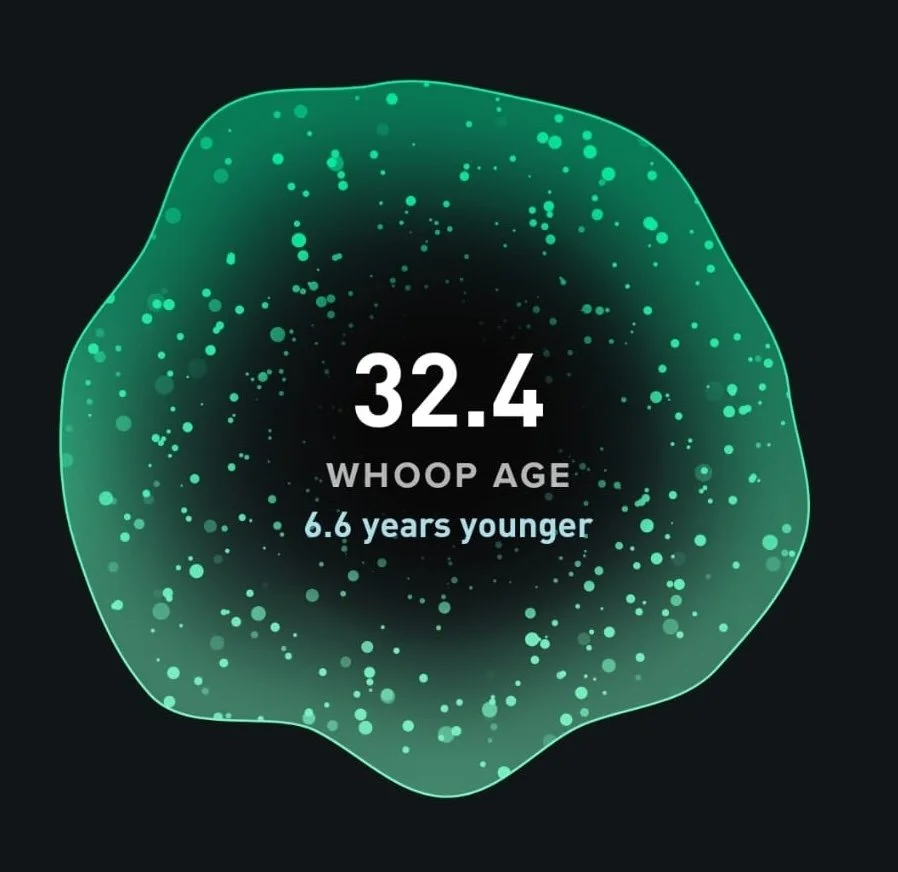
You’ve optimized your savings rate and portfolio, but have you optimized the one thing that decides how long you’ll get to enjoy it?
Reading time: 9 minutes
Quick answer:
Biological age vs chronological age is the key distinction here: your chronological age is simply how many years since you were born, while your biological age measures how old your body actually is at a physiological level. The two can differ by a decade or more in either direction, depending almost entirely on lifestyle.
For anyone on the path to FI or FIRE (Financial Independence, Retire Early), it could arguably be one of the most important numbers you're not tracking. A 48-year-old early retiree with the biological age of a 60-year-old has a fundamentally different retirement ahead than one who arrives at the same chronological age but with the body of a 38-year-old—which is exactly why we treat health as the other half of the FIRE equation.
Below, I break down exactly how biological age is measured with wearables, walk through my own numbers across all nine contributing factors (currently 32.4 at a chronological age of 39), and share the specific routine changes that have worked best for me. The goal is that you can apply the same approach whether or not you decide to use a wearable.
What You'll Get From This Article
✔ Why biological age matters more than your FI number for the quality and length of your retirement
✔ How Whoop measures biological age: the 9 key parameters and what each captures
✔ My current numbers, what they mean, and where I’m still trying to improve
✔ The specific routine changes that moved the needle most—sleep, running, strength
✔ Why this is the highest-leverage optimization available to anyone who’s on the path to FI
TL;DR — Biological Age and FIRE 🧬
🎂 Chronological age is fixed, but biological age is not—lifestyle is the main driver
⚠️ If you grind yourself into poor health during FI journey, you may retire a decade “older” than you thought
📊 VO2max, sleep consistency, and strength training are the three highest-leverage factors to optimize
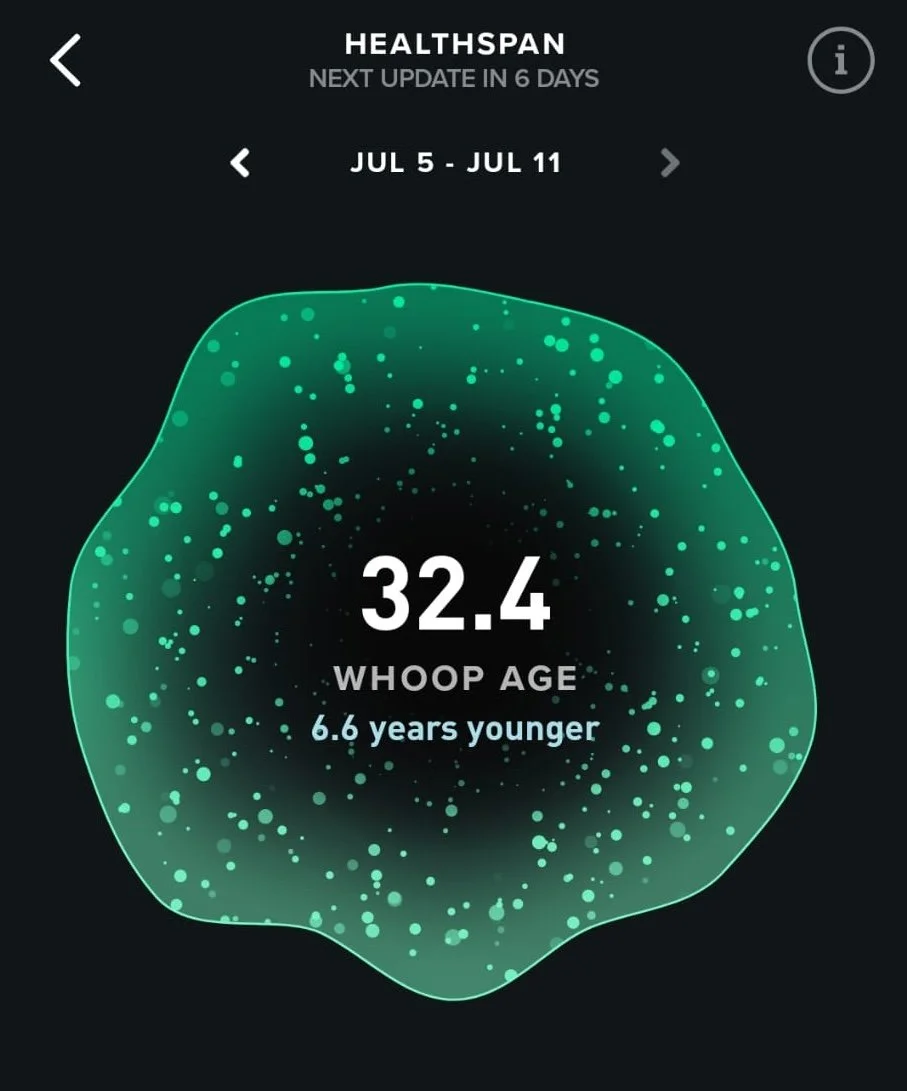
🏃 My numbers: chronological age 39, biological age 32.4—6.6 years younger
🎯 Goal: biological age under 30 before turning 40
💶 A wearable like Whoop is worth it only if it keeps you accountable—but then the ROI is very high
🔑 Finances already optimized? Optimizing for health is your highest remaining leverage
Same age and Portfolio, Very Different Retirements
Imagine two people who reach their Financial Independence (FI) number at 48, having saved and invested with the same discipline for more than two decades. One of them pursued a high-stress corporate career, which came with many 5-6 hours of sleep during the week, convenience food, and very little time for exercise. This person acknowledged the importance of health, but somehow postponed it in practice to “once I reach FI and have more time.”
The other retiree made similar financial choices but recognized early on that health compounds in a similar way that wealth does, and decided in their early 30s to build very deliberate habits around sleep, movement, and nutrition alongside the optimization of their savings rate and investments.
By their early retirement at 48, the first one may have a biological age closer to 60. Some of that may be possible to reverse with time and intention, but some of it may not be possible to fix. The damage from years of chronic stress, poor sleep, and sedentary behavior doesn’t just disappear when you send in your last notice at work.
In contrast, the second person makes it to FI with the biological profile of a late-30-year-old, and this person’s retirement may look very different: more active years ahead, a higher likelihood of staying healthy for longer with a shorter period of decline at the very end, and generally much better odds on how long and well they’ll live.
This is the key point we recently made in our Health & Longevity pillar article: optimizing for health during the accumulation phase of FI isn’t a distraction from the journey, but should be the other half of the same plan. It may sound obvious but still worth reminding ourselves of this simple fact: our portfolio funds our life but our health determines how capable and for how long we will be able to enjoy it.
In today’s article I’m sharing what metrics I’m currently tracking, what the numbers say, and the habits and routines that I've recently put in place to improve my health.

Being genuinely active and present for our family now and in the future is a great motivation for optimizing for health and longevity. Photo by Juliane Liebermann on Unsplash.
Why I Started Taking Biological Age Seriously at 39
The obvious answer you may be thinking is that, well, I’m almost 40 and probably going through a mid-life crisis. And yes, there is some truth to that—I can’t say that round number doesn’t scare me a bit. But if you’re a regular reader of the blog you know I’m already well past my mid-life crisis, which has led me to both leaving my previous careerand slowing down the FI journey.
For most of my adult life I’ve been reasonably fit. I certainly wasn’t anywhere near showing-off an iron 6 pack, but I did run or swim consistently about twice a week for the last decade or so, and I’ve also eaten very well compared to what is the norm around me. While healthy by general standards, I guess, I was certainly not overthinking any of this or trying to optimize my health as much as possible.
Having three young children at home may have been part of it too—the awareness that being genuinely present and active for them over the next few decades probably requires more than just “not being unhealthy.” But the deeper driver was the increasing realization that the choices I make now in my 30s and early 40s will likely determine my biological trajectory for the next decades, including the onset of disease, in ways that become much trickier to change later on.
In some ways, it’s not dissimilar to the compounding logic that applies to a FIRE portfolio. The earlier you start, the more compounding has a chance to work in your favor. Waiting until 55 to get serious about health is a very risky proposition, and analogous to starting to save for retirement at 55. Of course, late is better than never and you can still make progress at any age, but why give up the most valuable years if you’ve thought of it sooner.
I’ve also had more headspace to focus on it. Part of it has been our deliberate choice of slowing down our FI timeline and having, literally, more time on our hands. Working part-time, using parental leave as mini-retirements, and other choices we’ve recently made certainly creates more breathing room, where we’re more likely to take proper care of ourselves. The extra time doesn’t only make the FI journey more enjoyable, but also provides more opportunities for exercising consistently, sleeping properly, and eating healthily.
I’ve set a fairly concrete (and ambitious) goal for myself: to get my biological age under 30 before I turn 40. The timeline itself is admittedly a bit arbitrary, but what matters here really is that it keeps me motivated and more likely to follow through with the process—the runs, the lifts, and the earlier bedtimes are easier to do when you have a very specific goal in mind. While it’s a good way to kickstart habits, once they are in place, I find myself actually looking forward to the habit. The endorphins, mood benefits, and daily energy are definitely real and something to look forward to.
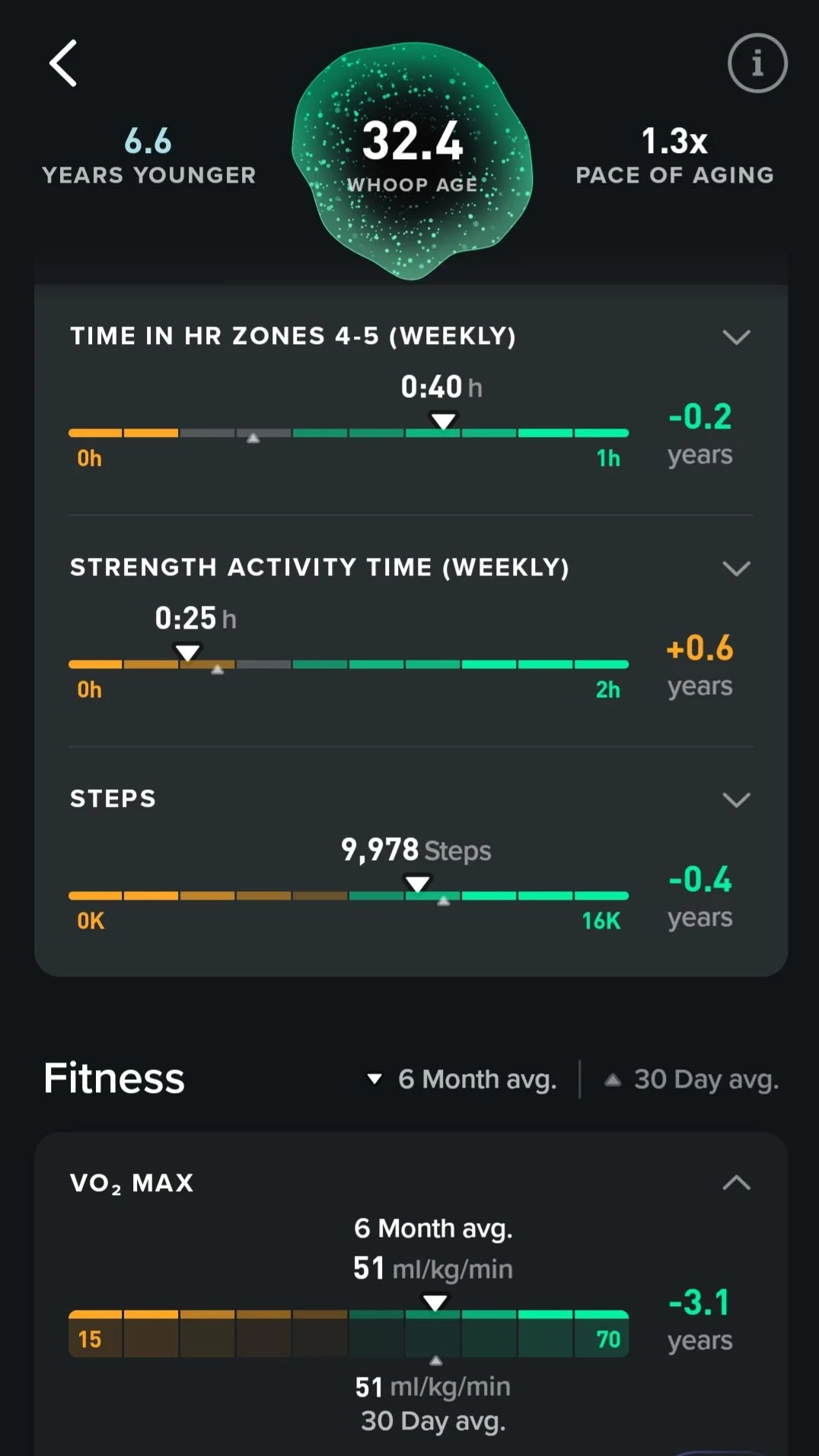
Whoop breaks down exactly which factors are adding or subtracting years from your biological age. Here are four of them and by how much each is moving the needle: time in zone 4-5, resistance training/strength time, steps, and VO2max.
What Whoop Actually Measures — and Its Limitations
I got a Whoop subscription for my birthday about six weeks ago, pooling contributions from my wife, parents and in-laws. Whoop is a wearable health tracker—a band worn on the wrist or bicep—that tracks physiological data continuously, 24 hours a day, and feeds that data into a biological age model that updates weekly.
The 9 parameters feeding the biological age model
The biological age score Whoop generates (“Whoop age”) is based on nine key metrics. Here’s a brief overview of what each of them captures, approximately ordered by the weight they carry in the model based on what I’ve observed. This is especially true for the first three metrics, which stand out strongly compared to the remaining six. Further below I present a table with my current numbers across each parameter.
VO2max: it represents the maximum amount of oxygen your body can use during intense exercise. It’s the single strongest predictor of all-cause mortality in the research literature, and the highest-leverage input in the Whoop model. The app estimates your VO2max based on resting heart rate (RHR), heart rate during exercise, sleep, and recovery patterns. Mine is currently 51 ml/kg/min, which is 85th percentile amongst Whoop users for my age and probably much higher across all population data. So, this is already in a solid range, but I’m trying to improve it slowly—a slow, months-long process.
Sleep consistency: this is not just how much you sleep, but how regular your sleep and wake times are (including naps). This surprised me the most when I started tracking: sleep consistency matters more than sleep duration once you’re over a certain threshold. Your body anticipates a regular schedule and programs its sleep architecture—the cycles of deep sleep, light sleep, and REM—more effectively when that schedule is predictable. All three cycles are important for optimal physical and mental health, so perhaps I should have been less surprised.
Strength training: this always appears very prominently too in the longevity research. Currently, this is one area where the app is actually adding to my biological age rather than subtracting. I had a minor skin procedure that prevented upper body training for several weeks, and this happened to coincide with Whoop’s calibration period. I’m reversing this slowly now with two to three intense 30-minute sessions per week.
Hours of sleep: this represents total sleep duration. Whoop tracks this, and it contributes to the modelled biological age, though the effect is smaller than I would have expected. I’m averaging 7 hours 32 minutes of real sleep time—in bed with lights out for about 8.5 hours but kids in the picture make things tricky. Either way, 7.5 hours is solid, though it counts for surprisingly little next to sleep consistency.
Time in zones 1–3 and 4–5: these two factors are the distribution of your cardiovascular effort across aerobic (zones 1–3) and higher-intensity work (zones 4–5, anaerobic). In most longevity-focused protocols, you aim for roughly 80% of training volume in zones 1–3—which represents moderate intensity at a conversational pace—with the remaining 20% in harder efforts. As observed in the figure above, these two factors don’t provide a lot of direct impact on the modelled age, but do indirectly via VO2max, which needs training both of these metrics thoroughly in order to improve.
Steps: the app tracks your daily movement volume beyond structured exercise. This captures the Blue Zone principle we’ve covered in the past: consistent low-level movement throughout the day has independent longevity benefits beyond structured training sessions. When prompted, Whoop’s AI interface recommends aiming consistently for 8,000-12,000 steps per day. As with many of these metrics, after a certain threshold you get diminishing returns.
Resting heart rate (RHR): a lower resting heart rate generally indicates a more efficient cardiovascular system. It’s a useful signal, but unlike the parameters above, it’s a downstream signal. It’s not something we can actually train directly, but mostly a reflection of the habits: for example, an elevated RHR often reflects poor sleep, inadequate recovery, or early signs of illness. The one thing you can control a bit is lowering your resting heart rate before bedtime—by not eating in the last hours before sleep and by having a proper wind down routine.
Lean body mass: the 9th parameter measures muscle, bone, and water mass. Unlike the other eight, Whoop doesn't measure this one itself—it relies on you feeding in the data. If you don’t, it’s treated as neutral rather than a penalty. You can get a reading from bioimpedance gadgets at many pharmacies or sports clinics (or from some smart scales) and enter it manually. In my case I don’t have it connected yet—but my guess is that if you’re doing everything else well, lean body mass will tend to follow.
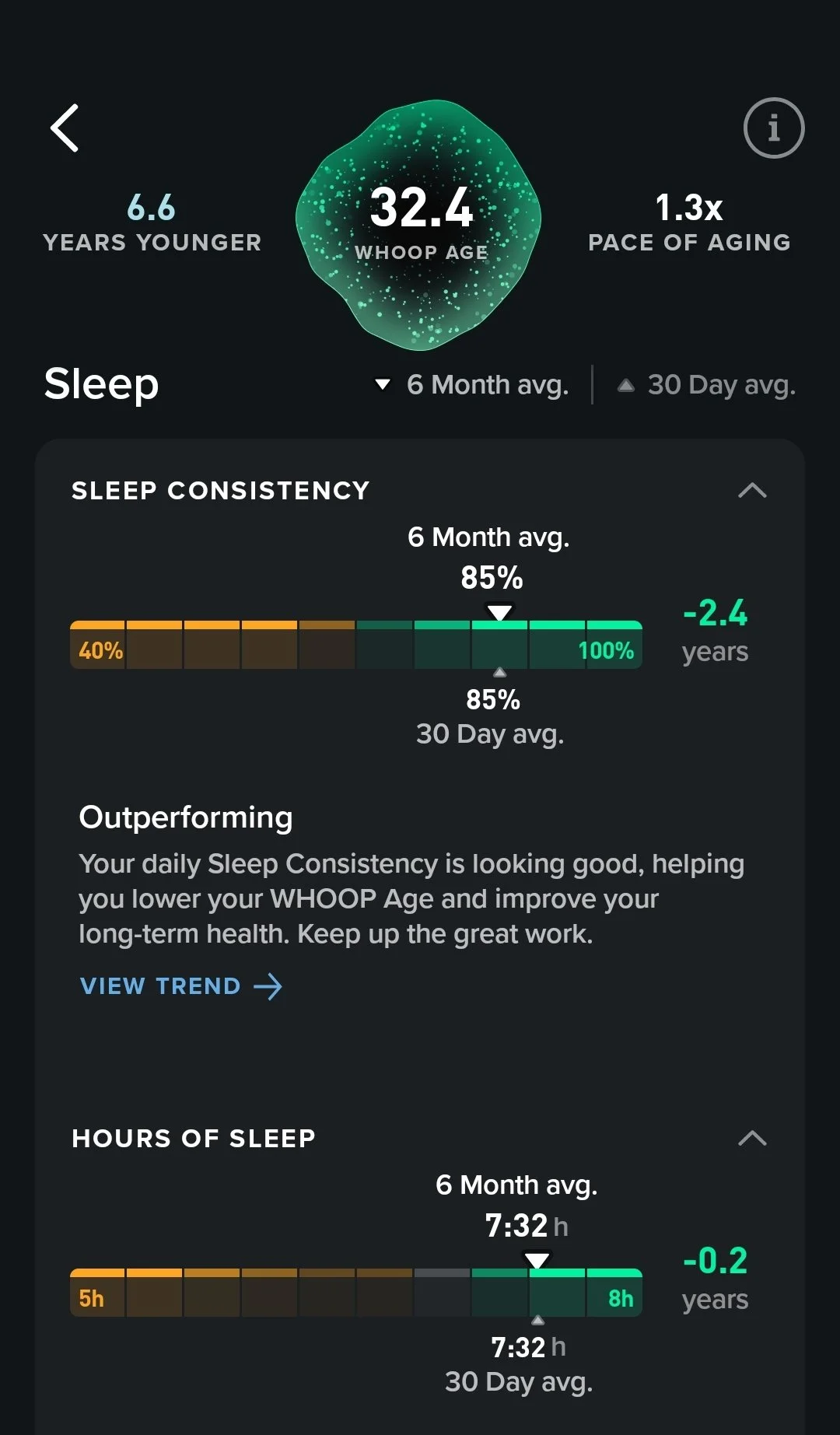
The two main sleep levers moving the biological age score are sleep consistency and hours of sleep. As observed, sleep consistency plays a larger role
.
Whoop tracks far more than the nine parameters
The nine metrics above feed the biological age model, but Whoop continuously tracks a broader set of signals that either feed into those parameters or give you useful standalone context. These include heart rate variability (HRV), daily strain, average heart rate, calories burned, recovery score, respiratory rate, time in bed, sleep hours vs needed (as a percentage), restorative sleep (deep and REM), sleep debt, sleep efficiency, total day stress, sleep stress, and non-activity stress.
HRV probably deserves a specific mention since it’s one of Whoop’s most cited daily signals. It measures the variation in time between consecutive heartbeats—a higher HRV indicates your autonomic nervous system is well-recovered and ready to handle stress, while a lower one signals the body is under strain. It’s influenced by sleep quality, alcohol, training load, illness, and chronic stress. While HRV feeds into your resting heart rate, sleep quality, and recovery score (which in turn influence the biological age model), it’s also worth tracking independently as a day-to-day readiness signal—arguably the most sensitive early warning system the device offers.
The app gives you a daily Recovery Score based on HRV and other factors (with a percentage score a color—green, yellow, red), which is helpful for you to plan your exercise around. For example, on days I’m “green”, i.e. more or less fully recovered (recovery score >67%) I might prioritize the zone 4-5 workout, whereas if I’m in low yellow a softer zone 2 workout is probably best. I haven’t been in red yet, but when it happens it’s probably time to take full rest.
Diet — the gap in the model
Whoop doesn’t track nutrition directly, and this is a limitation worth highlighting. Poor dietary choices don’t show up as a poor “diet score”, but they will show up downstream: elevated RHR overnight after a heavy or unhealthy meal, suppressed HRV after alcohol, or worse recovery scores after consecutive days of poor eating.
The app’s daily journal feature partially bridges this gap. Each morning I answer a short survey about behaviors from the previous day (mostly yes or no, sometimes at what time a specific behavior took place). There is a library of many dozens of behaviors you can choose to include or not in your survey—alcohol, late meals, fasting window, caffeine timing, stress levels, anxiety, specific foods, etc.
Over time, Whoop builds a statistical picture of which behaviors correlate most strongly with better or worse recovery outcomes. It’s not as precise as a food or behavior tracking app, but it’s definitely actionable: instead of counting macros, you’re seeing the direct physiological consequence of last night’s choices in the morning’s recovery score, which helps you both adjust and stay committed.
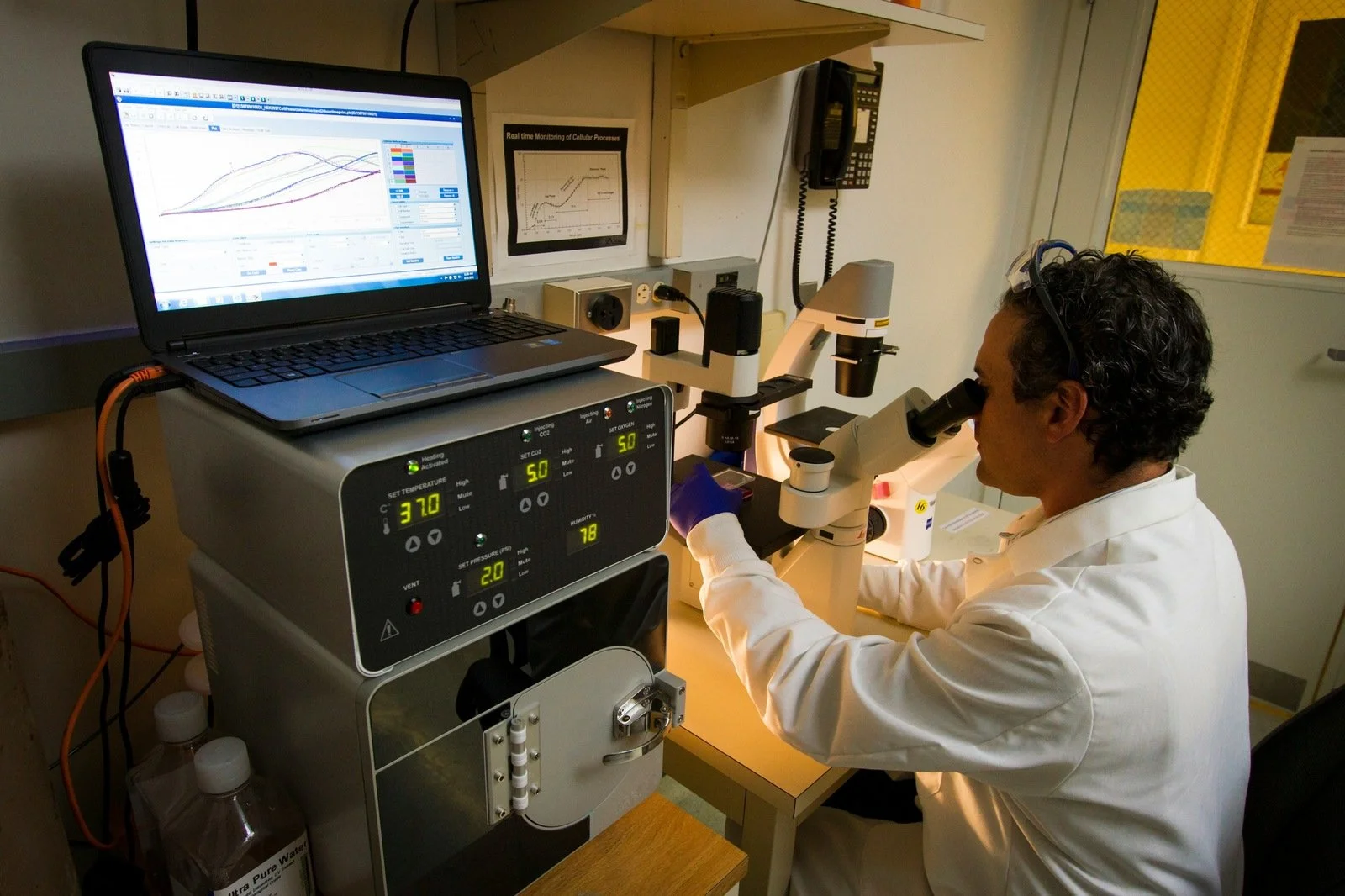
Lab tests and wearables serve different purposes. Blood biomarkers can detect future illnesses that wearable sensors can’t—but they won’t tell you which habits to avoid and which ones to double down on. Photo by National Cancer Institute on Unsplash.
On limitations — and why I still think it's worth it:
The Whoop age estimate is not a lab test. Similarly, a treadmill-based VO2max test, a DEXA scan for body composition and bone density, or a full blood biomarker panel will give you more precise measurements. Those remain important—especially the blood work for detecting metabolic dysfunction, cardiovascular risk markers, or early disease signals that wearables cannot predict.
But on the other hand, the annual check-up blood test has its own critical limitations: it gives you data once per year (in the best of cases) with no direct line of sight to the specific behaviors driving your results. You may get a better result one year, but remain unsure of whether it was the sleep changes, diet, the running, or the resistance training that moved the needle—and you’ll wait another extended amount of time to find out.
The wearable closes that feedback loop. If I go to bed late or eat a meal at 9pm, I see the effect immediately on my HRV and recovery score the next day. Or perhaps, when I’ve managed to nail the sleep consistency, I might see the VO2max estimate nudge upwards. The feedback cycle is days and weeks, rather than years. Yes, the absolute numbers may be less precise, but the trend and the behavioral signal are immediate and highly actionable.
In the end, I’d argue you need both: the wearable for daily accountability and behavioral feedback, and the annual blood panel for disease detection and metabolic markers the sensor simply can’t detect.
Interestingly, Whoop has started closing this gap itself. Its Advanced Labs feature (launched in late 2025) lets you upload bloodwork from any provider—or order a curated panel of 65 biomarkers—and connects those results to your continuous wearable data. So the “wearable vs. bloodwork” divide is narrowing: you can increasingly see how your daily habits map onto the clinical markers that predict long-term disease risk, all in one place.
Regarding cost, Whoop runs at €264/year (€22/month). If you’re on the path to FI, consider this framing: if optimal health adds even five to eight quality years to your retirement—which the research on VO2max and longevity strongly suggests is achievable—and your annual portfolio spend in retirement is €50,000, that’s €250,000-€400,000 of additional portfolio enjoyment. I wouldn’t see the €264/year as a cost, but an extremely high-return investment in the asset that determines what your portfolio is even for—and how long you’ll get to use it.
My Numbers — What They Mean and What I'm Working On
When I started using Whoop six weeks ago, the first biological age estimate that came back—after enough data had accumulated for the model to calibrate—was 33.1 years. Nearly six years younger than my chronological age of 39. Suffice to say I was both thrilled to see it and also very motivated to work towards lowering it further.
Since the first month’s calibration, it provides the biological age update weekly. Your Whoop Age updates weekly but reflects a rolling six-month average of your data, so any change you make shows up gradually rather than overnight.
The app also provides a second metric, “pace-of-aging”. While Whoop age is long term (looking at 6 months) pace of aging looks at how the last 30 days were versus the previous 6-month baseline. Therefore, pace-of-aging gives you a better short-term sense as to whether your changes are going in the right direction or not. In my case, the pace of aging is not reliable yet—I simply haven’t been using the wearable long enough yet.
Since its first calibration, the last two weeks improved my reading further to 32.7 years, and 32.4 last Sunday. So I'm currently 6.6 years younger than my chronological age—or, in Whoop’s terms, my health metrics are equivalent to those of a healthy 32-year-old.
In Table 1 below, I present how each factor is currently contributing.
Table 1: Each factor’s current contribution to my Whoop Age—negative values pull it down, positive values push it up.
| Parameter | What It Measures | Contribution to My Whoop Age | Notes |
|---|---|---|---|
| VO2max | Maximum oxygen use during intense exercise — the strongest single predictor of all-cause mortality in the research literature | −3.1 yrs | Currently 51 ml/kg/min. Improving VO2max is a slow, multi-month process. Plan is to continue zone 2 runs and incorporate higher quality runnning interval sessions |
| Sleep consistency | How regular your sleep and wake times are. Consistent timing allows your body to optimise deep, light, and REM cycles | −2.4 yrs | Sleep consistency 85%. By far the single biggest change I've made. Lights off 10:30pm, alarm 7:00am — no variation at weekends. Naps supressed. Still implementing and room for improvement |
| Strength activity time | Time spent on resistance-based training — preserves muscle mass, bone density, and metabolic function | +0.6 yrs | Currently the only metric penalising my score. Reversing this slowly with each update. 2-3 intense 30 min resistance training (1 upper body, 1 lower body). Plan to increase this slowly over time |
| Resting heart rate (RHR) | A lower RHR indicates a more efficient cardiovascular system. Also a useful early signal of poor sleep, illness, or overtraining | −0.6 yrs | 55 bpm. Downstream of everything else — less actionable than other factors. Late meals push it up noticeably overnight |
| Sleep duration | Total hours of sleep. Supports recovery, metabolic health, and cognitive function | −0.2 yrs | Averaging 7h 32min. Surprisingly modest contribution compared to sleep consistency |
| Daily steps | Total daily movement beyond structured exercise. Consistent low-level movement has independent longevity benefits | −0.4 yrs | Average 9,900 steps. Contributing positively. A reminder that the walk to the shops counts too |
| Time in zones 1–3 | Time spent at moderate aerobic intensity — the foundation of cardiovascular fitness and metabolic health | −0.3 yrs | 2h 29min. Two zone 2 runs per week (7–9 and 10–13km) covering most of this. Roughly 80% of total running are zone 2. Impact looks modest, but shows up importantly via VO2max |
| Time in zones 4–5 | Time spent at high intensity — complements zone 2 work and drives VO2max improvements over time | −0.2 yrs | 22 min. One interval session per week: 5–6 × 4-minute hard efforts with 3 minutes easy recovery in between. Impact looks modest, but shows up importantly via VO2max |
| Lean body mass | Muscle, bone, and water mass — critical for bone density, metabolism, and long-term mobility | Neutral | Not yet accounted for — Whoop treats this missing data as neutral rather than a penalty. Plan to add |
As mentioned earlier, the strength training component is the most important one for me to optimize further. It’s the only metric currently adding to my biological age rather than subtracting, and it’s also the area where I started latest and have the most room to learn and improve.
My goal is to get the biological age under 30 before I turn 40. That’s a 2.4-year improvement in roughly 10 months, which is ambitious but possible, I think, especially if I continue implementing and eventually increasing strength training, while I continue to improve marginally on sleep consistency, VO2max, and some of the other factors. I’m not stressed about the exact numbers, but just embracing and enjoying the process. In the end, what matters is not reaching the score itself, but implementing a set of healthy habits you can stick with for the long run.

The metric I’m most focused on improving right now. Strength training is currently the one area adding to my biological age. Photo by Frederik Rosar on Unsplash.
My Full Routine: Sleep, Running, Strength, and Diet
The table above covers most of my routine implicitly, but to make it concrete: three runs per week (two zone 2 at 7-13km plus one interval session or tempo run); two to three resistance training sessions of 30 intense minutes each (one upper, one lower body—at home with dumbbells and a barbell), lights off at 10:30pm every night, alarm at 7:00am. Dinner by 7:30pm or sooner when possible, fasting over a 16-18-hour window, and eating very healthily: I’m largely cooking every meal from scratch to avoid processed foods with too much sugar, salt, and other junk; eat large quantities of veggies and legumes relative to carbs; and generous portions of nuts and probiotics like kefir, home-made kimchi, and other ferments for gut health.
Since using the wearable, the single biggest change (and surprise) has been sleep consistency. Sleep consistency sounds boring and I probably knew deep down that it mattered, but I didn't realize how much the regularity of the schedule mattered relative to the total hours—and was surprised by how optimizing both made me feel noticeably better throughout the day almost immediately.
The strength training is the work in progress, and the area with the most upside. I may consider eventually going to the gym for more variety of exercises, but for now my barbell and dumbbell routines at home work—especially with little free time without kids.
For those of you here mainly for the personal finance content, the broader argument is simple: if your savings rate is solid and you’ve already optimized your finances on your path to FI, there’s probably not much left to squeeze out on the financial side. Why not turn to the more impactful lever available—and focus seriously on your health? It’s literally going to be the lever that determines how many years you enjoy that portfolio you took so long to accumulate.
If you enjoyed this article, here are some next steps:
👉 For more on healthspan and longevity: Health & Longevity: The Other Half of Your FIRE Plan
👉 Use our free FI Calculatorto model your retirement timeline (email unlock)
👉 For the basics on how to reach Financial Independence: What Is Financial Independence?
👉 Subscribe for monthly insights—one-click unsubscribe
👉 Browse through all our articles
🌿 Thanks for reading The Good Life Journey. I share weekly insights on personal finance, financial independence (FIRE), and long-term investing — with work, health, and philosophy explored through the FI lens.
Disclaimer: I am not a financial adviser, and this content is for informational and educational purposes only. Please consult a qualified financial adviser for personalized advice tailored to your situation.
Check out other recent articles




























About the author:
Written by David, a former academic scientist with a PhD and over a decade of experience in data analysis, modeling, and market-based financial systems, including work related to carbon markets. I apply a research-driven, evidence-based approach to personal finance and FIRE, focusing on long-term investing, retirement planning, and financial decision-making under uncertainty.
This site documents my own journey toward financial independence, with related topics like work, health, and philosophy explored through a financial independence lens, as they influence saving, investing, and retirement planning decisions.
Frequently Asked Questions (FAQs)
-
Chronological age is simply how many years since you were born. Biological age estimates how old your body actually is at a physiological level, based on markers like VO2max, resting heart rate, sleep quality, and heart rate variability. The two can differ by a decade or more in either direction, driven almost entirely by lifestyle — meaning two 48-year-olds can have the bodies of a 38-year-old and a 60-year-old respectively.
-
Whoop’s biological age (called "Whoop Age") is built from nine key metrics: VO2max, sleep consistency, strength training, hours of sleep, time in heart-rate zones 1–3 and 4–5, daily steps, resting heart rate, and lean body mass. The first three carry the most weight. The score updates weekly and reflects a rolling six-month average, so individual changes show up gradually rather than overnight.
-
It’s an estimate, not a lab test — a treadmill VO2max test, DEXA scan, or blood panel will be more precise in the specific items they measure. But the value isn’t absolute precision; it’s the daily feedback loop. A wearable shows you within days whether a behavior change helped, whereas an annual check-up leaves you guessing which habit moved the result. For tracking trends and staying accountable, it’s highly actionable.
-
The three highest-leverage levers are cardiovascular fitness (VO2max), sleep consistency, and resistance training. In practice that means regular zone 2 cardio with occasional high-intensity sessions, fixed sleep and wake times, and at least two strength sessions per week. Diet, daily steps, and stress management matter too, though many show up indirectly through the metrics above.
-
VO2max measures the maximum oxygen your body can use during intense exercise and is one of the strongest predictors of longevity in the research literature. Higher is better, and it declines with age without training. Mine is currently 51 ml/kg/min at 39, roughly the 85th percentile among Whoop users my age — solid, but with room to improve.
-
Once you’re above a minimum threshold of total sleep, the regularity of your sleep and wake times matters more than squeezing in extra minutes. A predictable schedule lets your body anticipate and properly program its sleep architecture — the cycles of deep, light, and REM sleep, each serving distinct restorative functions. In my own tracking, consistency moved my score far more than total hours did.
-
Not directly — there’s no “diet score.” But poor eating shows up downstream in the metrics it does track: elevated resting heart rate after a heavy late meal, suppressed HRV after alcohol, worse recovery after several days of poor food. Whoop’s journal feature also lets you log behaviors and see which correlate most strongly with better or worse recovery over time.
-
Whoop Peak costs around €22/month (€264/year). Framed against FI, that’s trivial: if optimal health adds even five to eight quality years to a retirement with €50,000 annual spend, that's €250,000–€400,000 of additional portfolio enjoyment. The one caveat — it’s only worth it if the feedback loop actually changes your behavior. For people who track and adjust, the ROI is enormous; for those who track and ignore, of course it would be wasted money.
-
HRV measures the variation in time between consecutive heartbeats. A higher HRV signals your autonomic nervous system is well-recovered and ready for stress; a lower one signals strain. It’s influenced by sleep, alcohol, training load, illness, and chronic stress, making it one of the most sensitive early-warning signals a wearable offers — often flagging problems before you consciously feel them.
-
Both, but the marginal returns shift over time. Once your savings rate, asset allocation, and withdrawal strategy are solid, further financial fine-tuning yields little. At that point health becomes the higher-leverage lever, because it determines how many good years you’ll actually get to spend the portfolio you worked so hard to build. Health is, in effect, the other half of the FIRE equation.
Join readers from more than 100 countries, subscribe below!
Didn't Find What You Were After? Try Searching Here For Other Topics Or Articles: