“Tourist Go Home”: What Europe’s Anti-Tourism Backlash Means For Expat Retirees
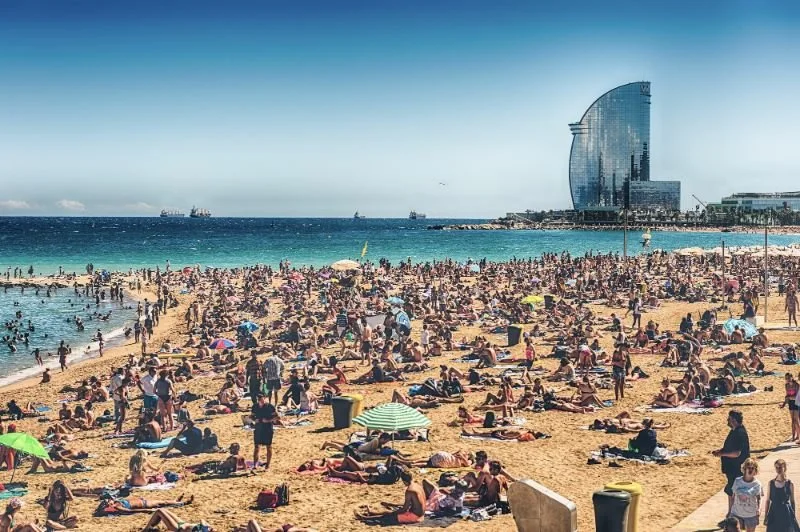
Barcelona, Spain. Barceloneta beach in summer—paradise or hell? Photo source: https://whattodoinbarcelona.com/
Reading time: 7 minutes
Quick answer:
Over the last few years, anti-tourism protests spread across some of southern Europe’s most popular retirement destinations—and anyone planning to FIRE (Financial Independence, Retire Early) abroad should understand the phenomenon and what’s actually driving it before choosing where to settle.
The sentiment is real in many places, growing, and some of it applies to long-term expat retirees too, not just selfie-stick tourists. But, as always, the story is usually more complex than the headlines suggest. The backlash is concentrated in a handful of overexposed cities, driven primarily by housing supply failures that predate foreign arrivals, and these issues are largely absent from secondary cities, coastal towns, and rural areas where people are not only wanted but also the geoarbitrage maths is better anyway.
What You'll Get From This Article
✔ What’s driving anti-tourism protests—and what it means for expat retirees
✔ The housing supply failure politicians don’t address or acknowledge
✔ Why a wave of departing Americans could compound the pressure on popular destinations
✔ The economic case for the long-term retiree vs mass tourism
✔ Where you’re genuinely wanted instead—and why it’s often cheaper too
TL;DR Anti-Tourism sentiment vs expat Retirees 🌍
🔴 Coordinated protests hit Spain, Portugal, Italy & Venice in 2025—SET alliance leads the charge
🏘️ “One more tourist, one less resident” logic applies to long-term foreign renters too
🏗️ Real cause: decades of housing supply failures, not Airbnb
🏨 Airbnb crackdowns mostly benefit hotel chains, not local residents
🇺🇸 Americans in Portugal up 500%+; US net migration negative for first time since the 1930s
🌾 Rural southern Europe: the opposite problem—depopulation, not overcrowding
💰 One retiree spending €80-120K/year locally beats hundreds of cruise passengers economically
🏠 Where you choose to settle matters more than your nationality or effort to integrate
The Backlash Is Real — and It Matters Even When It's Misdirected
On June 15, 2025, angry protesters in Barcelona armed with water pistols marched through the city’s historic centre, posting stickers reading “Tourist Go Home” around the city. The same day, other coordinated demonstrations took place in Palma, Ibiza, Venice, and Lisbon, formalizing the first transnational action by the SET alliance (Sud d'Europa contra la Turistització). This didn’t come out of nowhere, but was the culmination of years of mounting local frustration.
Over 25 million tourists visited Barcelona in 2024, a city of 1.6 million. A 2024 City Council survey found that 59.9% of residents believe the city has reached the limit of its tourism capacity, with the most-visited districts—Ciutat Vella and Gràcia—wanting fewer visitors specifically.
An expat considering retiring in Barcelona or Mallorca may be thinking “well, but I’m planning to actually live there, not just visit.” Yes, the distinction matters, and we’ll get to it. But the “one more tourist, one less resident” logic doesn’t stop at tourists—it applies to any foreigner taking a housing unit off the rental market, including a retired couple settling in for six months of the year.
The sentiment intensity varies substantially by country and region. Spain and Portugal are most acute within Europe, while in Italy it is concentrated in cities like Venice and Florence. Other places like Greece and Cyprus are developing some tensions but remain earlier in the cycle. France is generally quieter—the rural expat presence has been historically high but it has been more spread out rather than being concentrated in urban hotspots.
The practical implication is that the local backlash is geographically specific, and choosing, say, Braga over Lisbon or Santander over Palma and Barcelona may deliver a different social context and retirement experience. After all, even if the feelings are misplaced, nobody wants to go where they are not wanted.
Understanding this backlash properly means separating the perceived cause from the actual ones—and then deciding how it affects your choice of where to settle. That’s the structure of this article: first, we’ll cover the real driver behind the anger—which is not what many headlines suggest; then we’ll assess where the tourist/retiree distinction holds and where it doesn't, and finally, we’ll get to practical advice on where to actually go—hint: it’s probably not the cities making the “tourists go home” headlines.
Another under-reported angle may be a wave of Americans compounding the pressure. The number of Americans in Portugal has risen more than 500% since the pandemic, including a 36% jump in 2024 alone, according to Wall Street Journal reporting. And now, for the first time since the Great Depression era, the US saw a net negative migration, with about 150,000 more people leaving than arriving in 2025.

Lisbon, Portugal. We recently ranked Portugal as the best place to retire in Europe. However, its two main cities—Lisbon and Porto—have important housing issues to consider. Photo by Louis Droege on Unsplash.
The Real Cause — and Why It Matters for Where You Go
In some countries, the politically convenient narrative tends to blame rental platforms like Airbnb for their local housing problems. The more uncomfortable economic reality is that many southern European cities have deep structural housing supply failures that predate Airbnb by many years. Young Spaniards have had a hard time getting their first place for decades—this is mostly an unaddressed supply-driven problem that is made slightly worse by a demand one.
Planning bureaucracy, protected historic zones, and deliberately constrained supply have kept housing construction far below what demand in big cities requires—whether that demand comes from local young professionals, domestic migrants, or foreign retirees.
Let’s start with the rental platforms, the most common scapegoat. When Spain’s national government ordered Airbnb to delist nearly 66,000 listings in 2025 for regulatory violations—a move upheld by Spanish courts after Airbnb’s appeal—the impact on rents remains unclear so far, with full enforcement still rolling out. Many economists are skeptical it will meaningfully move prices either way; without addressing the chronic undersupply of housing, it’s more like a bandaid on a much deeper wound.
Still, the fact that many southern European cities have a supply-driven problem with housing doesn’t mean that additional demand pressures can’t aggravate it further. For example, Portugal’s government spent a decade actively incentivizing wealthy foreign buyers through their Golden Visa programme and Non-Habitual Resident tax regime, which further contributed to pricing locals out.
Portugal has since scaled back both schemes—the Golden Visa’s real estate investment route was closed in 2023, and NHR was replaced with a more limited successor in 2024—an implicit acknowledgment that foreign-demand incentives had become politically and socially costly.
There is also a commercial dimension that is under-discussed. Large hotel groups lobby and benefit enormously from pushing the Airbnb scapegoat, even if the root causes are other. But in reality, when a tourist moves from a private flat to a hotel chain, considerably less money stays in the local economy.
There is another political angle here complicating things further: in countries where homeownership rates are high, older voters who already own property benefit financially from keeping supply constrained and prices high. Blaming foreigners is politically easy; expanding construction rights is politically costly, since, ultimately, it would affect the valuation of their voters’ homes.
This is admittedly a generalization—housing politics vary significantly by country and municipality, and not every policymaker resisting construction is doing so out of self-interest. But the pattern is consistent enough across multiple southern European markets that it’s hard to ignore.
None of this means the local grievances are illegitimate. People are being displaced in some cities from the communities they grew up in against their will. But the anger is usually directed at visible foreigners or rental platforms rather than at the housing and planning policies that created the conditions in the first place.
What does all this mean for an expat retiree? Even if your economic contribution is net positive to the local economy, ultimately local perception is what will determine your daily experience. In my view, you want to avoid retiring somewhere where you are not wanted, regardless of whether the resentment is justified or not.
The Tourist vs The Retiree — and When the Distinction Doesn't Hold
Of course, tourism shouldn’t be fully conflated with long-term expat residence. A cruise ship that delivers 4,000 passengers to Venice for a few hours generates congestion and stress, wears down public infrastructure, and leaves very little money in the local economy.
In contrast, a retired couple living in a Portuguese town for six months shops at the local market several times a week, pays rent to a local landlord, hires a cleaner and handyman, eats regularly at local restaurants, and pays taxes the average tourist never touches. A couple living off a €2-3M portfolio and spending €80-120,000 a year locally creates employment across multiple sectors without competing with residents for jobs—an economic footprint that is large, sustained, and locally embedded in ways mass tourism rarely achieves.
Unfortunately, housing is the exception. A retired couple taking a long-term rental in Lisbon’s Alfama removes that unit from the local rental market just as effectively as an Airbnb conversion for tourists would. Similarly, buying property in central Lisbon pushes prices higher in a market where young Portuguese professionals already struggle to buy.
All this is, again, in the context of a supply-constrained context. Although the mechanism differs from mass tourism, the consequence for local housing affordability does not.
This isn’t a contradiction of the earlier point about housing supply being the root structural cause—it’s a different question. Fixing the supply failure is a policy problem that goes far beyond any individual’s control. But while that root cause goes unaddressed, where you personally choose to rent or buy still shifts outcomes for the specific neighbourhood and the specific renters competing with you. In other words, acknowledging that politicians have largely failed to fix the real problem doesn’t mean your own housing choice is inconsequential to locals.
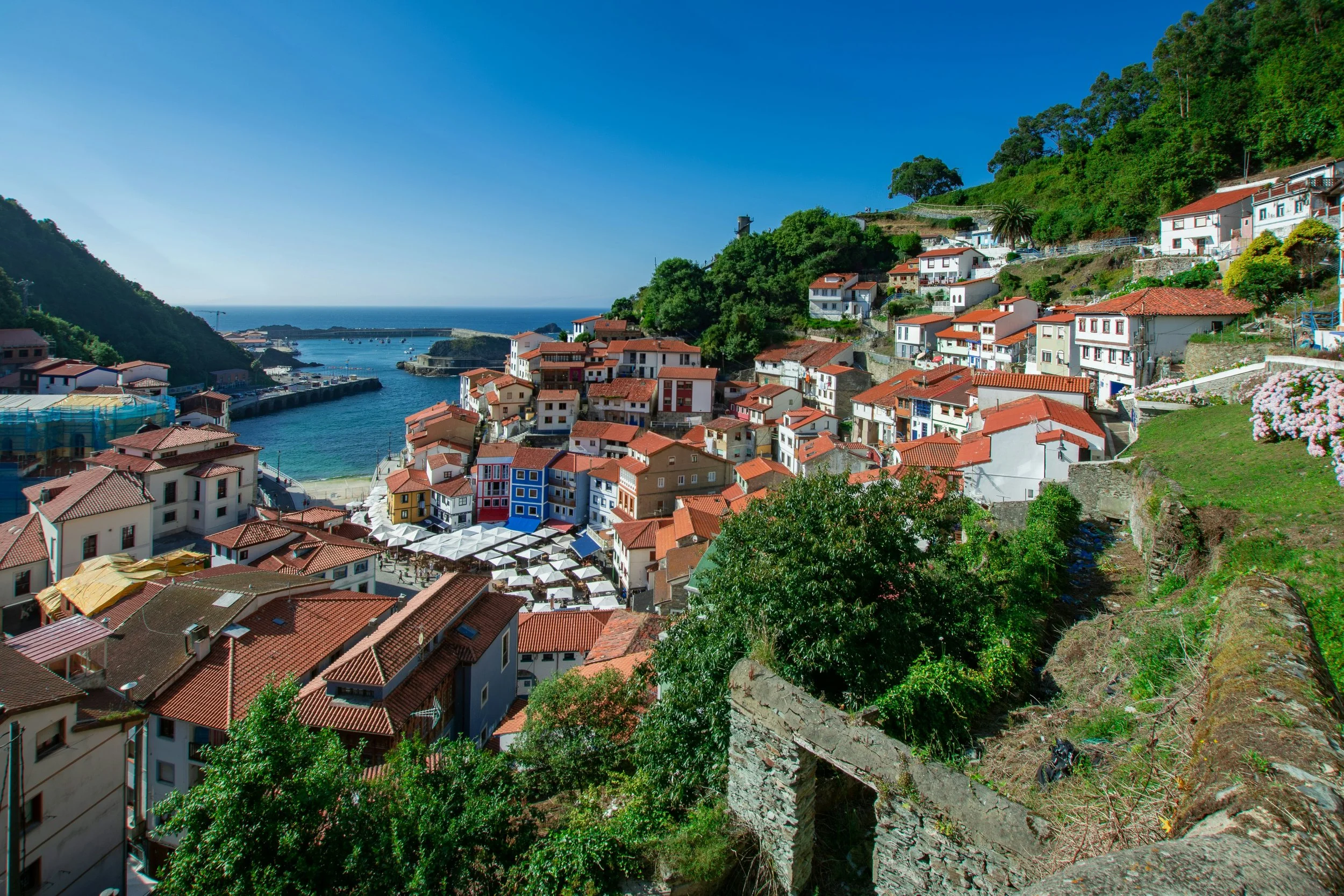
Asturias, Spain. Could you envision retiring in a smaller town in Spain’s beautiful north or in its rural interior? Photo by Moises Muniz on Unsplash.
Where You Are Genuinely Wanted — The Rural Counterargument
While Barcelona and Palma protest against over-tourism, hundreds of villages in Spain’s interior are closing schools and watching young people leave for cities. The depopulation crisis in rural areas is one of the defining demographic challenges of southern Europe. It is most severe in regions furthest from the coast and urban centers where protests concentrate.
Take Spain's Serranía Celtibérica as an example—an interior region spanning parts of Aragón, Castilla-La Mancha, and Castilla y León that is larger than Belgium. It has a population density below 8 people per square kilometre, comparable to Lapland, despite its Mediterranean location.
Many Spanish programs have been launched to address this (e.g., Volver al Pueblo and Hola Pueblos). The idea is to connect potential residents with rural municipalities, offering support for relocating in many regions. The same country where protesters spray water guns at tourists in Barcelona is funding programmes to attract national and foreign residents to its depopulated interior.
There are international parallels too—several Italian towns, particularly in Sicily (Sambuca di Sicilia, Mussomeli), have run well-publicized “1-euro home” schemes, where the nominal price comes with a renovation commitment and deposit, not a free house. Spain has smaller-scale regional equivalents in depopulated areas of Castilla y León and Galicia.
The Dordogne in southwestern France represents an established model of harmonious expat integration. Many British retirees settled there for decades without meaningful friction—so many that locals nicknamed it "Dordogneshire." Arrivals here come to an area with vacant stone farmhouses, declining populations, and genuine need for local economic activity.
Expats renovate properties that might otherwise decay, support local markets and artisan producers, and bring consistent spending to restaurants and other businesses. They are not displacing or competing with young locals for housing—because the young people are largely leaving to the cities.
Similar dynamics operate across several rural regions of France, Portugal, Spain or Greece. In these cases, the expat retiree’s spending is economic oxygen for communities that would otherwise lose population, services, and vitality.
Perhaps you are not attracted to the rural countryside. Still, between the protest-prone major cities and the fully rural and remote areas lies a substantial number of mid-sized cities worth considering that could equally meet your retirement needs. Genuine lifestyle quality, functioning infrastructure, housing markets not yet at crisis point, and communities that are more likely to welcome you with open arms.
Putting It Together — Where the Smart Money (and the Welcome) Actually Is
Where you choose to settle is the lever that matters most—and the good news is that it points in the same direction as cost. Cities with the most acute anti-expat sentiment—Lisbon, Barcelona, Venice, Florence—are also where the geoarbitrage cost advantage has narrowed the most in recent years, while secondary cities and rural areas remain both cheaper and more welcoming.
The backlash is real, but not evenly distributed. And remember that it really isn’t about you specifically—it’s about decades of constrained housing supply finally boiling over, with foreign residents serving as the most visible symptom rather than the structural cause. None of this means giving up on Southern Europe, or feeling guilty for wanting sun, culture, and an easier cost of living. It just means rethinking where exactly on the map you want to land.
That distinction matters in practice: a couple settling in a mid-sized secondary city with a working economy and no housing crisis—or in a depopulating rural region—creates a very different impact than the same couple settling in central Lisbon or Barcelona’s Gothic Quarter, where every long-term rental is one fewer unit for a young local family.
For FIRE-minded retirees, this isn’t bad news: the places where you’re more likely to be welcomed are often the same places where your money goes furthest. The cheapest options and the most welcoming ones are increasingly the same places, not a tradeoff.
👉 Curious how relocating to a secondary city or rural area abroad could shorten your own FI timeline? Run the numbers with our FI Calculator (email unlock)—it takes under 2 minutes and shows exactly how much a lower cost of living could save you in years, not just euros or dollars.
💬 Have you ever felt unwelcome somewhere you were considering retiring—or had to rethink a destination because of how it felt to be there as a foreigner? Would you trade a famous city for a quieter, more welcoming secondary one if it meant retiring sooner? Please share with us in the comments below.
If you enjoyed this article, here are some next steps:
👉 For the full geographic arbitrage framework, see our complete geoarbitrage guide
👉 For a hybrid approach without full relocation, see our Seasonal Geoarbitrage guide
👉 Decided the move still makes sense? Then the practical side: how to receive your income abroad and spend in euros without losing 2–3% to bank conversions
👉 Subscribe for weekly insights (one-click unsubscribe)
👉 For the specific risk of your destination getting more expensive, see The Hidden Risk of Geoarbitrage
🌿 Thanks for reading The Good Life Journey. I share weekly insights on personal finance, financial independence (FIRE), and long-term investing — with work, health, and philosophy explored through the FI lens.
Disclaimer: I am not a financial adviser, and this content is for informational and educational purposes only. Please consult a qualified financial adviser for personalized advice tailored to your situation.
Check out other recent articles




























About the author:
Written by David, a former academic scientist with a PhD and over a decade of experience in data analysis, modeling, and market-based financial systems, including work related to carbon markets. I apply a research-driven, evidence-based approach to personal finance and FIRE, focusing on long-term investing, retirement planning, and financial decision-making under uncertainty.
This site documents my own journey toward financial independence, with related topics like work, health, and philosophy explored through a financial independence lens, as they influence saving, investing, and retirement planning decisions.
Frequently Asked Questions (FAQs)
-
The protests are driven primarily by a housing affordability crisis that predates mass tourism by decades—decades of constrained construction, protected historic zones, and restrictive planning bureaucracy have kept housing supply far below demand. Tourism and foreign residency add demand-side pressure on top of this, but they aren't the root cause. Banning Airbnb in Barcelona, for example, didn't meaningfully lower rents, which is strong evidence the supply problem runs deeper than short-term rentals.
-
Physical safety isn't the concern—these remain very safe countries by any standard metric. The relevant risk is social: in a handful of overexposed cities (Barcelona, Lisbon, Venice, Florence), a meaningful share of residents view foreign arrivals negatively, which can affect daily life and integration. This sentiment is concentrated geographically and largely absent in secondary cities, coastal towns, and rural areas.
-
Barcelona, Palma de Mallorca, Venice, and Florence currently show the most acute backlash, with Lisbon following closely behind. Spain and Portugal are the most affected countries overall within Europe. By contrast, France's expat presence is more rural and dispersed, and has generated far less friction, while Greece and Cyprus are described as earlier in the same cycle.
-
Not primarily. Spain delisted nearly 66,000 Airbnb rentals in 2025 under pressure from Barcelona's former mayor, yet rents did not meaningfully fall afterward—a strong signal that short-term rentals are a visible symptom rather than the structural cause. The deeper driver is decades of underbuilding relative to demand, worsened by protected historic zones and slow planning approval.
-
Yes—the number of Americans living in Portugal has increased more than 500% since the pandemic, including a 36% jump in 2024 alone. This coincides with the first net negative migration year for the US in decades, with roughly 150,000 more people leaving the country than arriving in 2025, some of them heading specifically to Portugal and Spain.
-
The Golden Visa originally allowed wealthy foreigners to gain Portuguese residency through real estate investment, alongside the Non-Habitual Resident (NHR) tax regime. Portugal closed the real estate investment route in 2023 and replaced NHR with a more limited successor scheme in 2024, a response to mounting criticism that both programmes had contributed to pricing locals out of major cities.
-
Some regions effectively are, through programmes designed to counter depopulation rather than direct cash payments. Spain runs initiatives like Volver al Pueblo and Hola Pueblos connecting prospective residents with rural municipalities, and several Italian towns—particularly in Sicily—have run well-publicized "1-euro home" schemes, though these come with renovation commitments and deposits rather than a literally free house.
-
Economically, no—a retired couple spending €80,000-120,000 per year locally creates sustained local employment and embeds money in the community in ways tourism rarely does. But for the specific issue of housing supply, the distinction breaks down: a long-term rental taken by a foreign retiree removes a unit from the local market just as effectively as a short-term tourist rental would, in cities already facing housing shortages.
-
The two trends increasingly point the same direction. Cities with the strongest anti-tourist sentiment—Lisbon, Barcelona, Florence—are also where cost-of-living advantages for foreign retirees have narrowed the most in recent years. Secondary cities and rural areas tend to remain both cheaper and more welcoming, meaning the financially optimal choice and the socially considerate one are converging rather than competing.
Join readers from more than 100 countries, subscribe below!
Didn't Find What You Were After? Try Searching Here For Other Topics Or Articles: