Your Portfolio Returns 7%. Your Health Returns Far More

The whole point of reaching Financial Independence is to enjoy years of freedom. But how many capable, active years you actually get is decided less by your portfolio than by your health. Photo by Rachel Claire on Pexels.
Reading time: 7 minutes
Quick answer:
The FIRE (Financial Independence, Retire Early) community pays enormous attention to savings rates, withdrawal rates, and shaving years off the timeline to Financial Independence (FI). But far less attention goes to a question that matters just as much, if not more: how many healthy, capable years you’ll have to enjoy the freedom you worked so hard to build.
A five-to-ten-year swing in biological age is driven mostly by everyday lifestyle choices. For someone with an annual spend of $50,000, optimizing your health could be worth somewhere in the range of $250,000 to $500,000 in additional funded, active retirement years, for a cost of roughly $500 a year and a few hours per week. The time, for most people, is already there; it just needs to be reallocated from screens. The most common constraint isn’t money, but attention.
What You'll Get From This Article
✔ Why the standard FIRE framework treats health as an afterthought, and what that costs you
✔ How to put a rough dollar value on an extra year of healthy life
✔ The two-sided retirement timeline that FIRE plans usually ignore
✔ Why time, not money, is the real barrier, and where to find it
✔ A simple, evidence-backed health routine that costs less than one month’s streaming bill
TL;DR: The ROI of Health in FIRE 💪
🔑 FIRE has two sides: reaching FI quickly and extending lifespan and the healthy years on the far end
💵 Each extra healthy year is roughly one year of your retirement budget unlocked
🏃 The cost of a healthy year can be as low as $500 and 3–4 hours a week: best return in finance
📱 The average adult spends close to 6 hours a day on screens (outside of work)
⚠️ Sprinting to FI in poor health can backfire: gain ~3 years on one end, lose more on the other
🎯 Compressed morbidity: stay active longer, then decline quickly, rather than slowly for decades
🧬 Biological age is modifiable; research suggests lifestyle can shift it by years in either direction
😴 You can’t choose your parents, but you can choose your habits
The Missing Half of Your FIRE Plan: Why Biological Age Beats Savings Rate
The One-Sided FIRE Equation
Most FIRE (Financial Independence, Retire Early) treats the journey as if it were a race against time. How fast can I possibly reach my FI number, and what savings rate do I need to implement to get there? Or, what safe withdrawal rate should I aim for in early retirement: should it be a 5% or should I work more years and use a 3.5% instead?
These are questions we all need to grapple with, but they tackle the front side of the problem. But if you want a long retirement—which is usually the case for people looking to sprint there as soon as possible—then you also want to focus on the other half of the problem, which gets much less attention.
Once you do reach FI, how many good, healthy years will you actually have? I don’t just mean years alive, but also vigorous and active years. Years where you can travel, hike, play with grandchildren, live independently, and use that freedom you spent so long building.
The standard FIRE approach is implicitly assuming your body and health are constant. But, of course, it isn’t; your biological age—how old your body is at a functional level—can diverge from your chronological age by a decade or more in either direction, depending largely on lifestyle choices. Put simply, you can retire early at 45 with the age of a 35- or 55-year-old, or anywhere in between, depending on how you chose to take care of yourself.
What is the cost-benefit analysis of investing now in your health?

A few hours a week of movement is one of the highest-return investments available. Photo from Christopher Campbell on Unsplash.
What Is One Healthy Year Actually Worth?
How much would you pay for one extra year of healthy, active life? This is a financial question, but also a philosophical one. Arguably, the price tag of an extra, healthy year of life may be valued differently depending on what age you are. If you’re young and healthy now, perhaps you don’t value it so much; but someone in their late 60s may give it a huge price tag, and that valuation may increase with age.
We know intuitively, though, that one extra healthy year of travel, movement, independence, and presence with family is very valuable. And yet we tend to treat the lifestyle and habits that produce those extra years as something optional, or, in some cases, as something we’ll do once we’ve reached Financial Independence. We’ll surely have more time then.
Here’s one way to conservatively price those extra years. If your retirement budget is, say, $50,000 per year, then every additional healthy year you unlock by leading a healthy lifestyle now is effectively $50,000 you are able to unlock from your portfolio. A five-to-ten-year swing in extra years alive is $250,000-$500,000 of portfolio value you’re able to spend. These extra years aren’t speculative; research suggests they’re plausible to achieve by implementing the right habits.
But there is also the quality of the years you spend in good health. Retiring at 55 with the body of a 45-year-old is not the same as retiring with the body of a 65-year-old. One person is looking at decades of an active and fulfilling retirement, while the other could soon start having regular visits to the doctor and taking medication.
There is also the concept of “compressed morbidity” to consider. Most of us are afraid of the prolonged period at the end of our lives, when we are declining slowly and painfully. The goal shouldn’t be only to live longer, but to keep that period of decline as short as possible at the very end, staying active into your 80s and 90s, then passing quickly rather than slowly.
This is an actual pattern of aging present in many of the world’s longest-lived populations, where people remain physically and socially engaged well into their final years. The long, gradual deterioration many of us have become accustomed to is more like a Western default, which is a function, in part, of decades of earlier unhealthy choices. So, by aiming to live longer, I’m not just talking about reaching a number, say 95, but about being active and very healthy throughout your 70s, 80s, and perhaps even 90s.

The catch-up sprint: grinding toward your FI number on short sleep, chronic stress, and no time to move. You may win a few years of early retirement, but may ruin your health and the quality of your retirement in the process. Photo by Pham Nhat on Unsplash.
Burning Out Before You Retire: The Hidden Cost of Speed
A fairly common pattern among people who discover FIRE later, say in their late 30s or 40s, is to sprint too hard to catch up. They regret not stumbling across the FI concept or not paying proper attention to their finances sooner, and decide to work even harder. They take every promotion available, add a side hustle, and grind to their FI number as fast as possible.
Unfortunately, the trade is worse than it looks. Consider someone who finds out about FI at 45, sprints hard for 13 years, and retires at 58, gaining a few years over traditional retirement. Was it worth it? It depends; if that sprint relied on chronic stress, short sleep, little exercise, and convenience food, they may arrive with the physiology of someone considerably older, perhaps even a 68-year-old. The trade is not always as smart as you think, and there are many health issues that are simply hard to reverse.
As we mentioned earlier, a common counterargument is “I’ll fix my health once I reach FI; I will have plenty of time then.” If you’re young, perhaps. Someone sprinting to FI in their 20s will be able to better absorb the poor habits and perhaps recover once they reach their goal. But it gets harder as you get older. Conditions like metabolic dysfunction, declining bone density, and cardiovascular disease develop over decades; in many cases, by the time you finally plan to get healthy, some of the damage has already been done.
It doesn’t mean you can’t start improving your health at 55—you can, and it’s certainly worth doing—but as with a portfolio, the returns are simply highest when you start early.
$500 a Year and 3 Hours a Week: The cost of a healthy year
What does investing in your health actually cost? (and yes, we are going down a simplified cost-benefit-analysis route). In my case, I’ve estimated the direct cost to be roughly $500 per year, and a big fraction of this comes from a WHOOP subscription you don’t really need. The rest is estimated from running shoes, a basic home setup with a barbell and dumbbells, and a slightly higher grocery bill.
Of course, you could spend even less or a lot more. But the point is that, either way, the money involved is completely trivial when compared to the potential upside. Again, depending on your retirement budget, the benefit of one additional year of healthy life is in the 5-to-6-figure ball park.
The real cost, then, is probably time. And here I can already hear some of the objections: “I don’t have time to exercise, cook, and sleep eight hours,” or “I’m just too busy at the moment.” So, it’s worth looking a bit more into how most people spend their time.
It turns out the average adult spends about 2 hours and 21 minutes a day on social media alone. That figure doesn’t include TV, streaming, YouTube, gaming, and other screen time, which are counted separately. Worldwide, the average person spends—not counting work-related screen time—more than 6 hours per day looking at screens.
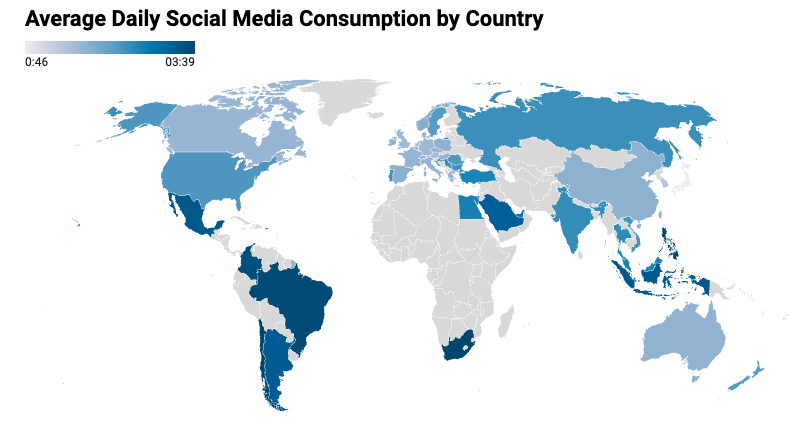
Figure 1: Daily social media consumption per country. From Chile’s 3h39m to Japan’s 0h 46m. United States (2h 09m), United Kingdom (1h 37m), Germany (1h 41m). Layer on top TV, streaming, gaming, and other screen time and you get to incredibly high hours per day on screen. Source: Comparitech.
I don’t want to state the obvious, but a large share of that is passive, algorithm-driven consumption and scrolling. It’s not work, connection, or rest; just scrolling. It’s not only keeping you from healthier habits, but it’s actively damaging your health.
In contrast, the evidence-based routine that moves the needle most for long-term health requires something like three to four hours a week of structured exercise (we’ll break it down further in the next section). This is about half of a single day’s average screen time. We’re talking about reducing 10% or so of the average weekly screen time and allocating it to exercise instead.
Again, the inputs are about $500 per year plus three to four hours a week. The output can be in the order of $250,000-$500,000 in additional funded years (for a $50,000 retirement budget), plus higher-quality years while you’re most active, and a shorter decline at the end.
That’s got to be one of the best ROI in personal finance. Measured against the roughly $7,500 you’d actually spend over fifteen years of consistency, that’s a return on the order of 30-60 times your money. You just get paid in extra years, not extra cash, which is probably why so few people run the numbers.
The Minimum Viable Health Routine: Less Than 4 Hours a Week
This article isn’t a how-to guide; please see our health and longevity pillar, which covers the science in depth, or my WHOOP article, which walks through how I’m tracking a proxy of my biological age.
But briefly, the evidence-backed minimum is simple. Of course, there could be a lot more to add, but here is the 80/20 for those wondering where to start:
Cardio: Aim to build towards two zone 2 cardio sessions per week at a conversational pace (say, 45 minutes each), plus one harder session that includes 15-20 minutes of zone 4-5.
Resistance training: aim towards a minimum of twice a week, around thirty minutes, covering the major muscle groups (I use dumbbells and barbells at home and follow different YouTube guides).
Sleep: seven and a half to eight hours of sleep for most on a consistent schedule. Consistent bedtime and wake time are very important, and usually overlooked.
Diet: lean on whole foods, diverse plants, and adequate protein while minimizing ultra-processed food. Avoid too much sugar or salt.
In my own WHOOP data, sleep consistency and cardiovascular fitness appear to be the biggest contributors to that gap. The broader research does point in the same direction on fitness: cardiorespiratory fitness (VO2max) is one of the strongest modifiable predictors of all-cause mortality we know of.
Strength training carries its own independent benefit: a meta-analysis of sixteen studies found muscle-strengthening activity associated with a 10–17% lower risk of all-cause mortality, cardiovascular disease (CVD), total cancer, diabetes, and lung cancer, with most of the gain reached at just 30–60 minutes a week.
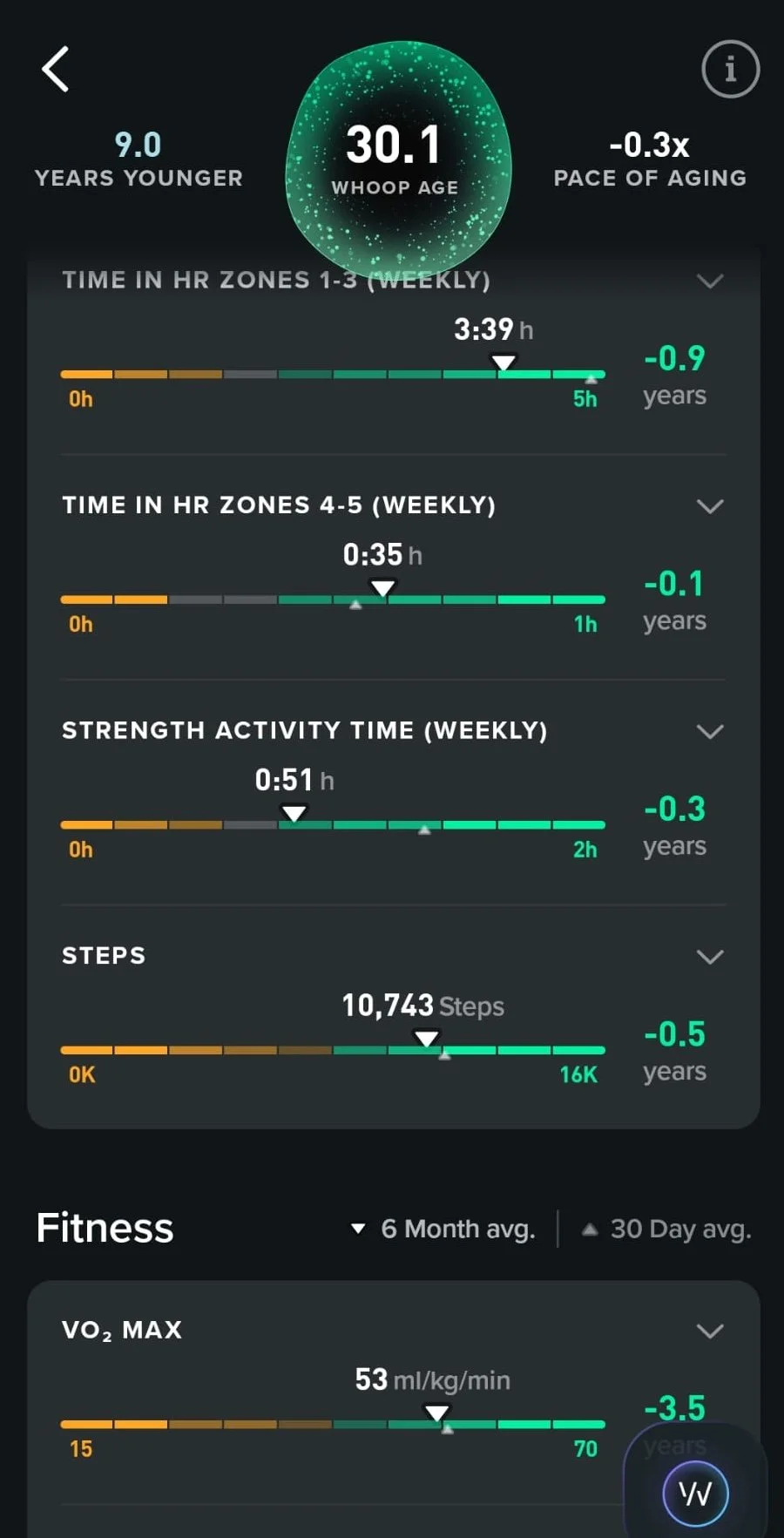
Figure 2: My own WHOOP data, showing a biological age of about 30 against a chronological age of 39.
Same Portfolio, Same Age — Completely Different Retirements
Here’s another way to think about it. People tend to imagine retirement as a single block: reach FI, then enjoy X years of freedom. The reality is closer to a curve—which resembles the retirement spending smile—with three distinct phases: the active, higher-spending “Go-Go” years; a gradual “Slow-Go” slowing down; and a “No-Go” stretch of limited mobility and higher healthcare costs.
How you invest in your health early on largely determines the shape and length of that curve. Two people with the same portfolio and the same age—say, retired early at 55—can have very different retirement experiences (Figure 3 below).
One sprinted to FI and arrived depleted, with a biological age of 65: their active “Go-Go” phase is very short, entering the “Slow-Go” years soon. In contrast, the same 55-year-old retiring with the health of a 45-year-old might get to experience two full decades of “Go-Go” years, followed by a soft gradual decline into the “Slow-Go” years, and with a final decline compressed into a few years at the end.
The second one not only gets more years to enjoy—a higher life expectancy—but also gets many more capable years—a larger healthspan—which enables them to spend the portfolio on experiences rather than care.
That’s the two-sided retirement in a nutshell: pursuingFI gives you freedom, but health decides what you can do with it.
Figure 3: How health shapes retirement (illustrative). Both people retire at 55 with the same portfolio, but at very different biological ages (45, green; 65 red). The vertical axis represents physical capability—the ability to be active, travel, live independently—as a percentage of where each stood at retirement. The health-invested retiree (green, biological age ~45) stays in the active "Go-Go" phase into their mid-70s, slows gradually, and fades in a short, steep final decline (compressed morbidity), dying around 95. The depleted retiree (red, biological age ~65) begins already diminished, gets a much shorter active “Go-Go” and “Slow-Go” phases, then slides into a prolonged morbidity tail—a long stretch of low-capability final decline—dying around 82. This illustration represents how the same portfolio and retirement date can lead to two wildly different retirements.
Genetics Loads the Gun. Lifestyle Pulls the Trigger
At this point some people will object, stating that genetics matter: “my uncle smoked and lived to 90, while my aunt exercised and died at 82.” Sure, genetics do play a role, and you can’t choose your parents. But the research on longevity suggests that for most people, lifestyle is the dominant driver rather than the exception.
The difference between a 50-year-old whose body functions like that of a 38-year-old and one whose body functions like that of a 62-year-old isn’t normally due to genetics, but to decades of different habits.
But the better framing to keep in mind is probabilistic, not deterministic: you can’t guarantee a long healthy life, but you can certainly shift the odds very meaningfully in your favor, and the cost of doing so is very small next to what’s at stake.
Your Portfolio Funds Your Life. Your Health Decides Whether You Can Live
The FI space is very good at optimizing the front end: savings rates, withdrawal rates, tax treatment, and portfolio construction. But we rarely apply that analytical rigor to the question of how we’ll experience our post-FI life: how many healthy and capable years we’ll actually have to enjoy what we worked so hard to build.
When you run the numbers, the gap is striking. For a few hundred dollars a year and a modest reallocation of time—time most of us currently give to screens—you can unlock hundreds of thousands of dollars in additional funded healthy years. The constraint is not really money; it’s the willingness to treat your health with the same intentionality you bring to your financial journey.
Your portfolio funds your life, but ultimately it’s your health that decides to what extent you’re able to live it, and for how long. I’ve spent years optimizing the first; I’m increasingly convinced the second is the higher-return bet.
If you enjoyed this article, here are some next steps:
👉 More on healthspan and longevity: Health & Longevity: The Other Half of Your FIRE Plan
👉 My personal health routine and WHOOP numbers: I'm 39, But My Biological Age Is 32
👉 Use our free FI Calculatorto model your retirement timeline (email unlock)
👉 For the basics on how to reach Financial Independence: What Is Financial Independence?
👉 Subscribe for monthly insights—one-click unsubscribe
👉 Browse through all our articles
🌿 Thanks for reading The Good Life Journey. I share weekly insights on personal finance, financial independence (FIRE), and long-term investing — with work, health, and philosophy explored through the FI lens.
Disclaimer: I am not a financial adviser, and this content is for informational and educational purposes only. Please consult a qualified financial adviser for personalized advice tailored to your situation.
Check out other recent articles




























About the author:
Written by David, a former academic scientist with a PhD and over a decade of experience in data analysis, modeling, and market-based financial systems, including work related to carbon markets. I apply a research-driven, evidence-based approach to personal finance and FIRE, focusing on long-term investing, retirement planning, and financial decision-making under uncertainty.
This site documents my own journey toward financial independence, with related topics like work, health, and philosophy explored through a financial independence lens, as they influence saving, investing, and retirement planning decisions.
Frequently Asked Questions (FAQs)
-
In pure return terms, often yes. For roughly $500 a year and a few hours a week, extending your healthspan by five to ten years can unlock $250,000–$500,000 in additional funded, active retirement years (considering a $50,000 annual budget), a return on the order of 30–60x your money. No portfolio reliably produces that. The catch is that the payout arrives in healthy years rather than dollars, which is why so few people run the numbers.
-
Lifespan is how long you live; healthspan is how long you stay healthy, active, and independent. You can extend lifespan without extending healthspan; living longer but spending the extra years in decline. The goal is to extend healthspan too, so that more of your retirement years are ones you can actually enjoy.
-
Surprisingly little. The direct financial cost can be as low as $500 a year: running shoes, some basic home weights, and slightly better groceries (a wearable is optional). The real cost is time: about three to four hours a week of structured exercise, which for most people can come from reallocating screen time rather than working less.
-
Compressed morbidity means staying active and healthy for as long as possible, then declining quickly at the very end, rather than enduring a long, slow deterioration over many years. It’s the pattern seen in many of the world’s longest-lived populations. The aim isn’t just to reach a high age, but to remain vigorous through your 70s and 80s and compress the period of decline into a short window.
-
Research suggests lifestyle is the dominant driver of biological age for most people. Your body’s functional age can diverge from your chronological age by a decade or more in either direction, depending largely on habits like exercise, sleep, and diet. This isn’t a guarantee—genetics play a role—but you can shift the odds meaningfully in your favor.
-
No. You can improve your health and fitness at almost any age, and it’s absolutely worth doing. But some conditions—like declining bone density, cardiovascular disease, and metabolic dysfunction—develop over decades, and by the time you address them, some damage may already be set. As with investing, the returns are highest when you start early, but starting late still beats not starting.
-
Less than most people assume. The evidence-backed minimum is roughly three to four hours a week: two zone 2 cardio sessions (conversational pace), one harder session with high intensity, and two short resistance-training sessions of about 30 minutes. A meta-analysis found most of the mortality benefit from strength training is reached at just 30–60 minutes a week.
-
They’re the three phases of retirement. The "Go-Go" years are active and higher-spending, full of travel and experiences; "Slow-Go" is a gradual slowing down; and "No-Go" involves limited mobility and higher healthcare costs. Investing in your health lengthens the Go-Go phase and compresses the No-Go phase, meaning more years spending your money on experiences rather than care.
-
FIRE culture is built around optimizing the path to financial independence—savings rates, withdrawal rates, portfolio construction—and it applies real rigor to the accumulation phase. But it rarely applies that same analytical lens to what happens after you reach FI: how many healthy, capable years you’ll actually have to enjoy the freedom. Health is the other half of the equation, and it usually gets far less attention.
Join readers from more than 100 countries, subscribe below!
Didn't Find What You Were After? Try Searching Here For Other Topics Or Articles: