What I’m Teaching My Kids About Money

Children absorb most of their money habits from watching their parents. Everyday moments teach far more than any formal lesson. Photo by Gustavo Fring on Pexels.
Reading time: 7 minutes
Quick answer:
Children absorb their core money attitudes remarkably early. According to research, the mental foundations are largely in place by around age seven, and mostly from observing the adults around them, not from any type of formal learning. So the highest-leverage move a parent can do is model a healthy relationship with money and let kids experience it directly. With three children under six, that’s what we’re trying to do.
We’re trying to implement simple approaches that teach about delayed gratification, entrepreneurship, or the importance of investing, while avoiding two traps I worry about most: developing a scarcity mindset that sees spending as morally wrong (the anxious extreme of frugality), or a passive mindset that treats money as something that just takes care of itself rather than a tool you need to actively learn to use.
The goal is to give them the vocabulary, habits, and tools early on, so that money becomes something they eventually command rather than something they fear or ignore, so they can grow up with the freedom to design the life they want.
What You'll Get From This Article
✔ Why the window of money scripts closes earlier than most parents realize
✔ How we’re using German flea market culture, a €2 weekly “allowance,” and a custodial brokerage account to teach about investing, entrepreneurship, and responsible stewardship of resources
✔ What the research says on delayed gratification and how kids pick up money habits
✔ How to balance frugality with abundance, and FI awareness with freedom to choose other paths
✔ Open questions I haven’t solved yet
TL;DR — Money Lessons for Young Kids 💶
🧠 Kids form money habits by age 7, including important emotional scripts they carry on in adulthood
🍬 Delayed gratification predicts more than money skills; it’s rooted in trust and self-control
💪 “Little jobs” for €2/week teach kids to connect effort to reward
🏪 German flea market culture teaches early entrepreneurship, frugality, and environmental awareness
📈 A custodial brokerage with small contributions teaches compound growth through lived experience
⚖️ Core tensions: responsibility without scarcity, Financial Independence awareness without pressure
🎭 Entrepreneurship and unconventional paths should be on the table from the start
❓ The hardest part for parents is managing our own money scripts that we prefer not to pass on
How Kids Learn About Money
The Window Is Smaller Than You’d Expect
There’s a finding in research on how children learn about money that has recently changed how I think about parenting: many of the mental foundations children rely on for money—self-control, planning, and the ability to delay gratification—are largely in place by around age seven. Many of these foundations underpin the habits they’ll carry around with them for decades to come. No pressure.
We’re not referring here to budgeting habits or learning about compound interest, but gut-level associations related to money. Does spending feel neutral, good, or guilty? What feeling does saving produce? Is money discussed openly, or avoided?
These early feelings—absorbed by watching the adults around them—are the seeds of what we call “money scripts”: the underlying beliefs about money that end up shaping behavior for decades. It’s possible yet very challenging to change those inherited scripts later on, because most people aren’t even aware they exist.
By age 7, children have picked up many of their scripts mostly from observation: who handles money at home, whether it causes tension, what signals success, or what feels taboo. None of these are conscious beliefs, but are nevertheless the foundation on which financial decisions are layered on later on.
I’ve been thinking about this for a while: why did I end up having so much interest in finance-related topics? It was certainly not my main career, yet here I am, creating a whole platform around financial education. A large part of it, I suspect, has to do with what was transmitted to me by my grandfather, who not only set up a custodial account for me when I was young, but also passed on some of his frugal habits.
Watching my single stock grow as a kid—and watching him get genuinely excited about it—is almost certainly where one of my money scripts took root: “saving and investing are important for your future.”
It certainly wasn’t the money itself: mid-five-figures by my early twenties was amazing at the time, but certainly not life-changing. What was life changing was the lesson embedded in watching that single stock grow: patience, consistency, and the proof that small steps add up to something meaningful.
It wasn’t just about setting up a custodial account. My grandfather probably didn’t need to, but we’d cut out newspaper coupons together, and after organizing them excitedly in his alphabetically ordered coupon folder, we’d head out to the grocery store for what seemed to me at the time to be a full-blown treasure hunt.
It was fun frugality and probably an early lesson on not being wasteful (“money is a resource to steward responsibly”). For every item on our shopping list, my grandfather would check his folder for a coupon, and if he had one, the hunt was on to find that product in the store.
I want something that feels similar for my kids. The kind of fun, hands-on learning that comes from doing something rather than being lectured, where hopefully lessons about patience, saving, and not being wasteful are absorbed and carried on. That’s the aspiration anyway; we’re still learning little by little on how we can get there.

The famous marshmallow test was understood for a long time as a story about willpower. But the more useful lesson for parents is actually about trust: children learn to wait when they’ve seen that the second marshmallow reliably arrives. Photo by Leon Contreras on Unsplash.
What the Marshmallow Test really Teaches parents
I couldn’t write an article on this topic without briefly referencing the famous marshmallow test. To recap, a Stanford team offered children the option of having one marshmallow now, or two if they could wait fifteen minutes. The children who waited later did better on a range of life outcomes, and the popular takeaway was that willpower is a fixed trait; some kids have it, some don’t.
But more recent research tells a more nuanced story that is, thankfully, more useful to parents. Researchers found that a child’s willingness to wait depended heavily on whether they trusted the environment: children from less stable backgrounds often eat the marshmallow not because they lack self-control, but because experience has taught them that promised rewards don’t always arrive. The script they’ve rationally learned is “a bird—or marshmallow—in the hand is worth two in the bush.”
So, building delayed gratification isn’t about training willpower little by little, but about building an environment where effort is connected to direct and visible outcomes, and where promises are always kept. We need to make sure that second marshmallow really does show up.
We’re experimenting with a “little jobs” system for our 5.5-year-old built around this. He excitedly agreed to small consistent tasks like setting the table, helping tidy, getting his siblings’ toothbrushes ready before bedtime, and many other small tasks. Almost always, he performs them with a very positive demeanour; he clearly likes to be involved in our household routines and have his own set of tasks just like his parents do.
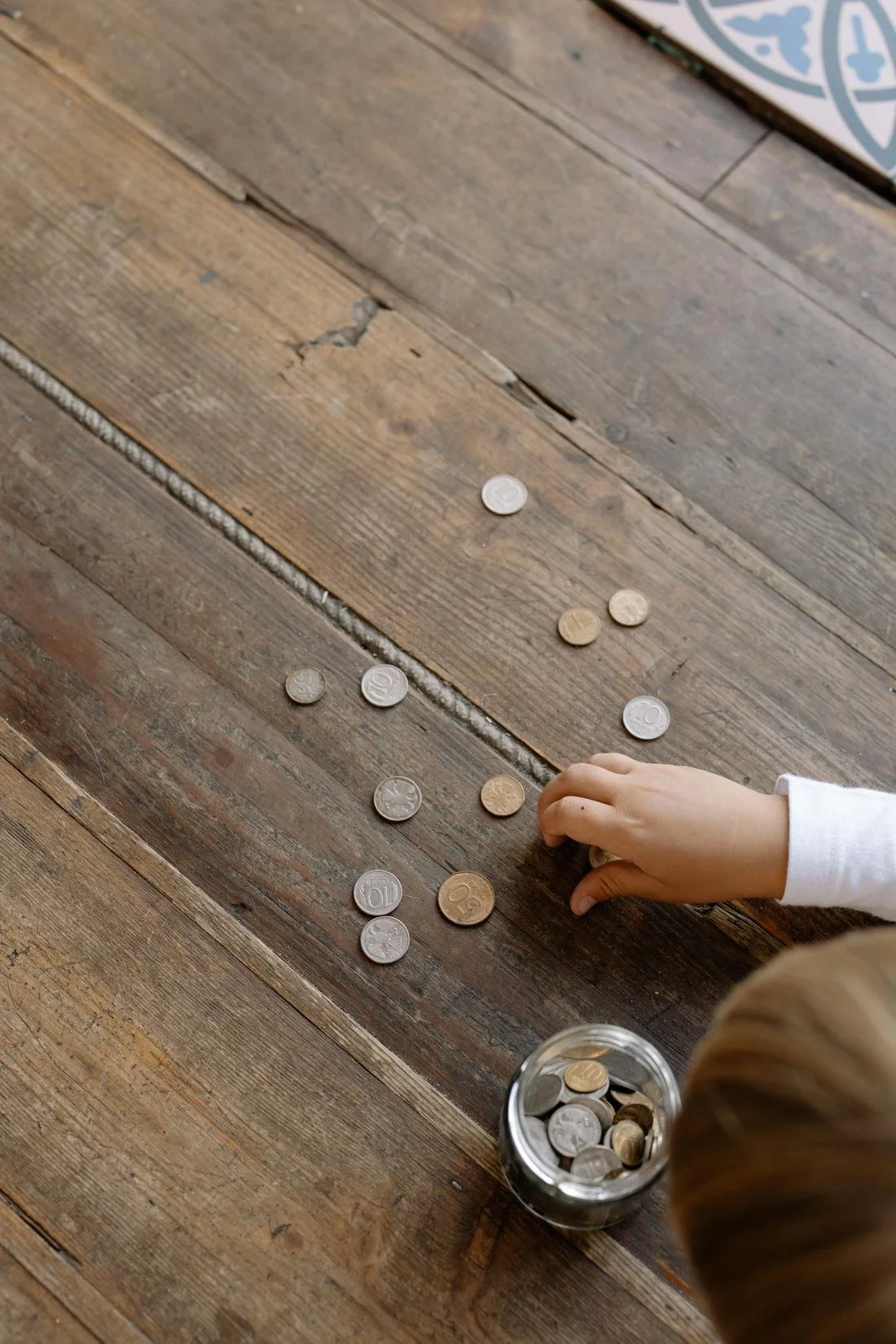
He gets €2 on Sunday, delivered reliably. The amount, of course, is arbitrary. He still doesn’t care whether it’s 50 cents or €20; he just enjoys the action of receiving it and collecting it in his little piggy bank. What matters is the pattern, the narrative that effort is rewarded, and learning by doing, not by us telling him something abstract. In this initial stage, we’re just encouraging him to save—he’s very proud of his growing pile—but eventually we’ll include a spending part to the exercise too.
We’re also helping them build that delayed-gratification muscle in a non-financial setting. We have a little garden allotment where the kids play but also help us plant, water, and wait. Seeing that consistent effort pay off over weeks and months is, hopefully, the same lesson as the piggy bank, but with delayed gratification you can taste.
Two More Ways We’re Teaching Our Kids About Money
Beyond the weekly “little jobs” we just covered, there are two other things we’re deliberately doing to build these habits early.
A custodial investment account
As mentioned, we opened small brokerage accounts through our German bank in the kids’ names (a “Junior-Depot”). It’s basically a custodial investment account, which is funded with very modest monthly contributions from us and family.
Again, the goal isn’t to produce some trust fund, but that, by the time they are ten or twelve, they’ll have watched a real portfolio grow (and wobble) over the years with their own eyes. They’ll hopefully understand how small, regular contributions do add up over time, and perhaps start to ask deeper questions about finance.
Building curiosity around finances—like any topic, really—is the best way to encourage learning. We recently covered how the German government is setting up a children’s scheme (“Frühstart-Rente”) to contribute to their automatically-created brokerages from age 6 to 18.
Our custodial accounts mirror what my grandfather did for me. The money I could access at eighteen was nice, but the real inheritance and lesson was understanding how wealth builds through patience and consistency. I want my kids to have that same embedded lesson early on, even if the amounts are tiny.
The Flea Market: Entrepreneurship, Frugality, and Gratitude.
Second-hand flea markets are culturally normal in Germany across most social classes. My wife loves them, and we bring the kids along now and then to help: they set up the stall, handle the coins, and hand over the clothes and toys they’ve grown out of to a new family.
The lesson for them here isn’t that we need the few extra cash; it’s certainly not a meaningful amount of money. The script we’re trying to create here is that resources are meant to be looked after and even passed on if possible, not wasted. And it’s a relatively easy lesson to learn when it’s something you no longer need.
But it’s also an early form of entrepreneurship: identifying value, pricing, selling, doing simple math with the money, or talking to adult customers. There are other older children selling pancakes or home-grown tomato plants nearby, and, honestly, the can-do attitude of these children is impressive.
Finally, it’s also a lesson in gratitude. These clothes and toys served us well. Rather than letting them pile up or throwing them out, we’re happy to pass them on to another family that could use them. This feels like frugality done right; closer to responsible stewardship of resources than penny-pinching.
For our five-year-old, it’s just a fun morning out. But hopefully two money scripts are forming: first, that you can create value, not just consume it; and, second, that resources, whether money or things, are meant to be used responsibly.

This is what money is for. The goal isn’t to pile it up, but to buy the freedom to spend time on what matters. Photo by Josh Willink on Pexels.
The Core Tension: Responsibility Without Scarcity
I’ve hinted earlier that I want to avoid my kids inheriting any extreme money scripts. I’m a natural saver who writes about frugality, so I probably have taken it too far sometimes; as with other themes on the blog—like the speed of reaching Financial Independence—I’ve tried to moderate myself over time.
I think frugality is important, but I don’t want to pass on a scarcity script either: the idea that spending is inherently wasteful, that enjoyment should always be deferred, or that money is mainly for protection rather than simply a tool for living.
Either way, I’m a natural saver, while my wife is looser with spending, so my hope is that seeing both approaches is healthy for them to experience.
Of course, money isn’t good or bad in itself. It’s just a tool, and every time you spend it you’re making a tradeoff about what matters. The ultimate skill isn’t about maximizing how much money you accumulate, but working out what actually matters to you and using your money accordingly.
I’m trying to instill the idea of tradeoffs early on, even with our five-year-old. When I say no to a toy or experience, the argument isn’t that “we can’t afford it,” but that “we’re choosing to save for our 1-month holiday” instead. The simple tradeoff we’d like them to understand is that we choose a less spendy lifestyle precisely so we can work part time, go on longer holidays, and spend more time with them. Each choice we make in life has a cost, and the cost isn’t always money, but time.
Eventually, I’d like them to be aware of the concept of Financial Independence; that starting early, and saving steadily, you can buy substantial freedom without extreme sacrifice. But at the same time I don’t want to push them into it.
I’ve seen too many people in the FIRE community pushing themselves too hard because they hate their jobs. Well, since they’ll be exposed to the FI concept very early, I’d advocate for a middle ground, where they’re still easily on track for FI, while avoiding non-rewarding careers entirely. The hope is that—if that is their wish—they also have the freedom to choose less conventional paths like sport, the arts, music, building something, or a cause they care about, without money being a deciding factor.
The money script I grew up believing was that the safe route in life was a steady job at a “prestigious” company. Entrepreneurship wasn’t even on my radar until my late thirties; ideally I’d expose them to that possibility much sooner.
The balance I’m after, I guess, is this: raising kids who take money seriously without being afraid of it. Who can save, delay, and steward it, but who also know that money is only worth anything when it’s spent on building a life that truly matters to them.
Teaching Kids About Money: What I’m Still Figuring Out
All my kids are under six, so most of this is an ongoing experiment, certainly not a finished plan (please submit your ideas in the comments!). Like most parents, I’m also new to parenting. Before wrapping up, here are some things I’m still working through or thinking about.
First, there’s the digital question. As mentioned, right now our lessons lean on physical money, because a five-year-old needs to see money to understand it. But at some point, the piggy bank becomes something digital, and I haven’t planned out what that transition looks like yet. If you’re aware of good tools or games for older kids that help bridge it, please let me know.
Second, there’s also a bias I’m watching for in myself. Research suggests parents tend to talk to boys about investing and entrepreneurship differently than they do with girls. We’re trying to avoid this with our daughter.
Third, our unravelling AI world worries me. I’m guessing most parents think about this often. The world around us is changing so fast that it feels uncertain to be a parent nowadays: how can we help our kids when we have no clue what the world will look like 10 years from now? (I’m holding back here; I think this deserves its own post).
So no, I haven’t figured everything out. Not the digital transition, and certainly not the more important AI question. Hopefully that’s alright. I keep coming back to my grandfather, and realizing he didn’t have any master plan either; he simply led by example, spent time with me, and let me indirectly learn about money, patience, and consistency. And it stuck. I hope to do the same, and let’s see how things turn out.
💬 What’s one money lesson from your own childhood that stuck with you—good or bad? I’d love to hear what shaped your money habits and behaviors today. Please share with us in the comments below.
If you enjoyed this article, here are some next steps:
👉 For more on money scripts: The Childhood Beliefs Still Running Your Finances
👉 Model what Financial Independence looks like starting at 18: FI Calculator (email unlock)
👉 Subscribe for weekly insights—one-click unsubscribe
👉 Check out all our articles for more
👉 Browse 150+ articles at The Good Life Journey
🌿 Thanks for reading The Good Life Journey. I share weekly insights on personal finance, financial independence (FIRE), and long-term investing — with work, health, and philosophy explored through the FI lens.
Disclaimer: I am not a financial or legal adviser, and this content is for informational and educational purposes only. Please consult a qualified financial adviser for personalized advice tailored to your situation.
Check out other recent articles



























About the author:
Written by David, a former academic scientist with a PhD and over a decade of experience in data analysis, modeling, and market-based financial systems, including work related to carbon markets. I apply a research-driven, evidence-based approach to personal finance and FIRE, focusing on long-term investing, retirement planning, and financial decision-making under uncertainty.
This site documents my own journey toward financial independence, with related topics like work, health, and philosophy explored through a financial independence lens, as they influence saving, investing, and retirement planning decisions.
Frequently Asked Questions (FAQs)
-
Earlier than most parents expect. A University of Cambridge study found the mental foundations for money habits — self-control, planning, delaying gratification — are largely in place by around age seven, mostly absorbed from observation rather than formal lessons. That’s why modeling matters more than teaching at this stage.
-
It’s debated. Paying for everyday household tasks can teach transactional thinking (“I only help if I'm paid”), while never connecting effort to reward misses a lesson too. Our middle ground: basic family participation isn’t paid, but extra “little jobs” earn a small, consistent weekly amount.
-
At age five or six the exact amount barely matters — a child doesn’t distinguish 50 cents from $10. What matters is consistency and the pattern that effort reliably leads to reward. We give $2 every Sunday, delivered without fail.
-
Through direct experience, not lectures. Let them handle real coins, earn small amounts, watch something they own grow, and see you make thoughtful money choices out loud. Young children learn financial habits far more from doing and observing than from being told.
-
To a point. Most young children can grasp saving toward something concrete, especially when it’s made tangible — a growing pile in a piggy bank, a savings chart. Understanding abstract concepts like interest comes later; the early win is simply building the “waiting pays off” habit.
-
It can be a powerful teaching tool — watching a real portfolio grow (and wobble) over years builds intuition about patience and compounding. But the account itself is optional; the free version is letting kids watch and ask questions about money decisions. The lesson is in the watching, not the amount.
-
The famous experiment was long read as “willpower is fixed.” Newer research shows the ability to wait depends heavily on trust — children wait when they've learned that promised rewards actually arrive. So the parental job isn’t drilling willpower; it’s building an environment where effort reliably connects to outcome.
-
It’s a real challenge, because children lose the concrete sense of money when they can’t see it change hands. Leaning on physical money early — coins, a piggy bank, cash at a market — helps build that intuition before transactions become digital and abstract.
-
Awareness is the first step. Children absorb your emotional reactions to money whether you intend it or not, so naming your own scripts out loud — and showing that beliefs about money can change — matters more than any system. The hardest part of this is usually the parent, not the child.
-
Aim for responsibility without scarcity: teach saving and stewardship, but frame money as a tool for building a good life, not something to fear or hoard. Talking about tradeoffs (“we’re choosing to save for our holiday”) teaches intentional spending without guilt.
Join readers from more than 100 countries, subscribe below!
Didn't Find What You Were After? Try Searching Here For Other Topics Or Articles: