
San Sebastian, Spain. Spain ranked as one of our top early retirement destinations in Europe. Photo by ultrash ricco on Unsplash.
Reading time: 7 minutes
Taxes to Weigh When Retiring Abroad: Beyond Headline Capital Gains
Today we break down exactly how taxes work once you start withdrawing from your FIRE portfolio abroad. You’ll see how to estimate the taxable gain inside a withdrawal, compare real-world effective tax rates (with examples from Spain and Portugal), and understand other levies—wealth, inheritance, and exit taxes—that often matter far more than headline capital-gains rates.
How Capital Gains Taxes Really Apply to FIRE Withdrawals
Many aspiring retirees wishing to retire abroad get spooked by capital gains tax (CGT) headlines in some countries. There are normally two issues underlying these concerns. First, many individuals pursuing FIRE (Financial Independence, Retire Early), especially early on, imagine that each dollar withdrawn from their portfolio will be taxed at the headline CGT rate. If 30% of your withdrawal were to be taxed, of course it would be scary. But this is generally not the case.
In reality, CGT rates apply only to the gain component of your portfolio, i.e., the growth in the portfolio’s value beyond your periodic contributions. So, your effective tax rate is always a fraction of that headline number. Even where statutory rates hover around 25–30%, once you factor in the proportion of withdrawals that represent your own contributions, the real bite—as we’ll see in today’s article—is normally much lower.
Many countries further soften the impact of CGT with allowances or exemptions. Understanding all these details often reveals that the actual CGT bill can be relatively modest. Unfortunately, newcomers to FIRE tend to focus only on headline rates and assume it applies to the entire withdrawal. This is an error that can lead to unnecessary anxiety, overly large target retirement portfolios, or poor relocation decisions.
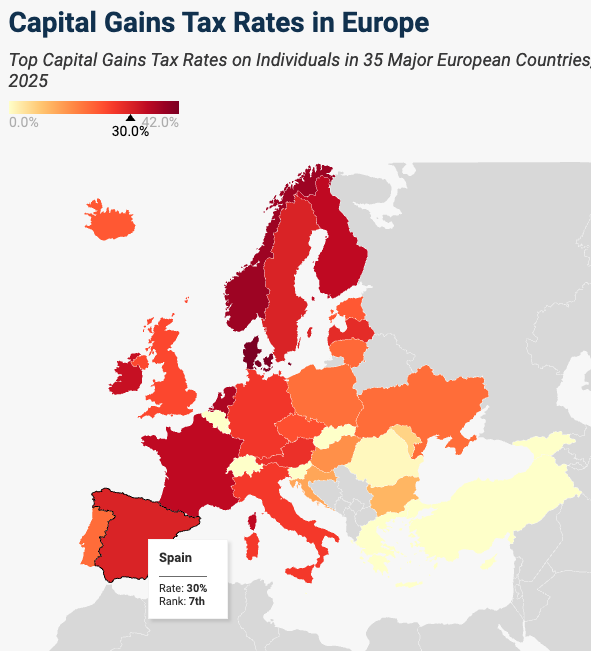
Headline capital gains tax rates in Europe. Source: Tax Foundation (2025)
Secondly, by focusing too narrowly on CGT there is the risk of forgetting other types of taxes, some of which can actually be substantially more damaging to your portfolio than CGT. As we’ll cover further below, it’s important to assess holistically a country’s tax regime, including CGT, but also potential wealth taxes, exit taxes, and inheritance taxes. Some of these can vastly outweigh the impact of CGT.
It’s also important to recognize how dynamic tax law can be. Take Portugal’s once-famous Non-Habitual Resident (NHR) regime, which offered ten years of near-zero tax on many foreign income streams; those rules have already been tightened. The Netherlands is another recent example: its Box 3 reform could potentially redesign how investment returns are taxed in ways that could meaningfully delay FIRE timelines for investors there.
The bottom line is that a country attractive today may not look the same in ten or fifteen years, so any plan should include flexibility and periodic review. Regularly checking tax treaties and residency rules helps you stay compliant and avoid double taxation.
Finally, it’s also worth mentioning that context matters. Cost of living (COL) usually has a larger effect on a FIRE portfolio than marginal differences in CGT. If you retire to a low-COL region, your required portfolio size, and therefore your withdrawal amount, is smaller, reducing the years of required saving.
Taxes matter, but cost of living and lifestyle tend to be the larger levers for FIRE. For a full framework on how these factors interact when choosing where to retire abroad—including costs, safety, healthcare, climate, and global destination rankings—see our comprehensive guide to retiring abroad through geographic arbitrage.

Odeceixe Mar Beach, Portugal. Portugal ranked as the best location in Europe for early retirement. Photo by Joao on Unsplash.
Beyond Capital Gains: Wealth, Inheritance, and Exit Taxes
Choosing a retirement destination purely for its capital gains tax (CGT) rate can be shortsighted. In a previous article, we saw how retiring to Denmark (the country with the highest CGT headline of Europe) could still make sense when considering the low property prices found in some beautiful seaside regions.
Indeed, lifestyle factors—cultural fit, language, climate, community, landscape, and others—are what ultimately determine your quality of life and day-to-day happiness. Healthcare deserves attention too, though with a FIRE portfolio most can usually budget for private insurance abroad or select countries with public access for its residents. In practice, the combination of lifestyle satisfaction and cost of living will influence your financial stability far more than a five-point difference in CGT.
When it comes to taxes we should assess the total tax burden and how it affects us individually. As mentioned, wealth taxes, exit taxes, and inheritance/estate taxes can outweigh the impact of CGT. For instance, Spain’s wealth tax can significantly dent large portfolios; despite a €700,000 exemption and a further €300,000 primary residence exemption, multi-million portfolios can face a high five-figure annual tax bill.
For instance, a €4M portfolio in Valencia could pay roughly €30k in taxes before even accounting for taxes on any withdrawal, regardless of the portfolio’s market performance.
Or take France: it levies an exit tax on unrealized gains, so a multimillion-euro portfolio could trigger a six-figure bill when you leave, especially if you move to a country without a favourable tax treaty. Moreover, some countries levy hefty inheritance taxes that may disrupt your plans to pass assets to heirs (or to inherit yourself), while in others there is no tax. It’s also important to check whether your home country and your prospective new country have a double-tax treaty, as these agreements can prevent you from being taxed twice on the same income or gains.
Countries also vary in how they tax investment vehicles. Some even offer a step-up in basis—resetting the taxable value of assets when you become a resident or at death—which can dramatically reduce future capital-gains exposure. Other countries diverge in how they tax specific products: for example, Denmark taxes accumulating ETFs very differently from distributing ETFs, a quirk that doesn’t apply in most other European countries
When you consider taxes, CGT is only one piece of a very large puzzle. Also, consider that tax regimes evolve, so it’s risky to base a lifelong plan on today’s rules. Instead, monitor changes every few years and be ready to adapt to new realities. A country that is currently attractive for retirement might change dramatically in the future. Being willing to relocate can be a powerful hedge against policy risk.

Phi Phi Islands, Thailand. Thailand ranked as one of our top budget-friendly retirement destinations of Asia. Photo by Evan Krause on Unsplash.
Estimating Your Taxable Gains to Find Your Effective CGT Rate
To understand our real exposure to CGT, we should start out by estimating the portion of our portfolio that represents gains rather than contributions. You can build a simple excel sheet, enter periodic yearly contributions and assume a rough 7% real return from your investments. Then you can see on a yearly basis how the share of your contributions and portfolio gains changes over time relative to the total portfolio size.
Below we show a simple example, considering a €2,000 monthly investment over time. Notice though that the absolute amount doesn’t really matter here. As long as the contributions are constant you can consider roughly these shares of gain vs contributions for tax purposes.
Table 1: Breakdown of share of portfolio gains vs contributions over time.
| Year | Total Contributions (€) | Portfolio Value (€) | Unrealized Gains (€) | Gains as % of Portfolio |
|---|---|---|---|---|
| 10 | 240,000 | 342,103 | 102,103 | 29.8 % |
| 15 | 360,000 | 621,879 | 261,879 | 42.1 % |
| 20 | 480,000 | 1,015,091 | 535,091 | 52.7 % |
| 25 | 600,000 | 1,564,471 | 964,471 | 61.7 % |
| 30 | 720,000 | 2,338,905 | 1,618,905 | 69.2 % |
The key takeaway here is that the more time passes—because of compounding—the larger the share of unrealized gains are relative to the total portfolio. After 10 years, portfolio gains represent roughly 30%, but after 30 years they represent nearly 70%.
To estimate taxes, let’s assume a moderate FIRE timeline, say 20 years, and use the 52.7% as a rough estimate of the share of gains from the portfolio. Let’s consider a €1.5M portfolio and an annual €60k withdrawal to cover living expenses. What would the tax bill roughly look like in Spain versus Portugal?
In Table 2 below we find Spain’s CGT brackets. For a €60k withdrawal, only the gain share (€31,620) would be taxed (52.7% of the withdrawal). Applying the different brackets to this amount, our total tax bill would be €6,520—a 11% effective tax rate on the withdrawal. Applying Portugal’s flat 28% CGT to the same amount would give us a tax bill of €8,850 tax, almost a 15% effective tax rate.
Table 2: Capital Gains Tax brackets for Spain
| Taxable savings income (annual gains + interest + dividends) | Rate |
|---|---|
| up to €6,000 | 19% |
| €6,000 – €50,000 | 21% |
| €50,000 – €200,000 | 23% |
| €200,000 – €300,000 | 27% |
| above €300,000 | 28% |
As observed, the effective tax rate is far lower than the scary headline CGT: 11% and 15% in Spain and Portugal (in this example), respectively, versus 28% headline CGT in both countries. In practice, the impact of these CGT differences between these two countries are negligible; inputting these effective tax rates in FIRE calculators changes the FI timeline by a few months.
The bottom line is that CGT is not a good metric to assess a retirement location’s suitability. A country with twice the effective tax rate as Spain may delay your retirement timeline by a year or so. As mentioned, the cost of living or other non-financial variables should play a much larger role in deciding what country to retire to.
Is Spain therefore a better place to retire to than Portugal? From a financial perspective… not really, and this is the second point I wanted to make.
If you look only at CGT, Spain seems the better choice tax-wise. But Portugal has no wealth tax, no inheritance tax (for close family), and no exit tax. Spain has all three, and while they’ll impact each individual differently depending on many factors, it’s safe to say that Portugal is still more tax-friendly for the vast majority of FIRE retirees.
Again, the lesson is that while headline CGT rates get all the attention, they are rarely what makes or breaks a FIRE plan. For most investors the effective CGT bite is much lower once you account for the fact that only gains are taxed. But if your net worth climbs into the multiple-million range or you plan to change countries later in life, wealth taxes and exit taxes can dwarf the annual capital-gains bill.

For strong FIRE budgets or those who want to escape the heat of southern Europe, Denmark may be a very nice place to retire. Photo by Marc Najera on Unsplash.
Beyond Taxes: Cost of Living, Healthcare, and Lifestyle Factors
While taxes can influence your retirement planning, they are only one piece of the puzzle. Visa and residency rules determine whether you can actually settle in a country long term. Health-care access and quality will also matter far more to your day-today wellbeing than a few percentage points of CGT.
Climate, language, cultural fit, political stability and even the ease of building a social network all shape how happy you’ll be once you arrive, whether you’re weighing Mediterranean options or the calmer balance offered by the Nordic countries.
Cost of living is especially critical. It determines how large your portfolio needs to be and how long it will take to reach Financial Independence. Shaving 30% off your annual spending by choosing a lower-COL region usually has a much larger effect on the years you need to work than trimming a few points off an effective tax rate, as illustrated in today’s example with Spain and Portugal.
If you’d like a structured way to weigh in some of the non-financial factors, our retirement relocation tool combines variables like climate, healthcare quality, safety, political stability, pollution, English proficiency, and more. Using a multi-factor approach keeps taxes in perspective and helps you identify locations that will actually support a long and satisfying retirement.
Another practical piece worth planning, especially if you’re retiring from the US or anywhere outside the eurozone, is currency conversion. Your withdrawals will need to become euros every month for as long as you’re there, and how you set that system up is important, since it can save you thousands yearly in hidden fees.

Santa Teresa Beach, Costa Rica. Costa Rica ranked as a top retirement destination for Latin America. Photo by Nathan Farrish on Unsplash.
Conclusion: Build a Flexible FIRE Plan Abroad
Headline capital-gains rates make for eye-catching charts and maps, but they rarely decide whether a country is a good place to retire. What truly matters is the effective tax rate, and that depends on how much of your withdrawal is gain, the allowances you can claim, and the local tax brackets. For a typical FIRE portfolio the real bite is often half or less of the headline rate.
For small or lean-FIRE portfolios, wealth taxes and exit taxes are usually irrelevant; the standard exemptions put you below the thresholds. But as your net worth climbs into the multi-million range, or if you expect to move from the EU to a non-EU country later in life, those other taxes—wealth, inheritance, exit—can dwarf capital-gains tax and deserve careful planning.
The key takeaway from today’s article is to take a holistic view when deciding where to retire to: weigh in all taxes, cost of living, healthcare, and cultural and lifestyle fit. Make sure to build flexibility into your plan and change it accordingly, since many countries update their tax regimes periodically; a country’s tax landscape today may look very different in ten or fifteen years.
Of course, no forecast can guarantee future tax rates; the best defence is flexibility and to keep your living costs low enough that a future tax hike won’t derail your plan.
💬 Are you looking to relocate in Europe upon reaching Financial Independence? Please let us know in the comments below where you are considering and how taxes or other hurdles affect your planning.
If you enjoyed this article, here are some next steps:
👉 Model your tax situation and stress-test the full plan: our ProjectionLab walkthrough
👉 New to Financial Independence? Check out our Start Here guide—the best place to begin your FI journey. Subscribe below to follow our journey
👉 What to consider before relocating abroad? Read our full geoarbitrage guide
🌿 Thanks for reading The Good Life Journey. I share weekly insights on money, purpose, and health, to help you build a life that compounds meaning over time. If this resonates, join readers from over 100 countries and subscribe to access our free FI tools and newsletter.
Don’t miss our article on the best 5 places to retire early in Latin America or the most budget-friendly early retirement destinations in Asia.
Disclaimer: I’m not a financial adviser, and this is not financial advice. The posts on this website are for informational purposes only; please consult a qualified adviser for personalized advice.
Check out other recent articles




























About the author:
Written by David, a former academic scientist with a PhD and over a decade of experience in data analysis, modeling, and market-based financial systems, including work related to carbon markets. I apply a research-driven, evidence-based approach to personal finance and FIRE, focusing on long-term investing, retirement planning, and financial decision-making under uncertainty.
This site documents my own journey toward financial independence, with related topics like work, health, and philosophy explored through a financial independence lens, as they influence saving, investing, and retirement planning decisions.
Frequently Asked Questions (FAQs)
-
Capital gains tax is usually applied only to the gain portion of your withdrawal—the amount by which your investments have grown beyond your contributions. Each country has its own brackets or flat rates; For example, Spain uses progressive bands up to 28%, while Portugal applies a flat 28% rate.
-
Using a 20-year portfolio with about 52% gains, roughly €31,600 of a €60,000 withdrawal is taxable. Spain’s progressive CGT produces about €6,500 of tax (~11 % of the withdrawal). Portugal’s flat 28 % CGT produces about €8,850 (~15 %).
-
For small lean-FIRE portfolios they rarely bite, because Spain allows a €700,000 personal allowance plus €300,000 main-home exemption and Portugal has no general wealth tax. But for multimillion-euro portfolios, annual wealth taxes or Spain’s national “solidarity tax” can cost tens of thousands of euros.
-
An exit tax is a levy on unrealised gains when you move tax residence. France and Spain apply such taxes to large portfolios if you leave for a non-EU/EEA country, and the bill can easily reach six figures unless deferral rules or treaties protect you.
-
Tax regimes are dynamic: Portugal tightened its famous NHR regime after only a few years, and Spain recently added a national solidarity wealth tax. Review your plan every few years and stay informed about double-tax treaties and new legislation.
-
Cost of living usually dominates. Lower daily expenses reduce the portfolio size you need and shorten your working years far more than small differences in capital-gains tax rates.
-
Visa and residency rules, healthcare quality, political stability, climate, language, and cultural fit all determine long-term happiness. Taxes matter, but lifestyle and healthcare access often have a bigger impact on a successful FIRE plan.
Join readers from more than 100 countries, subscribe below!
Didn't Find What You Were After? Try Searching Here For Other Topics Or Articles: