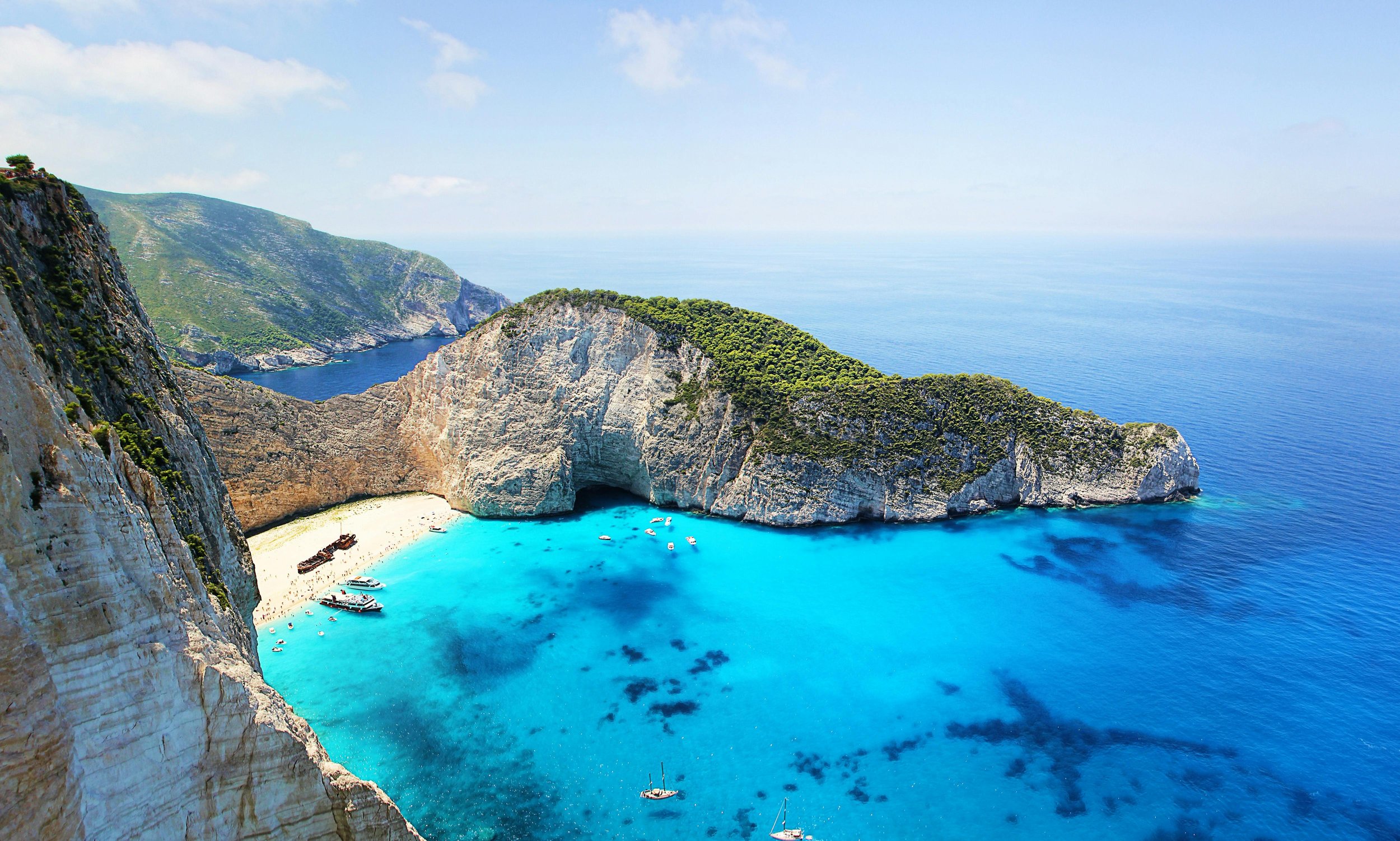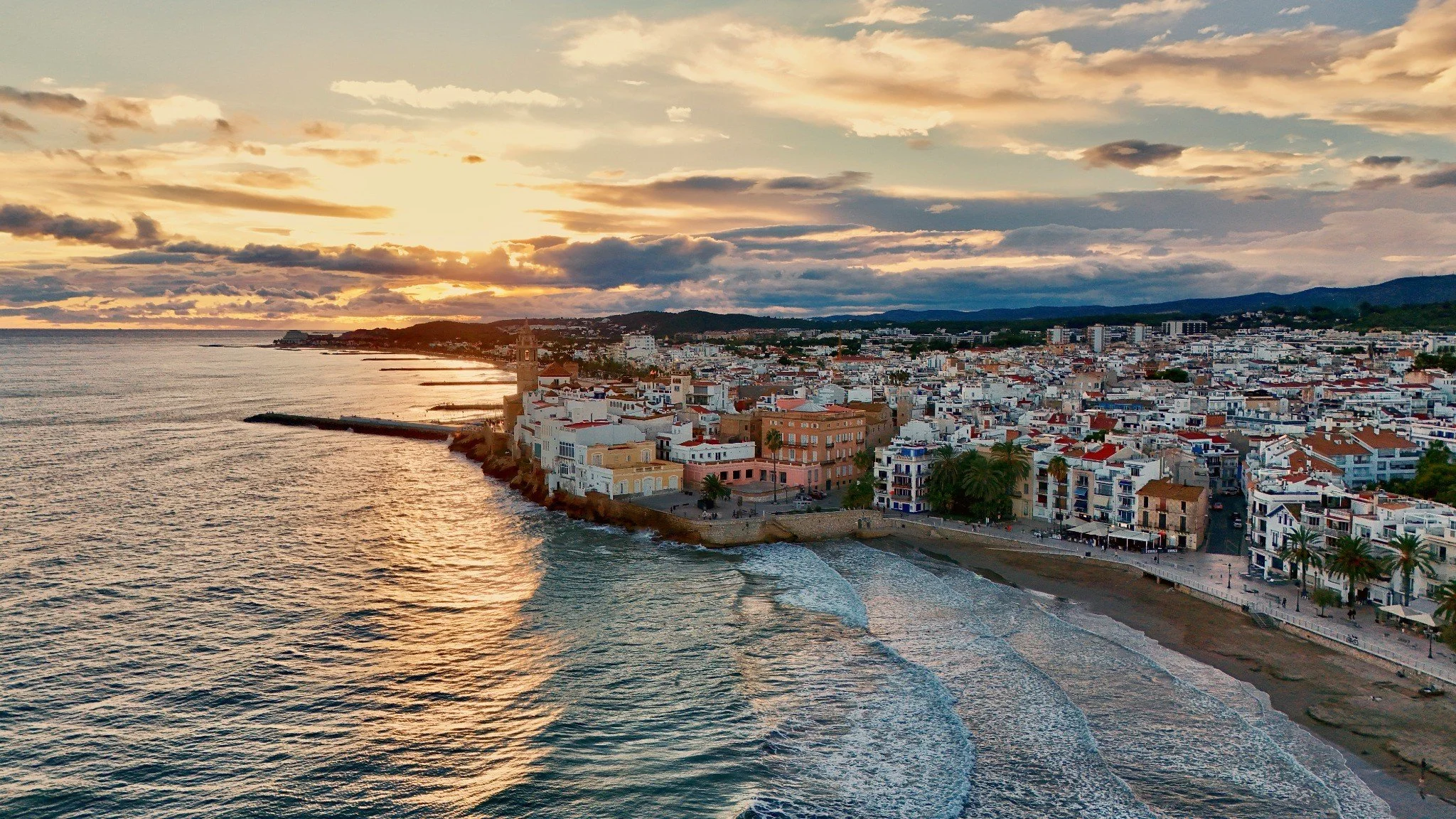
Sitges, Spain. Although Cataluña is far from the regions most affected, it could still see about 9 additional hot days in summer over the 2041-2070 period compared to today. by Photo by Max on Unsplash.
Reading time: 7 minutes
Quick Answer: How Climate Change May Affect Retirement in Europe
Climate change is expected to significantly increase extreme heat across southern Europe by mid-century. Many popular retirement destinations—especially in Spain, Greece, and Cyprus—could see substantially more days above 30°C, raising health and comfort concerns for retirees. However, impacts vary widely by region, with northern coasts, Atlantic areas, and higher-altitude locations likely to remain comparatively resilient.
What You’ll Learn in This Article
✔ Which European retirement hotspots face the biggest heat increases
✔ What the “Hot Days” metric reveals about future summer comfort
✔ Why extreme heat matters more for retirees’ health than average warming
✔ Which regions of Europe may remain relatively climate-resilient
✔ How to use climate-analogue tools to plan smarter for retirement abroad
TL;DR: How Climate Change Could Reshape Europe’s Retirement Map
🌡️ Europe’s summers are heating fast: the Mediterranean in particular is projected to warm by 2–2.5°C by 2050, and well above 3°C by 2100 under current scenarios (SSP2-4.5).
🔥 The number of “Hot Days”—defined as days where temperatures exceed 30°C—will surge across southern Europe: especially in Spain, but also in Greece, Cyprus, or Portugal. Some regions may face 60–70 days above 30°C each summer by mid-century, a brutal increase of about 10-15 additional days per summer compared to today.
❤️ Why this matters for retirees’ health: more frequent heatwaves raise risks of dehydration, poor sleep, and cardiovascular stress, especially for older adults.
🏖️ Not all regions are equal. Coastal and northern areas like northern Portugal and Spain are projected to remain mild and may increasingly gain appeal compared to its southern counterparts.
🏔️ Smart planning beats relocation fear. Using climate-analogue tools and considering non-traditional retiree locations today, retirees may identify better solutions—in higher altitudes, coastal zones, or Atlantic regions—with lower future heat exposure.
🌍 Long-term takeaway: Europe’s top retirement hotspots won’t vanish, but their comfort map will shift substantially. Planning with climate and health in mind will become as essential as assessing cost of living or healthcare quality.
👉 This article is part of our Health & Longevity pillar, the complete guide to healthspan, longevity science, and how it connects to your FIRE (Financial Independence, Retire Early) plan.
👉 Considering retiring abroad? Climate risk is now one of the key variables in choosing a destination. For the full framework on geographic arbitrage—including costs, taxes, safety, healthcare, and global retirement rankings—see our comprehensive guide to retiring abroad through geographic arbitrage.
Author’s note: Over the past three years, we’ve developed a data-driven Retirement Relocation Tool (free with email; PC only)that compares over 100 countries across ten variables—from cost of living to healthcare and safety. This methodology has already been applied to our Europe, Asia, and Latin America rankings. Today’s article builds on this to examine how climate change impacts some of the best retirement locations.
How Climate Change Could Reshape Europe’s Best Retirement Destinations by 2050
Europe’s attractiveness for retirees has long rested on a nice balance of culture, healthcare, and climate, but that final ingredient is changing fast. This article explores how rising temperatures could alter the comfort and livability of some of today’s top retirement destinations in the decades ahead.
These shifts will not just shape vacation preferences but also long-term decisions for those considering retirement in Europe’s warmest regions. Preliminary projections suggest that some of today’s most popular retirement regions may become less comfortable during peak summer months over the coming decades.
In this article, we use real climate data from Copernicus and the European Climate Data Explorer to show how heat and livability are projected to shift across Europe’s top retirement destinations—Portugal, Spain, Greece, Croatia, and Cyprus—by mid-century. You’ll see where summers may become uncomfortably hot, how this affects health and day-to-day comfort for retirees, and which regions could remain resilient or even improve as the continent warms.
As with all long-range climate projections, these estimates carry uncertainty and depend on future emissions and adaptation pathways, i.e., how quickly mitigation policies succeed in reducing greenhouse gas emissions.
We’ll close with some practical tools and strategies to help you plan smarter, including how to use the so-called “climate analogues” to visualize what your chosen location today could feel like a few decades down the line.

Climate change impacts will likely change where people chose to retire. What could today’s best retirement destinations look like in a couple decades time? Photo by Adolfo Félix on Unsplash.
Europe’s Warming Future: Why 2°C Doesn’t Tell the Whole Story
When people hear that the planet may warm by “over three degrees” by 2050, the first impression is that the number itself sounds modest. But, of course, it hides the full story. The Copernicus Climate Atlas shows that under our current heating and policy trajectory (approximately following the SSP2-4.5 scenario in technical lingo), Europe is warming faster than the global average.
Specifically, the Mediterranean basin is among the most exposed regions. As observed in Figure 1 below, already by mid-century, mean annual temperatures could rise by 2-2.5°C relative to pre-industrial levels, reshaping not only what local ecosystems look like, but also how our everyday lives feel. Following our current policy trajectory, by the end of the century we could easily be well above 3°C.
Yet, what matters for retirees isn’t the mean headline figure. It’s the experience of living through longer, hotter summers that will make outdoor activities uncomfortable for most and unsafe for older adults.
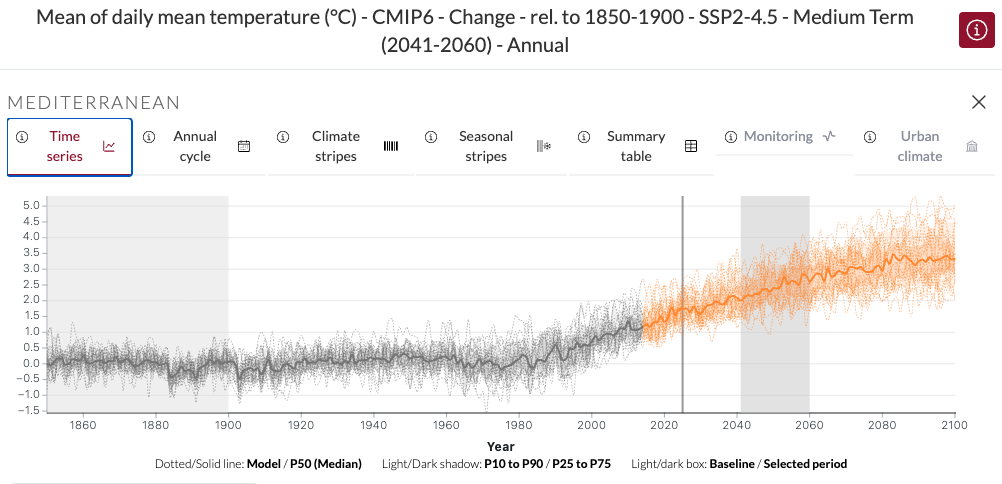
Figure 1. Projected change in mean annual temperature across the Mediterranean region (1850–2100) under the SSP2-4.5 scenario. The orange curve shows the median across modeled projections relative to pre-industrial levels, with the range indicating uncertainty across different models. Temperatures are expected to rise by about 2–2.5 °C by mid-century (2041–2060, grey vertical bar) and substantially exceed 3°C by 2100 if current policy trajectories persist. Data source: Copernicus Climate Atlas (CMIP6, ECMWF).
It’s important to note, though, that average temperature graphs can be deceptive because they flatten out what we actually feel. A “small” rise in the mean hides much steeper increases in extreme heat events; more days when temperatures crosses thresholds that the human body finds physiologically stressful.
This shift is what makes heat not only an environmental issue, but also a health impact and lifestyle problem. Europe’s climate future isn’t about living with slightly warmer weather, but with more unbearable days that fundamentally change when and how we spend time outdoors, or sleep comfortably at night.
If you’ve spent time in southern Spain in summer (e.g., Seville or other cities in Andalucía, Murcia, or Extremadura), you know that locals already stay indoors for long stretches during the hottest hours of the day. Some cities in these regions could be good examples of places that will barely be livable during summer within a few decades.
In today’s post, we move from abstract averages to metrics that better reflect lived experience. Specifically, we’ll use the number of “Hot Days” metric—defined as days over 30°C and see what this likely looks like in future summers ahead. This measure, drawn from the European Climate Data Explorer, gives us a more intuitive sense of how retirees’ summers will actually feel.
The rest of the article is not about global targets or political debates over 1.5°C. It’s about whether you’ll spend half your summers indoors if you choose to retire in today’s popular retirement locations.

In a recent analysis, Spain ranked as the 2nd best place to retire in Europe. Alicante is one of Spain’s top retirement hotspots. Valencia could have about 12 additional hot summer days in a couple decades compared to today. Photo by Dean Milenkovic on Unsplash
Future Summers in Europe: What the ‘Hot Days’ Index Tells Retirees
If Figure 1 showed the trend, Figure 2 below shows the experience. The Hot Days index—the number of days per summer above 30°C—offers a more tangible view of what retirees might actually feel by mid-century. Based on the “current policies” pathway (i.e., RCP 4.5), southern Europe could see a dramatic exposure to extreme heat.
This measure shows how often the weather will simply feel too hot to be outside, especially for older retirees. Some retirees may increasingly consider seasonal relocation strategies to maintain comfort across different regions.
According to the European Climate Data Explorer projections (Figure 2), large parts of the Mediterranean, Balkans, and Eastern Europe present moderate to high number of hot days in summer. Substantial parts of Spain and Portugal, Greece, Turkey, and Cyprus could face 60-70 hot days each summer during the 2041-2070 period.
Although it varies per region, this is roughly 10 additional Hot Days compared to the baseline 1991-2020 period. And, remember, it’s not only having more hot days per summer, but the number of extreme heat events is also expected to increase substantially.
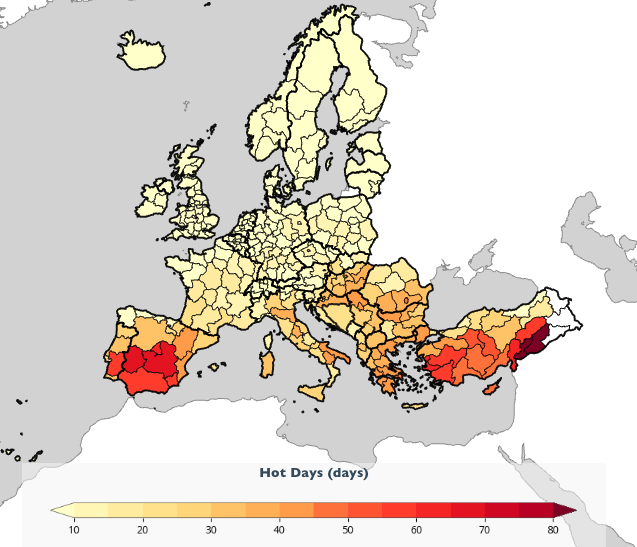
Figure 2. Projected “Hot Days” (days > 30°C) across Europe, 2041–2070, RCP 4.5 scenario.
Data from the European Climate Data Explorer (Copernicus Climate Change Service). Darker red areas indicate regions expected to experience 60–80 days above 30°C each summer, conditions that pose growing health risks for older adults and challenge livability in popular retirement zones.
Why should we care? Assessing the number of hot days matters because the human body, especially in older age, struggles to regulate heat effectively. In practice, more days above 30°C means higher risks of heat stress, dehydration, and cardiovascular strain, as well as disrupted sleep and reduced mobility.
The Mediterranean lifestyle is attractive to many retirees. In our data-driven ranking of Europe’s best budget-friendly retirement destinations, Portugal ranked first, followed by Spain, Croatia, Greece, and Cyprus. Many regions within these countries could become increasingly challenging to live in. Retirees should factor in projected heat trends—alongside other key variables like cost of living, healthcare, and safety—when choosing where to retire in Europe.
It’s important to remember that these projections don’t make all of southern Europe “unlivable”. But they highlight a growing divide between areas that are less resilient than others. Planning where to retire will increasingly mean checking not just property prices, cost of living, or healthcare quality, but the future “comfort map” of summer temperatures.
So what do these numbers actually mean for the people most likely to live through them? Let’s look at how rising heat specifically affects retirees’ health and quality of life.
Why Extreme Heat Is a Hidden Health Risk for Retirees in Europe
Retirees are especially vulnerable to heat stress. Age reduces the body’s ability to regulate temperature, and many medications can further heighten a person’s sensitivity to heat. What feels like a warm, but bearable, summer afternoon at 35°C in your forties can become exhausting or outright dangerous in some cases in your seventies. Heat also compounds other factors that matter to retirees’ health, such as sleep and day-to-day mobility.
This is why the conversation around retirement abroad should increasingly include climate comfort—or resilience to other climate change impacts—alongside cost of living, safety, local openness, or healthcare. In some areas of Spain and Greece, average maximum temperatures during future summers may regularly exceed 35°C, similar to today’s Gulf state climates.
This doesn’t make these countries automatically unlivable, but it could redefine when, where, or how you’d want to live there. In the same way that many Europeans flock to Souther Europe in the summer, we may start seeing, if it’s not happening already, the inverse: both Europeans holiday-makers and retirees flocking to the north.
Skeptics might argue that technology and adaptation will offset some of these risks. While that’s partly true, adaptation comes with costs—energy demand, water scarcity, and infrastructure stress—that could change the economics of retirement living. But more importantly, I doubt that most retirees in southern Spain would happily envision living indoors most of their summer. They moved there precisely to enjoy today’slovely climate and outdoor lifestyle.
Retirement destinations that may have been unthinkable to many, e.g., Nordics countries, could start presenting a slightly better appeal as climate change impacts progress. In our own family, we’ve already started avoiding holidays in southern destinations during mid-summer, especially with little ones. Even as someone who loves Mediterranean countries, I’m increasingly curious about the north and how livability might shift in the coming decades. I expect to not be the only one looking north as climate change impacts progress.
Note as well that, although adaptation is possible, it does have some limits. Cooling technologies can offset heat indoors, but higher electricity costs and potential drought restrictions could challenge convenience and affordability. Also keep in mind that these heat projections aren’t taking into account the urban-heat-island (UHI) effect, which can dramatically increase the temperature in urban areas.

Malaga is another one of Spain’s top retirement hotspots. Andalucía as a region could have 60 hot summer days by 2040, 10 more than today.Photo by Willian Justen de Vasconcellos on Unsplash.
How Europe’s Top Retirement Destinations Compare Under Climate Change
Among our top 5, budget-friendly retirement destinations in Europe, some are projected to remain surprisingly resilient, while others could face sharper declines in livability, especially in Spain. Portugal continues to stand out as one of the best choices overall, particularly if you avoid southern regions like Alentejo (roughly 57 Hot Days per summer for the 2041-2070 period). Algarve and other coastal regions in the center and upper half are likely to remain milder, maintaining the same breezy comfort that makes them attractive today.
Spain, by contrast, could see stronger impacts. Its bottom half—with the exception of Valencia—could easily see more than 60 Hot Days per year, reaching 70 in Extremadura. In contrast, the upper half could present a different picture, with its beautiful northern region, including Asturias, Galicia, Cantabria, or the Basque Country, becoming increasingly more attractive for retirees.
Indeed, climate impacts diverge strongly by region. To illustrate, and as observed in Figure 3, Andalucía will increase its Hot Days to 60 per summer, representing roughly a 11-day increase in relation to its 1991-2020 baseline. In contrast, Asturias will have only 1 Hot Day over the summer season over the same future period. As mentioned, the same countries may remain popular overall, but the specific regions retirees prefer will likely shift.
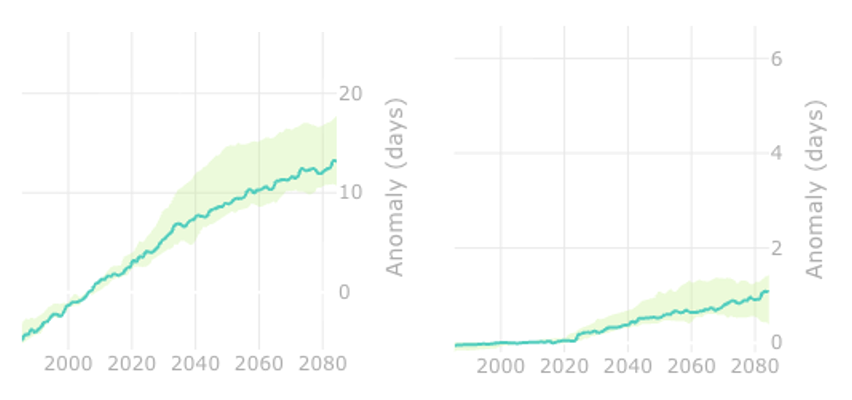
Figure 3. Number of hot days increase relative to baseline level (1991-2020) for Andalucía (Left) vs Asturias (Right). Source: Climate Adpat.
From Europe’s top 5 retirement destinations, Greecefaces the steepest relative increase in Hot Days compared to its baseline. To illustrate: while most warmer regions in Spain experiment an increase of around 10-12 days in Hot Days over the 2041-2070 period relative to their baseline (1991-2020), a majority of Greek regions experience a 14-16 day increase. Still, in absolute terms, Greece generally remains a bit cooler than Spain, as observed in the map in Figure 2 above.
Croatia’s popular coastline observes smaller increases compared to Spain or Greece—with around 17 Hot Days per season over the 2041-2070 period—a 9 day increase in relation to its baseline. In contrast, the more interior Pannonian regions could have about 35 Hot Days per season, a 12-day increase over the baseline. Finally, Cyprus, while culturally and financially appealing, offers a similar profile to Greece, with expected 46 Hot Days per summer, a 13 day jump relative to its baseline.
The lesson is clear: not all southern European regions are equal, and even the climate impacts change within each country. Micro-climates matter more than ever. Future retirees should think in terms of altitude, coastal breezes, and green cover, not just healthcare, property prices, or capital gains tax regimes.
As mentioned earlier, the same principle applies when looking beyond the Mediterranean. Nordic countries like Denmark, Sweden, or Norway are gaining relative appeal as climate change might warm-up and lengthen the duration of their summers. For those planning decades ahead or in poor health, our recent article on Nordic countries unveils a very high quality of life in the context of a rapidly changing climate.
It’s also worth remembering that the figures shown here representregional or country-level averages. Within each area, conditions can vary dramatically; for example, some inland zones of Murcia or southern Valencia in Spain regularly record hotter summers than the regional mean in Andalucía or Extremadura. The same pattern holds across Greece, Portugal, and Croatia, where coastal breezes or elevation can cut peak temperatures by several degrees.
This is another reason why exploring city-level data and climate analogue tools can be so valuable: they allow you to zoom in on specific destinations and understand how livability may evolve at the local scale, not just at the regional or national one.
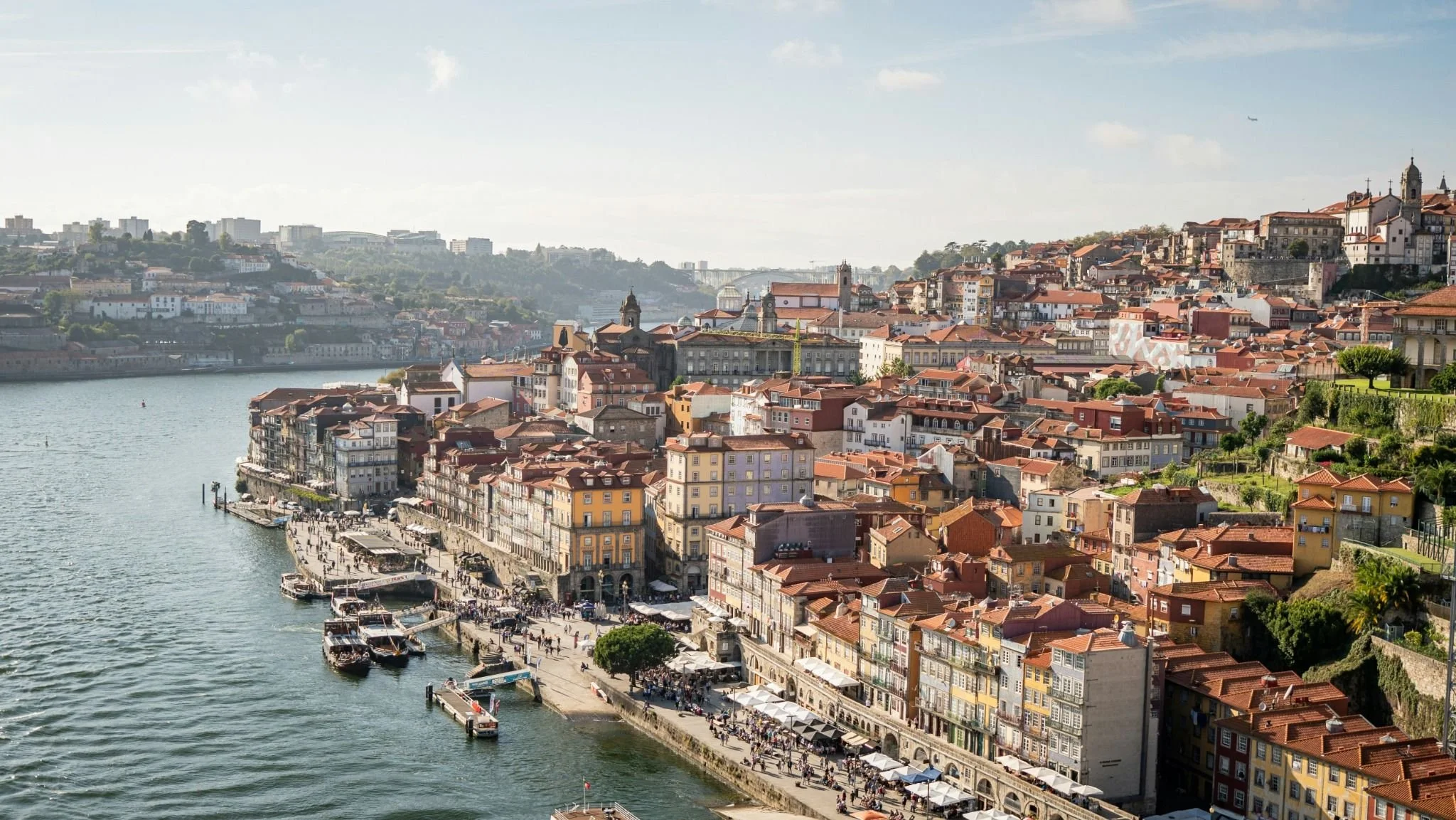
Porto, Portugal. In a recent analysis, Portugal ranked 1st as the best place to retire in Europe. Although its region will also likely experience about 10 additional hot summer days on average compared to today, it will remain overall a cooler region compared to some areas in southern Portugal and Spain. Photo by Matt Roskovec on Unsplash.
Planning a Climate-Resilient Retirement: Tools and Climate Analogues
While this article focused on heat, expat retirees should also consider other climate risks that could affect Europe’s south: increased wildfires or water shortages in many countries, or higher electricity and insurance costs related to extreme wheather. None of these are reasons to abandon the dream of Mediterranean living, but they do underscore the importance of informed planning.
Understanding how these trends change geographically and how they interact with your age, health, and financial flexibility can help you design a retirement plan that remains resilient over the long haul.
Thankfully, today’s tools make it easier than ever to visualize what the future could look like in your chosen destination. Take, for instance, the Climate Analogues Explorer, which lets you click on a city and see what its climate will resemble in 2050. For example, Madrid could resemble the climate found today in Cordoba by 2080, while Cordoba, in turn, could soon resemble that of Kazerun, a city in Iran.
Ultimately, climate-proof retirement planning doesn’t mean giving up on sun and sea. It means understanding their future cost, and whether they align with your health and individual heat tolerance.

Climate Analogues explorer: What will Cordoba (Spain) feel like climate-wise under current climate change’s mitigation scenario? Assuming continuation of today’s policies, its climate could resemble that of Kazerun, Iran by 2080.
For those seeking a balance between warmth and well-being, Atlantic and Adriatic coasts, northern Portugal, and higher-altitude regions of Spain and Italy likely offer promising paths. Similarly, some areas in Northern Europe that seem less appealing today may offer valuable heat relief in the decades ahead.
At The Good Life Journey, financial independence and long-term well-being go hand in hand. Understanding how your environment shapes health and happiness is part of planning the life you truly want.
If you found this article useful, here are your next steps:
👉 Find your ideal retirement destination: Try the Retirement Relocation Tool (PC only; free with email)
👉 Stay in the loop:Subscribe for new research, articles, and free tools
👉 Explore our top retirement rankings:Europe, Latin America, Asia, Nordics.
If, besides climate change, you’re also interested in a broader overview of the safest and most affordable retirement options worldwide, check out our 2026 global ranking of safe and low-cost retirement destinations. It complements this climate-focused view by adding the equally important dimensions of safety and affordability to your long-term planning.
💬 How do you picture your ideal climate in retirement? Would you still choose the Mediterranean sun knowing summers could top 30°C for months, or would you trade some heat for comfort and health up north? Have you noticed the summers getting hotter where you live? Are you already thinking about climate resilience in your retirement plans?
🌿 Thanks for reading The Good Life Journey. I share weekly insights on personal finance, financial independence (FIRE), and long-term investing—with work, health, and philosophy explored through the FI lens.
Disclaimer: I am not a financial adviser, and this content is for informational and educational purposes only. Please consult a qualified financial adviser for personalized advice tailored to your situation.
Check out other recent articles



























About the author:
Written by David, a former academic scientist with a PhD and over a decade of experience in data analysis, modeling, and market-based financial systems, including work related to carbon markets. I apply a research-driven, evidence-based approach to personal finance and FIRE, focusing on long-term investing, retirement planning, and financial decision-making under uncertainty.
This site documents my own journey toward financial independence, with related topics like work, health, and philosophy explored through a financial independence lens, as they influence saving, investing, and retirement planning decisions.
Frequently Asked Questions (FAQs)
-
By 2050, southern Europe—especially Spain, but also Greece, Cyprus, and Portugal—is projected to experience the largest rise in extreme heat. Many inland and southern coastal areas could see 60–70 hot days above 30°C each summer. The Mediterranean basin overall will warm faster than northern Europe, where summers will remain much milder.
-
The Hot Days Index counts how many days per year the daily maximum temperature exceeds 30°C. It’s an intuitive way to measure how often heat becomes uncomfortable or dangerous, particularly for older adults. Unlike average temperature charts, this index shows the real-life impact of climate change on day-to-day comfort and health.
-
Older adults are more vulnerable to heat stress because the body’s ability to regulate temperature declines with age. Extended exposure to temperatures above 30–35°C increases the risk of dehydration, cardiovascular strain, and poor sleep quality. Heatwaves can also limit outdoor activity, mobility, and social engagement—key factors for maintaining health and wellbeing in retirement.
-
Not necessarily—but the comfort window is shrinking. By mid-century, summers in parts of southern Spain and Portugal, Italy, and Greece could become uncomfortably hot for months at a time, especially inland. However, coastal and northern regions of these same countries—like northern Portugal or Spain’s Asturias—should remain relatively mild and attractive for retirees seeking mild climates without extreme heat.
-
Northern and Atlantic-facing regions—such as northern Portugal, coastal France, the Basque Country, and Croatia’s Adriatic coast—are expected to retain pleasant summer climates. Further north, Denmark, Sweden, and Norway could see longer warm seasons without dangerous heat, potentially becoming new retirement hubs as the Mediterranean warms.
-
When evaluating a retirement destination, consider future climate projections alongside cost of living, healthcare, and safety. Tools like the European Climate Data Explorer and Climate Analogues Explorer let you visualize how your chosen location’s climate may evolve. For example, Madrid’s 2080 climate could resemble today’s Córdoba, a much hotter environment. Códoba’s, in turn, could resemble that of parts of Iran.
-
Besides rising temperatures, retirees should factor in wildfires, drought-related water shortages, and higher insurance or utility costs. These risks vary widely by region—Portugal and Greece face increasing wildfire frequency, while southern Spain and Cyprus may confront long-term water stress. Planning ahead for these factors adds resilience to any long-term retirement plan.
-
Under current emissions pathway (RCP 4.5 / SSP2-4.5), the Mediterranean region is expected to warm by about 2–2.5°C by mid-century, with summer extremes increasing faster than annual averages.
-
Climate analogues compare a city’s future projected climate to another city’s current conditions. For example, Madrid in 2080 may feel like today’s Córdoba. Using tools like the FitzLab City Climate Explorer, retirees can preview how future heat levels might change their chosen destination and decide whether they’re comfortable with that lifestyle shift.
Join readers from more than 100 countries, subscribe below!
Didn't Find What You Were After? Try Searching Here For Other Topics Or Articles: