Where in the World Is Actually Safe to Retire Early? A Cross-Continent Reality Check

#3 most affordable and safe country to retire in Europe—according to perception-based safety data. Can you guess which country ranks #1? Photo by Cody Black on Unsplash.
Reading time: 7 minutes
Short on time? The TL;DR compares regions in under a minute—then you can jump straight to Europe, Latin America, or Asia below.
Author’s note: Over the past three years, we’ve developed a data-driven Retirement Relocation Toolthat compares over 100 countries across ten variables—from cost of living to healthcare and safety. This methodology has already been applied to our Europe, Asia, and Latin America rankings. Today’s article builds on this to examine how safety and low cost of living determine the best retirement locations.
Quick answer — What are the safest and cheapest countries to retire in 2026?
By region: in Europe, Estonia, Slovenia, Croatia, Georgia, and Czech Republic offer the best balance of safety perception and affordability. In Latin America, Mexico, Paraguay, Chile, Dominican Republic, and Colombia stand out. In Asia, China, Nepal, Thailand, Vietnam, and Sri Lanka combine low costs with strong safety scores. Note that these rankings focus specifically on safety and cost—for a full multi-variable ranking including healthcare, climate, openness, and other factors see our regional deep dives linked below.
What You'll Get
✔ Top 5 safest and most affordable retirement destinations per region
✔ How perception-based safety data works—and why it matters for retirees
✔ Key caveats: where national data masks local realities
✔ How to use our Retirement Relocation Tool to filter by your own priorities
✔ Links to full regional rankings for deeper dives
TL;DR — Safest & Cheapest Places to Retire in 2026
🇪🇺 Europe: Estonia, Slovenia, Croatia, Georgia, and Czech Republic rank safest and most affordable.
🌎 Latin America: Mexico, Paraguay, Chile, Dominican Republic, and Colombia offer solid safety value for retirees on a budget.
🌏 Asia: China, Nepal, Thailand, Vietnam, and Sri Lanka combine low costs with strong safety perception.
📊 Safety scores use reported perception-based data from Numbeo, which often provides a more useful gauge of day-to-day experience.
Prefer a deeper dive by region?
👉 Best countries to retire in Europe
👉 Best places to retire safely on a budget in Latin America
👉 Safest & most affordable retirement destinations in Asia
👉 Explore very high quality of life in the Nordics (if you don’t mind the cold)
👉 Considering retiring abroad more broadly? For the full geographic arbitrage framework— including timeline impact, taxes, healthcare, climate, seasonal options, and how to choose between regions—start with our comprehensive guide to retiring abroad through geographic arbitrage.
How to use this guide
Use this article to compare regions (Europe vs Asia vs Latin America)
Jump to the regional deep dive that fits you best
Use the Retirement Relocation Tool to shortlist specific countries based on further criteria beyond safety
If you already know your region, the Retirement Relocation Tool is the fastest way to shortlist countries using safety, cost, healthcare, climate, and other variables (PC-only, free for subscribers).
Safest and Most Affordable Countries to Retire in 2026 (Europe, Asia & Latin America)
When I started looking into retiring abroad, the same two questions kept coming up: “Is it safe?” and “Can I afford it?”
This article is not a country-by-country retirement guide—and it's deliberately different from our regional rankings, which score countries across 9 variables. Here, we zoom in on just two: safety and affordability, which are important considerations for many people use when exploring options abroad.
Using data from our free Retirement Relocation Tool and Numbeo’s global Safety Index, we highlight top regional performers across Europe, Latin America, and Asia for those pursuing Financial Independence through geographic relocation, and explain how perception-based safety data works—and what it actually means for retirees deciding where to live abroad.

When balancing safety and low cost of living, Estonia takes #1 spot in Europe. Not interested in the cold? That’s fine, the ranking is full of warmer countries. How would Estonia perform though in a more comprehensive analysis of other retirement variables across Europe? Photo by Dmitry Sumin on Unsplash.
Safest and Cheapest European Countries to Retire in 2026
According to 2025 data from Numbeo and The Good Life Journey’s Retirement Relocation Tool, Europe offers some of the world’s safest and most affordable places to retire.
Europe’s diversity makes it a fascinating case study for would-be retirees. Considering both affordability—cost of living (COL)—and safety, the top 5 countries in Europe are Estonia, Slovenia, Croatia, Georgia, and Czech Republic (see Figure 1 below). These five countries consistently achieve Safety Index scores that are on par or superior to those of Nordic countries, but without their price tag. Some retirees even combine these locations seasonally to balance cost and climate.
These five countries emerge as the most balanced destinations in 2026—making them some of the best European countries to retire safely and cheaplywhen combining high safety perceptions with manageable living costs. Many of these countries strike a rare balance—peaceful environments, EU-adjacent governance standards, and living costs far below Western Europe’s average.
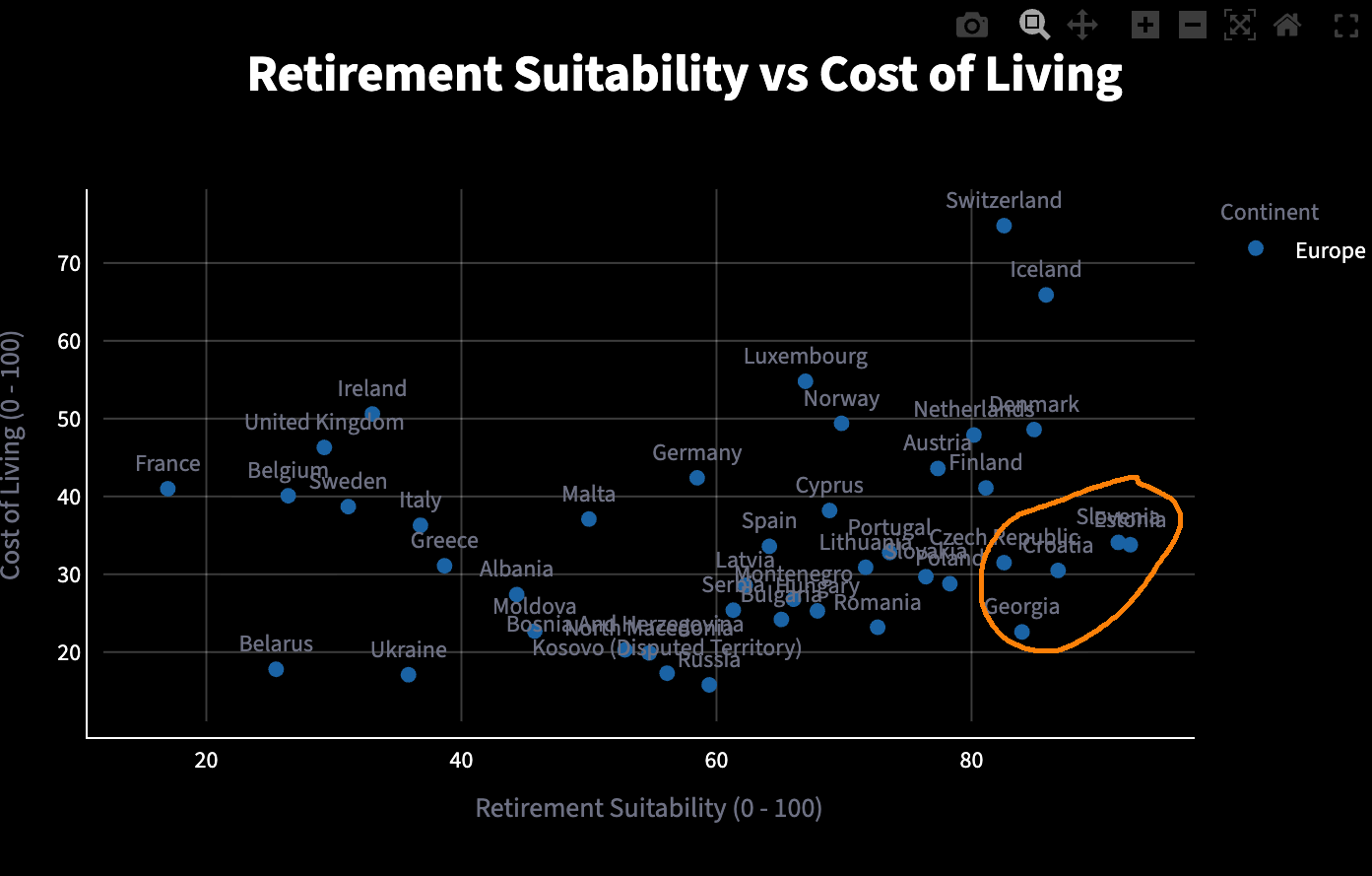
Figure 1: Retirement Suitability Index from our Retirement Relocation Tool (PC-only, free for email subscribers) vs Cost of living. In this case, only Safety is selected in the Retirement Relocation Tool from 9 different possible variables. Estonia, Slovenia, Croatia, Georgia, and Czech Republic top the list considering both variables simultaneously.
When looking at Numbeo’s Safety Index alone, the top 10 countries in the dataset are: Andorra, Isle of Man, Monaco, Estonia, Slovenia, Croatia, Iceland, Denmark, Czech Republic, and Switzerland. However, the top three microstates—Andorra, Monaco, and the Isle of Man—score exceptionally high on safety but fall outside our analysis for being both prohibitively expensive and too small to provide robust, multi-variable data in our Retirement Relocation Tool. Switzerland, Iceland, and Denmark are, of course, also on the pricier side.
Popular retirement destinations like Portugal, Spain, or Italy are genuinely very safe by global standards, but they score lower on this specific ranking due to urban petty crime in tourist-heavy areas pulling down the perception data. (There’s a related but distinct factor worth weighing too: growing anti-tourism sentiment in some of these same cities, which has nothing to do with physical safety and everything to do with whether you’ll feel genuinely welcome.)
A couple of caveats are worth keeping in mind when reading this Safety Index. First of all, the Safety Index used here is measuring people’s perception on safety, which may differ in some cases from cold, official statistics.
Secondly, because Numbeo data is largely collected from residents and expats, the results may over-represent the areas where foreigners live—typically urban centers or coastal zones—rather than rural interiors or cities far from the coast. However, for most retirees who actually plan to live near established expat communities, this makes the findings even more relevant.
Simply be aware of this caveat; if you’re looking to retire somewhere more rural, these city-skewed statistics may not serve you so well. In any case, once you’ve identified a set of potentially interesting countries, it’s always important to look in detail at the differences found within those countries.
Looking west across the Atlantic, Latin America tells a different story—where warmth, affordability, and safety perceptions intertwine.

Mexico ranked as #1 in terms of safety and cost of living. How would it perform in a more comprehensive analysis of other retirement variables across Latin America? Photo by Spencer Watson on Unsplash.
Safest and Most Affordable Latin American Countries for Retirees
Latin America is a region often characterized by contrast—lush natural beauty, warm cultures, and, often, uneven perceptions of safety. Perception doesn’t always align with actual crime data—many communities with low violent crime still suffer from reputational stigma. Others, by contrast, experience localized risks that outsiders rarely hear about.
But when filtering for both low cost of living and reasonable safety perceptions—compared to its regional peers—five countries stand out in 2026: Mexico, Paraguay, Chile, Dominican Republic, and Colombia (see Figure 2). These are among the safest and most affordable countries to retire in Latin America today.
While the scores are substantially lower than those in Europe, these five countries stand out as regional bright spots—places where affordability meets a relative sense of order, safety, and predictability compared to other neighboring nations. Of course, crime perception doesn’t always translate to personal experience—urban and rural realities can differ, and even within “safe” countries, localized risks exist.
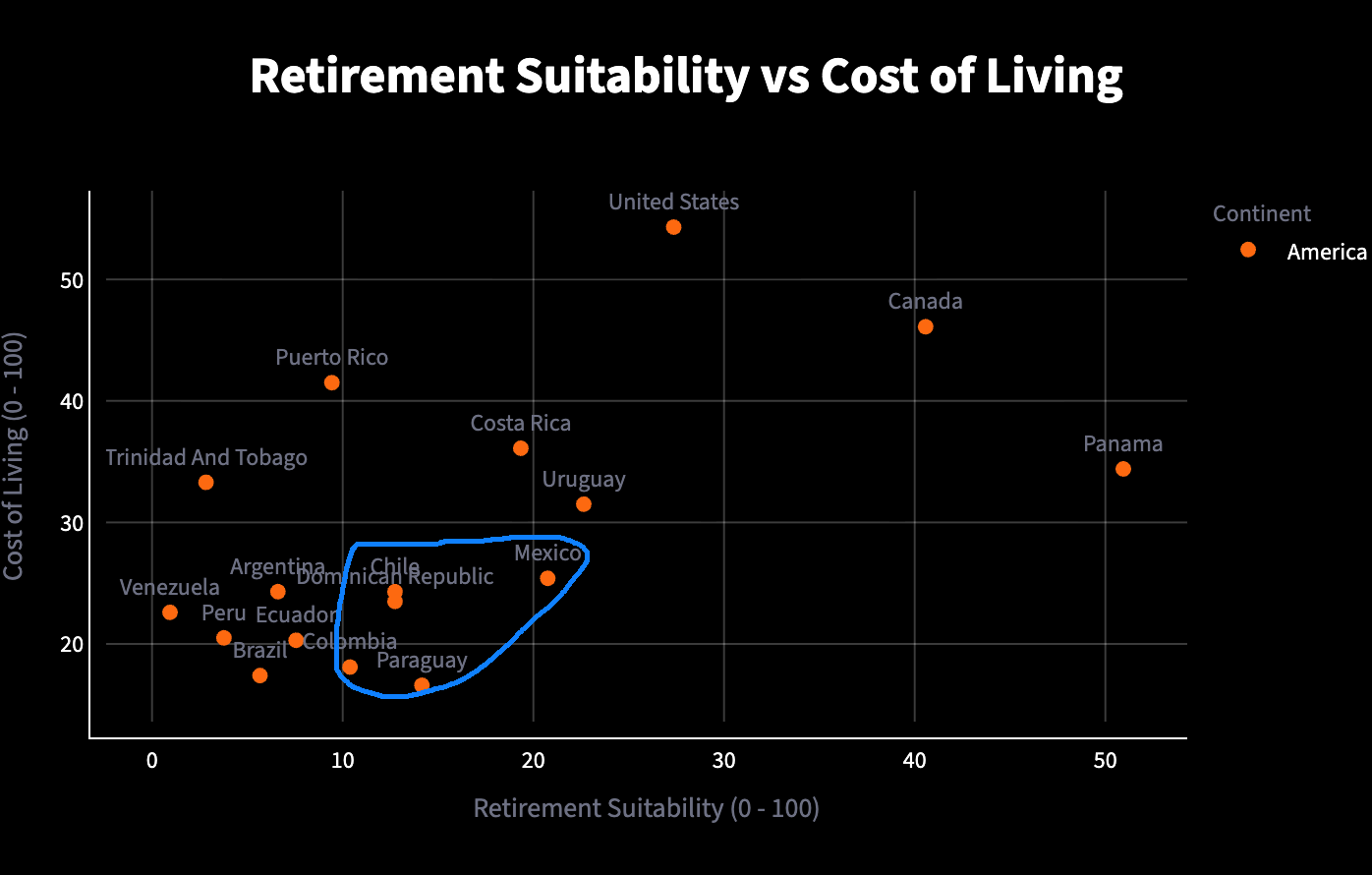
Figure 2: Retirement Suitability Index from our Retirement Relocation Tool (PC-based, free for email subscribers) vs Cost of living. In this case, only Safety is selected in the Retirement Relocation Tool from 9 different possible variables. Mexico, Paraguay, Chile, Dominican Republic, and Colombia top the regional list considering both variables simultaneously.
One particularly interesting finding is Mexico’s position. I’ll admit, I was personally surprised to see Mexico rank so high—especially given how often safety concerns dominate conversations about it. But the data from expats living there tells a more reassuring story.
While the country often makes headlines for organized crime, perception-based surveys tell a more nuanced narrative: many expats living in coastal and central regions report feeling relatively safe compared to other countries in the region. This suggests that national-level news headlines may not fully reflect the realities of localized expat environments. Similarly, Paraguay surprises as a low-cost, low-crime option that flies under most radars.
Again, these are not the absolute safest countries in the region—Panama, Uruguay, and Costa Rica would rank higher on pure safety—but they strike a more attainable balance for cost-conscious retirees. Within each country, safety can vary widely by region: Mexico’s Yucatán or Colombia’s Coffee Axis, for instance, often score far higher than national averages, underscoring the importance of city-level research before moving anywhere.
Moving east, Asia presents yet another dynamic—where retirees often find exceptional affordability and unexpectedly strong safety perceptions.
Safest and Cheapest Asian Countries to Retire (South, East & Southeast Asia)
Asia’s story is slightly different—especially for retirees searching for safe and affordable countries in the region.When narrowing our focus on South, East, and Southern Asia in particular, the dataset highlights countries that combine low costs with very respectable safety perceptions—key for retirees seeking some adventure without too much insecurity.
The top performers based on 2026 perception data are China, Nepal, Thailand, Vietnam, and Sri Lanka. While we can certainly find safer destinations—say, Singapore, Hong Kong, Japan, or South Korea—those fall into higher COL locations and thus don’t make this “affordable + safe” shortlist.
In a previous analysis looking at 9 different retirement suitability metrics, we found that Thailand, Malaysia, and Indonesia were the strongest candidates overall in the region. Interestingly, both Indonesia and Malaysia perform substantially worse in this perception-based Safety metrics in relation to the five countries shortlisted.
Using these perception-based metrics can be useful in Asia, where petty crime is sometimes underreported or unevenly tracked by governments. In such environments, perception data can offer a clearer picture of day-to-day safety as experienced by foreign retirees.
Still, there are caveats. In Thailand and Vietnam, expats often cluster in hubs such as Chiang Mai, Da Nang, Hanoi, or Ho Chi Minh City—places where community support and familiarity may enhance perceived safety. Meanwhile, Nepal’s Safety Scores benefit from its slower pace of life and low violent crime rates.
Across this region, the overall pattern is clear: many parts of Asia remain among the most affordable global options, and several destinations also deliver surprisingly high comfort and perceived security levels for retirees on moderate budgets.

Thailand ranked as #3 in terms of safety and cost of living. How would it perform in a more comprehensive analysis of other retirement variables across Asia? Photo by Yavor Punchev on Unsplash.
How We Measured Safety and Affordability for Retirement Abroad
Having lived and worked across multiple regions, I’ve found perception-based safety data often aligns more closely with day-to-day experience than official crime statistics—especially for expats.
An additional advantage of using perception-based datasets like Numbeo is theircross-country consistency. Official crime statistics vary widely in collection methods and transparency, making comparisons across nations unreliable. By contrast, standardized perception data offers a more uniform framework for evaluating safety worldwide—especially important for retirees comparing countries with different reporting systems.
To close, it’s worth briefly unpacking how these results were built—and what they do and don’t tell us. All safety data in this analysis comes from the Numbeo Safety Index, which is perception-based rather than purely statistical crime data. That means it reflects how residents and expats feel about safety in their daily lives—a crucial distinction when evaluating retirement safety rankings or best countries for expats. It includes questions on petty crime, violent crime, corruption, or just confidence in walking alone during day and night.
This makes it a useful complement to official crime data, particularly in regions where reporting rates or transparency differ significantly. For example, perception data can often capture day-to-day realities—like street safety or local trust—that formal crime figures can overlook.
Our own free Retirement Relocation Tool (PC-only, email unlock) builds on this foundation by combining the Safety Index with nine other variables—cost of living, healthcare, political stability, openness, climate comfort, and more. Together, these create a more holistic picture of long-term livability. In addition to these variables, we’ve also explored other factors, ranging from tax regimes to how heat and livability will change in coming decades due to climate change.
In this article, we narrowed the focus to just two factors—safety and affordability—because these remain the first filters most retirees use when exploring options abroad. But real-world retirement planning benefits from considering the full matrix of variables that influence retirement well-being.
Across regions, several clear patterns emerge.Latin America—even among its top performers—tends to have substantially lower Safety perception scores than either Europe or Asia. Between Asia and Europe, Europe’s top five countries generally rank safer but also substantially more expensive. The major outlier is China, which combines very low reported crime perception with living costs comparable to Georgia.
Ultimately, the best retirement destination depends not just on where you’ll pay less or feel secure, but on where all the pieces—climate, healthcare, openness, language, pollution, and stability—fit together for your own lifestyle. Our interactive Retirement Relocation Tool is designed for exactly that: allowing you to consider multiple factors, visualize trade-offs, and explore how your ideal destination changes when you shift priorities from price to peace of mind.
Regardless of which country you choose, another relevant item to keep in mind: your income will need converting into euros, pesos, dong, etc. every month for years to come, so setting up a currency conversion system properly is important to avoid losing thousands of dollars in unnecessary bank fees.
While our analysis highlights the best countries overall, the smartest retirement choices are often made locally. Even within the same country, safety and affordability can vary dramatically between regions or cities. After using our Retirement Relocation Tool, be sure to check how safety and affordability vary locally within each country to truly find a location that fits your comfort and budget.
💬 How do you picture your ideal retirement environment? Would you prioritize low living costs even if safety perceptions are a bit lower, or pay more for extra peace of mind? Have you ever lived abroad—or noticed how safety and affordability can feel very different once you’re there?
If you enjoyed this post, here are some next steps:
👉 Use our Retirement Relocation Tool to rank countries by your own priorities—safety, cost, healthcare, climate and more (PC, email unlock)
👉 Wherever you land, the money question is the same: how to receive and convert income without losing 2–3% to your bank
👉 For the full geographic arbitrage framework—complete guide to retiring abroad
👉 Subscribe for weekly insights—one-click unsubscribe
👉 Browse 130+ articles at The Good Life Journey
🌿 Thanks for reading The Good Life Journey. I share weekly insights on personal finance, financial independence (FIRE), and long-term investing—with work, health, and philosophy explored through the FI lens.
Disclaimer: I’m not a financial adviser, and this is not financial advice. The posts on this website are for informational purposes only; please consult a qualified adviser for personalized advice.
About the author:
Written by David, a former academic scientist with a PhD and over a decade of experience in data analysis, modeling, and market-based financial systems, including work related to carbon markets. I apply a research-driven, evidence-based approach to personal finance and FIRE, focusing on long-term investing, retirement planning, and financial decision-making under uncertainty.
This site documents my own journey toward financial independence, with related topics like work, health, and philosophy explored through a financial independence lens, as they influence saving, investing, and retirement planning decisions.
Check out other recent articles






























Frequently Asked Questions (FAQs)
-
The safest and most affordable retirement destinations include Estonia, Slovenia, Croatia, Georgia, and the Czech Republic in Europe; Mexico, Paraguay, Chile, Dominican Republic, and Colombia in Latin America; and China, Nepal, Thailand, Vietnam, and Sri Lanka in Asia.
-
We use Numbeo’s Safety Index, which reflects how residents and expats perceive daily safety—covering issues like petty crime, corruption, and nighttime confidence. It’s a perception-based, not police-report dataset.
-
Because it captures real-world experiences, especially in regions where official crime statistics may be incomplete or underreported. Expats often provide valuable local insight into what day-to-day safety feels like.
-
Generally yes—since retirees often live in expat-friendly urban or coastal areas, perception data better reflects what they’ll personally experience than nationwide averages.
-
Europe scores highest on average, followed by Asia. Latin America, while offering lower costs, generally ranks lower on safety perception.
-
While Mexico’s national headlines can be alarming, many regions popular with expats—like Yucatán, Mérida, and Lake Chapala—report low crime and high feelings of safety in surveys.
-
Asia remains more affordable overall, though European countries like Georgia and Croatia offer a good middle ground of safety and value.
-
China, Nepal, Thailand, Vietnam, and Sri Lanka combine low living costs with strong safety perceptions, making them attractive to expats.
-
It varies by country, but inequality and organized crime raise perceptions of risk. Still, many areas remain peaceful and expat-friendly.
-
Our Retirement Relocation Tool (PC only, free for email subscribers) combines ten variables—healthcare, climate, openness, stability, and more—to help you build a complete picture of livability.
Join readers from more than 100 countries, subscribe below!
Didn't Find What You Were After? Try Searching Here For Other Topics Or Articles: