Variable Percentage Withdrawal (VPW): Is This the Smarter Alternative to the 4% Rule?

Looking for a safe and comfortable retirement? The Variable Percentage Withdrawal (VPW) strategy ensures you won’t run out of money. Trogir, Croatia. Croatia ranked as one of the top 5 best retirement hotspots in Europe. Photo by Sergii Gulenok on Unsplash.
Reading time: 9 minutes
Quick answer:
Variable Percentage Withdrawal (VPW) is a retirement withdrawal strategy where you withdraw a set percentage of your portfolio each year—based on your age and asset allocation—instead of a fixed dollar amount. The rate adjusts over time with your life expectancy and market performance, which sharply reduces the risk of running out of money. It’s most often compared to the 4% rule and “guardrail strategies,” and is especially popular with early retirees planning long or flexible retirements.
What you’ll get from this article
✔ An overview of Variable Percentage Withdrawal (VPW) and how it works in practice
✔ How VPW compares to the 4% rule and the Guardrails strategy
✔ How to read the Bogleheads VPW table and use the calculator, with simple examples
✔ The pros, cons, and real-world trade-offs of applying VPW and who it’s not for
✔ How to estimate your own FI number straight from the VPW tables
TL;DR — VPW in a nutshell 📊
📈 Withdrawals adjust yearly to life expectancy and portfolio value: more in good years, less in bad
🛡️ More dynamic than the 4% rule: spending flexes with the market, cutting the risk of depletion
📋 A simple Bogleheads table gives your safe withdrawal % by age and asset allocation
👴 Works for early and traditional retirees
⚖️ Main trade-off is that income fluctuates. Often best paired with other strategies (more in article)

The path to Financial Independence is simple, but not easy. Photo by Ante Hamersmit on Unsplash.
What Are Retirement Withdrawal Strategies?
Before diving into the Variable Percentage Withdrawal (VPW) strategy itself, this section briefly reviews two common retirement withdrawal frameworks: the 4% rule and the Guardrail Withdrawal Strategy. If you’re already familiar with them, feel free to skip ahead to the VPW section below.
When can I retire, how much do I need to save, and how much can I withdraw from my portfolio on a yearly basis once retired? We've addressed these questions in detail in our complete guide to safe withdrawal rates for early retirees, which maps every major strategy in one place—including the 4% rule, Bengen's updated 4.7% analysis, guardrails, VPW, and the bond tent.
We also have a dedicated deep-dive on the Guardrail Withdrawal Strategy (GWS). I recommend reading it alongside this post to fully understand the pros and cons of each approach.
In a nutshell, the 4% rule can be incredibly powerful at the start of your wealth accumulation phase. At the start of your investing and Financial Independence journey, it acts as a guide to determine how much money you need to achieve Financial Independence to retire comfortably. According to the rule, it amounts to 25 times your annual expenses.
For example, if you envision needing $40,000 in retirement, you would aim to accumulate a $1M portfolio ($40,000 x 25). In your first year of retirement, you would withdraw 4% of your portfolio (i.e., $40,000) and in subsequent years adjust annually for inflation to maintain your spending power.
It is a “set and forget” strategy; once you retire, you withdraw fixed amounts annually, regardless of market fluctuations, portfolio growth, or life expectancy. There is substantial nuance related to this rule, and I recommend revising our coverage of its advantages and disadvantages in our previous post.

Bali, Indonesia. Looking forward to retiring early abroad? Check out our top early retirement destinations in Asia. Photo by Darren Lawrence on Unsplash.
In contrast, the GWS operates under the assumption that you should align your annual portfolio withdrawals with the stock market’s performance. According to this approach, it is important to pay attention to what the market is doing and to adapt your spending accordingly. You don’t have to do this on a 1:1 ratio i.e., if the market goes down 20%, you don’t need to reduce your spending by 20%, or vice versa. But you do need a buffer for both cases.
This flexible spending strategy, recommended by financial advisor Michael Kitces, suggests withdrawing within a “safety lane” defined by two guardrails, allowing you to adjust withdrawal rates based on market performance thresholds. According to the GWS, we could start out by spending 5% of our portfolio in the first year of retirement, and adjust by inflation in subsequent years.
However, if you find the market has performed strongly over the initial years and you find yourself in the following year withdrawing 4% or less of your current portfolio, then you know you have “hit” the lower guardrail. You are spending too little and can therefore give yourself a 10% raise. If you were planning to withdraw $50,000 for that year, you could take $55,000 instead. Similarly, if you reach the upper guardrail—if your withdrawal represents 6% or more of your portfolio—you should adjust your planned withdrawals downward by 10%.
In this introduction, we’ve briefly reviewed two key withdrawal strategies that can be used by early retirees. Now, let’s jump right in to today’s withdrawal strategy: the Variable Percentage Withdrawal (VPW), also known as the VPW withdrawal method popularized by the Bogleheads community.

As an analogy, think of the Guardrail Withdrawal Strategy (GWS) as the bumper rails found in bowling alleys. Guardrails make it really hard to miss the mark! The guardrails are 4% and 6%; your withdrawal as a percentage of your portfolio should always stay in between these two limits. Photo from: murreybowling.com
Now that we’ve covered the fixed 4% rule and the Guardrail approach, let’s look at the VPW approach.
What Is the VPW Strategy and How Does It Work?
The Variable Percentage Withdrawal (VPW) strategy is a dynamic retirement withdrawal approach that adjusts your annual withdrawal rate based on both portfolio value and remaining life expectancy. Its goal is to maximize lifetime income while preserving long-term sustainability.
The VPW strategy focuses on maximizing retirement income while preserving the portfolio for long-term sustainability. Unlike the 4% rule, VPW does not aim to preserve a constant real income. Instead, it allows spending to rise and fall with portfolio realities: lower withdrawals in market downturns and higher withdrawals in strong years.
VPW also adjusts withdrawals over time: early in retirement it uses lower withdrawal rates, which gradually increase as remaining life expectancy shortens. This approach is generally appealing to those seeking to maximize income while safeguarding against portfolio depletion in retirement.
The VPW strategy originated from the Bogleheads community, an online forum dedicated to low-cost, index fund investing. It was collaboratively developed and refined by members of this community as a response to the rigid nature of static withdrawal approaches.
Prominent personal finance researchers and retirement experts such as Michael Kitces and Wade Pfau have helped popularize VPW and similar dynamic strategies by discussing their advantages over static withdrawal methods in the broader financial planning community. VPW is grounded in actuarial logic similar to required minimum distributions (RMDs), but applied voluntarily and more conservatively.
How to Use the VPW Table and Calculator (Step-by-Step)
How would prospective retirees apply this method in practice? We are going to answer this question using the free VPW spreadsheet and calculator developed by the Bogleheads community. This spreadsheet contains a lot of information and assumptions, but, for the purpose of this blog post let’s focus, as a starting point, on the “Tables” tab (screenshot below).This free VPW retirement calculator spreadsheet—developed by Bogleheads—helps you find your safe withdrawal rate (SWR) depending on your situation.
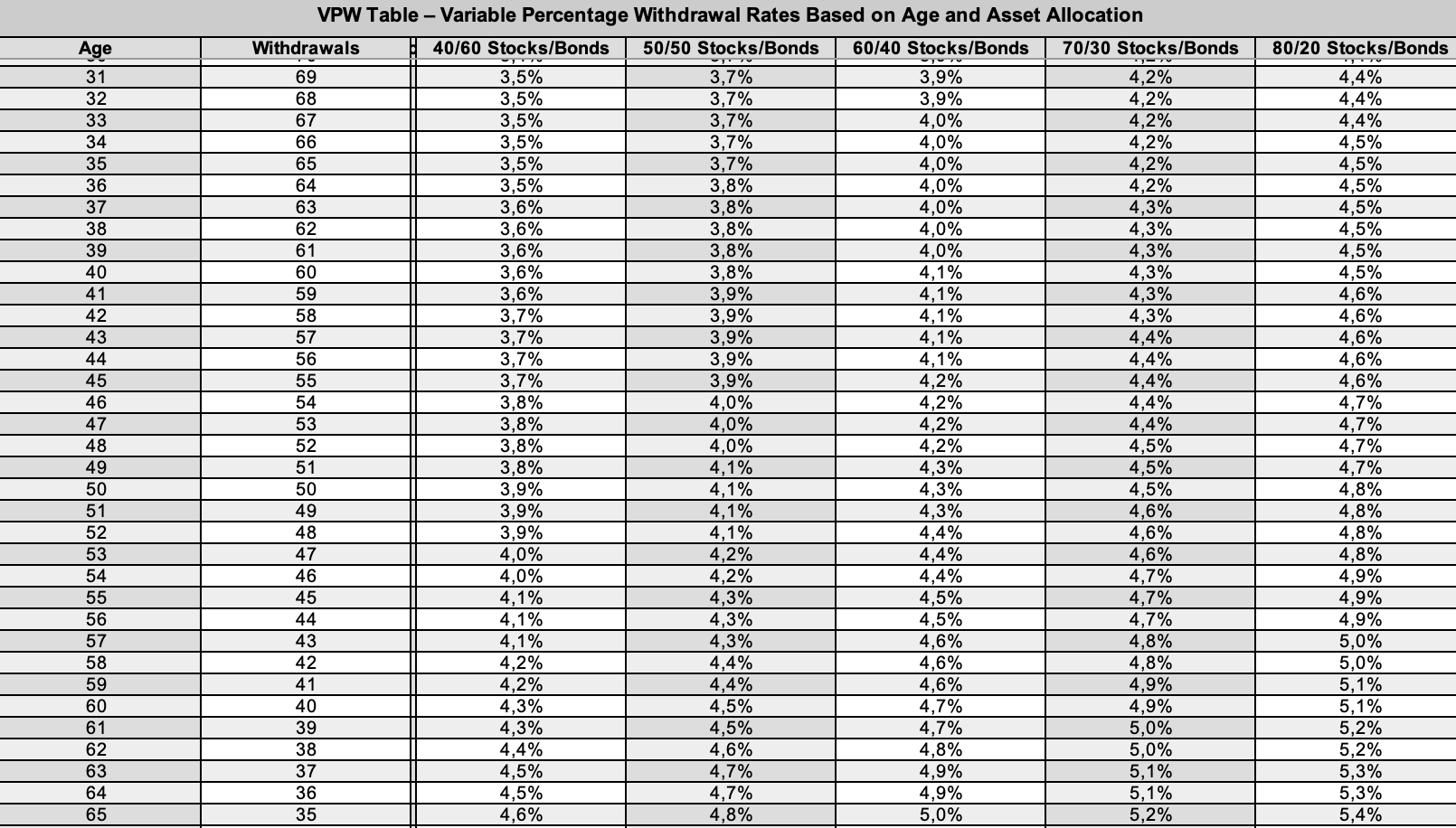
Table 1. Screenshot of the VPW table: Variable Percentage Withdrawal rates based on age and asset allocation. If you’re a 45-year-old early retiree with a 80/20 portfolio, you would start out by implementing a 4.6% withdrawal rate in retirement.
In a nutshell, the table above provides you with the maximum percentage withdrawal you can use from your portfolio annually in retirement. Say you are 45 years old, have $1M invested in a 80/20 stocks-to-bonds portfolio, and want to know exactly how much you can safely withdraw in your first year of retirement without fear of depleting your portfolio.
According to this method, you would withdraw up to 4.6%. So, if you have $1M dollars in your portfolio, in your first year of retirement you could withdraw up to $46,000 to cover your lifestyle expenses. If your asset allocation remains unchanged, the next year’s withdrawal rate could increase to 4.7% to account for your now slightly lower life expectancy. The table goes all the way to age 100.
The spreadsheet allows you to actually calculate a more nuanced withdrawal amount that also takes into account additional benefits in the future. In the “Retirement” tab (see Figure below), you can edit the following cells in yellow: age, portfolio balance, portfolio allocation, portfolio withdrawal frequency, and information related to pension plans.
For instance, building on the above example (45 y/o, $1M portfolio, 80/20 asset allocation), we can add an additional $2,000 per month from Social Security kicking in at age 65. Under this updated scenario, instead of our original $46,000, we can now withdraw a higher amount, $55,000.
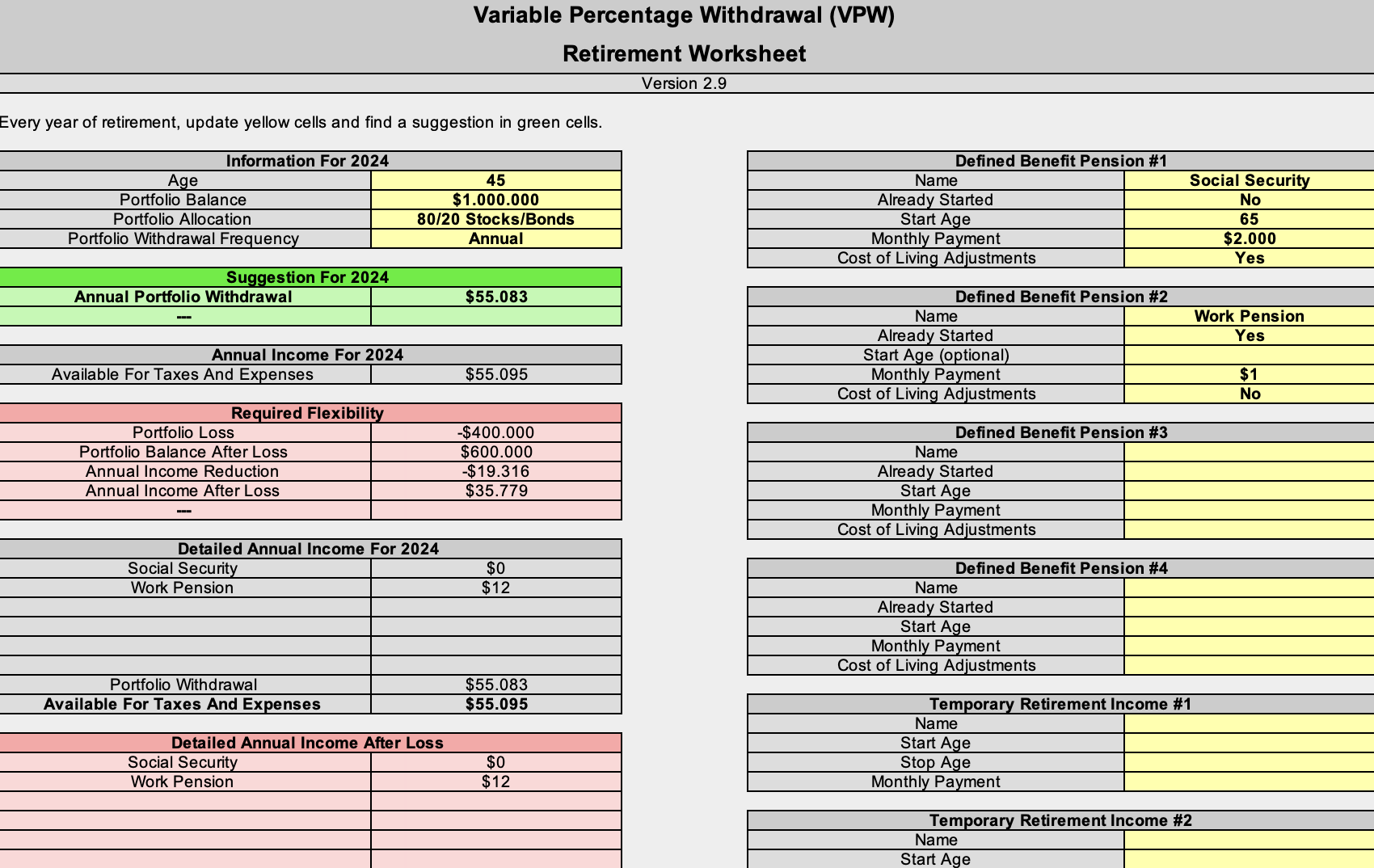
Figure 1. “Retirement” tab of Variable Percentage Withdrawal (VPW) tool from Bogleheads. Editing the cells on the right side (in yellow) allow you to account for future income (e.g., social security).
As mentioned earlier, you must apply the same calculation on an annual basis. Notice that, if there is a significant market downturn (e.g., 20%), you will have to enter a reduced portfolio amount in the tool. Even if the percentage withdrawal increases slightly (e.g., from 4.6% to 4.7%), your overall withdrawal amount will be substantially reduced in relation to the previous year due to the market performance. By being flexible in your retirement spending, you are protecting your portfolio to ensure it lasts your entire life.
Remember to factor in taxes when planning your withdrawals. Depending on which country you live in and the type of account you plan to withdraw from, such as taxable investment accounts or tax-advantaged retirement accounts, your actual net withdrawal amount may be reduced by capital gains taxes, income taxes, or other levies.
Although the tool doesn’t explicitly calculate your Financial Independence (FI) number, you can easily determine it using the withdrawal tables. The “Accumulation” tab provides you with how much you need to invest on a monthly basis to be able to retire at a target age, accounting for current age, salary, portfolio value, and asset allocation, but doesn’t explicitly show you the portfolio target value.
Nevermind, it’s easy to calculate. Go to the “Tables” tab (screenshot above) and decide on a retirement age and an asset allocation. Let’s assume I want to retire by age 55 with a 80/20 asset allocation, the table show us a 4.9% withdrawal rate. Next, we need to understand what are our monthly expenses in retirement will be: if we need, say, $4,500 per month ($54,000 per year), we could then calculate our portfolio target as $54,000/0.049= $1.1M. This could be the Financial Independence number we can aim towards.
With the mechanics in place, let’s look at the circumstances under which the VPW shines and where it struggles.

Are you pursuing Financial Independence to retire early? Have you given thought to how you’ll actually spend your time in early retirement? Photo by Aaron Mickan on Unsplash.
Pros of the Variable Percentage Withdrawal Method
As a withdrawal strategy, the VPW approach offers the following advantages related to sustainability, customization, and maximization of portfolio usage:
Long term sustainability of portfolio: This strategy minimizes the risk of over-withdrawing during market downturns, helping retirees safeguard their portfolio against depletion. In other words, it aligns spending with remaining assets, similar to other variable spending strategies. This is a clear advantage over fixed withdrawals such as the 4% rule, which struggles addressing sequence of return risk (SORR).
Customizable to age and asset allocation: This is my personal favourite. The VPW strategy can be applied equally to a traditional retiree (e.g., 65 years old) or to a very early retiree (e.g., someone in their early thirties). It can also be customized to your biological age. The VPW provides detailed tables that guide retirees in choosing the optimal withdrawal percentage based on their age and asset allocation. Early retirees will use a lower withdrawal percentage than their older counterparts, while investors with more aggressive asset allocations can use a higher withdrawal percentage than those with more conservative portfolios.
Maximizes portfolio usage: this approach allows the retiree to enjoy the fruits of their labor. The VPW approach enables retirees to use more of their portfolio during favorable market conditions, avoiding the overly conservative spending of static withdrawal strategies. For instance, it is well documented that, in the vast majority of cases, applying the 4% rule will leave retirees with a larger balance than that which they started with.

Have you considered your biological age when assessing your withdrawal strategy in retirement? Photo by Simon English on Unsplash.
Of course, no strategy is perfect. VPW also comes with drawbacks we should weigh carefully.
Cons of the VPW Withdrawal Strategy (and How to Manage Them)
We should also be aware of the following disadvantages of using the VPW strategy and how to mitigate them. No withdrawal strategy fully eliminates longevity risk; VPW simply makes the trade-off explicit rather than hiding it behind fixed assumptions.
Income fluctuations and uncertainty: Applying the VPW strategy requires adjusting withdrawals on an annual basis, which can lead to significant income fluctuations. This volatility is often cited as the main criticism of VPW, but it is also the mechanism that makes the strategy mathematically robust over long retirements. However, not everyone has the ability (or wish) to adjust their spending so strongly to market changes. Some retirees could have limited flexibility. If this is a major concern to you, then the GWS strategy—also a variable spending approach—could be a better alternative to consider.
Complexity in implementation: Calculating and applying this withdrawal method is straightforward for determining your annual retirement withdrawal rate: are you retiring when you are 48 and would prefer an asset allocation of 60/40? Then…(checking table), you should use a 4.2% withdrawal rate. Is it at age 55 with a 80/20 asset allocation? Then you should use a 4.9%. This process took me less than a minute to figure out. The complexity, rather, lies in adjusting your budget to fluctuating withdrawal amounts. For example, during a significant market downturn, the same 4.2% withdrawal rate you used last year might result in a lower dollar amount this year, potentially making it harder to fund your lifestyle. The psychological aspect of adjusting spending downward during market downturns could be challenging for many retirees.
No guaranteed income floor: This point is related to the previous one, but worth stating explicitly. Unlike other approaches that incorporate guaranteed income sources, this method provides no minimum withdrawal level to cover essential expenses. This may affect retirees differently. If you own your house and have low fixed expenses, perhaps this is less of a concern. For those of us who—given the property prices in big cities and their ratio to salary—prefer to rent, this may be an important drawback to consider. In a nutshell, you need to have some built-in flexibility.
Risk of longevity uncertainty: The VPW approach ramps up with withdrawal percentages as retirees age, allowing for higher spending in their later years. This is why understanding your true health horizon is so critical—your biological age may suggest a shorter or longer retirement than calendar averages imply, which can significantly change your portfolio target and safe withdrawal strategy. However, this method’s assumption considers “only” a life expectancy of 100. Go beyond this and you risk depleting your portfolio entirely. A simple mitigation strategy could be to just leave your withdrawal percentage constant after a certain age, e.g., 85 or 90. In other words, after a certain age, you no longer follow this method. Retirees frequently pair VPW with guaranteed income sources like annuities or pensions to create a safety net for extended longevity.
Allocation of funds per age: Of course, part of the focus of the VPW approach is to not run out of money, but the consequence in practice is that you may end up with significantly more to spend at age 87 than you had at 57 or 67. If you are familiar with Bill Perkin’s philosophical approach outlined in Die with Zero, and are familiar with the Retirement Spending Smile pattern, you may reach the conclusion that this money allocation is illogical, since your spending will still be substantially reduced compared to earlier years. Again, if this point is a major concern to you, then the GWS strategy—also a variable spending approach—may be a better alternative.

How will your spending change in retirement over time? For most, it will follow the Retirement Spending Smile pattern: expenses will be comparatively high during the initial retirement years; followed by a period of decreasing expenses; and a final uptick in expenses at the end of our life. Photo by Galen Crout on Unsplash.
Is VPW the Right Retirement Strategy for You?
The Variable Percentage Withdrawal (VPW) strategy provides a flexible approach to retirement withdrawals, aligning spending with market performance and life expectancy. While it provides important advantages in relation to fixed withdrawal strategies (e.g., the 4% rule), it has potential drawbacks related to income fluctuation and longevity risk that need to be considered and mitigated.
The VPW strategy excels in adaptability and maximizing portfolio usage, but it requires retirees to manage complexities and potential risks carefully, particularly regarding longevity and income stability. Generally, if paired with other strategies like guaranteed income sources (e.g., pension, Social Security, other), this is a very solid approach to follow.
Ultimately, the VPW tables are a guide. Real-world flexibility often fills the gap between financial math and human life. A severe market downturn doesn’t necessarily mean you have to sacrifice your quality of life; if you’re willing to be flexible, it could mean a season of slow travel in a lower-cost country or engaging in part-time, low stress work.
If you are a bit unnerved by some of its drawbacks, however, I think the Guardrail Withdrawal Strategy (GWS) circumvents some of them: there is less annual income fluctuation over time, the longevity risk does not apply, and the disproportionate allocation of funds to later years is not an issue.
If you enjoyed this article, here are some next steps:
👉 Want to estimate your timeline to early retirement? Use our FI Calculator (free via email)
👉 Check out our comprehensive guide to Safe Withdrawal Rates (SWR)
👉 Compare VPW vs Guardrails (a possible companion strategy)
👉 Revisit the 4% rule (useful for estimating your FI number, even if you don’t spend that way)
👉 Subscribe to get free FI tools and the weekly newsletter (one-click unsubscribe anytime).
💬 I’d love to hear your thoughts. Which withdrawal strategy are you planning to use on the decumulation phase of Financial Independence? What are your thoughts on the VPW strategy? Share your thoughts and experiences in the comments below.
🌿 Thanks for reading The Good Life Journey. I share weekly insights on personal finance, financial independence (FIRE), and long-term investing — with work, health, and philosophy explored through the FI lens. If this resonates, join readers from over 100 countries and subscribe to access the free FI tools and newsletter.
Disclaimer: I’m not a financial adviser, and this is not financial advice. The posts on this website are for informational purposes only; please consult a qualified adviser for personalized advice.
Check out other recent articles





























About the author:
Written by David, a former academic scientist with a PhD and over a decade of experience in data analysis, modeling, and market-based financial systems, including work related to carbon markets. I apply a research-driven, evidence-based approach to personal finance and FIRE, focusing on long-term investing, retirement planning, and financial decision-making under uncertainty.
This site documents my own journey toward financial independence, with related topics like work, health, and philosophy explored through a financial independence lens, as they influence saving, investing, and retirement planning decisions.
Frequently Asked Questions (FAQs)
-
VPW is a dynamic retirement withdrawal strategy that sets each year’s withdrawal as a percentage of your current portfolio, based on your age and asset allocation. Unlike the 4% rule, it doesn’t aim for constant income—withdrawals rise in strong markets and fall in weak ones. This keeps spending aligned with what your portfolio can actually support, greatly lowering the risk of running out of money over a long retirement.
-
The VPW approach was created and refined by the Bogleheads community—an online group inspired by Vanguard’s Jack Bogle. It is widely discussed by retirement experts like Michael Kitces and Wade Pfau.
-
The 4% rule fixes your first-year withdrawal at 4% of your portfolio and then adjusts that dollar amount for inflation, ignoring how markets perform afterward. VPW instead recalculates a percentage of your current balance every year, so income flexes with the market. The trade-off is that VPW gives you less predictable income, but far better protection against depleting your portfolio during a downturn early in retirement.
-
The VPW calculator is a free spreadsheet built by Bogleheads. It lets you enter age, portfolio, and allocation to get safe withdrawal amounts that update each year.
-
VPW is considered one of the more robust withdrawal strategies because, by design, you can never fully deplete the portfolio through market losses alone—withdrawals shrink automatically as the balance falls. The catch is that “safe” here means the portfolio survives, not that your income stays steady. Its main assumption is a life expectancy of 100, so planning past that age requires a tweak, such as freezing your withdrawal percentage after 85–90.
-
Largely yes, because withdrawals are always a percentage of the remaining balance, the portfolio mathematically can’t be exhausted by market losses alone. The real longevity risk is living past the strategy’s built-in age-100 assumption, or being forced to cut spending below your essential costs in a prolonged downturn. Retirees commonly close both gaps by pairing VPW with annuities, a pension, or Social Security as a floor.
-
Main drawbacks include income variability and the lack of a guaranteed income floor. Retirees with high fixed expenses may prefer pairing VPW with pensions, annuities, or Guardrail Withdrawal Strategy.
-
Your rate depends on your age and stock/bond split, read straight from the VPW table. As illustrations: a 45-year-old with an 80/20 portfolio starts near 4.6%, while a 55-year-old with the same allocation starts around 4.9%. The percentage climbs each year as your remaining life expectancy falls, and more aggressive allocations support slightly higher rates than conservative ones.
-
Both are flexible, but they solve different worries. VPW maximises portfolio usage and guarantees you won’t run out, at the cost of more income swings and later-life over-accumulation. The Guardrails strategy caps how much your income moves year to year and sidesteps the back-loading problem, which many retirees find psychologically easier. If steady, predictable income matters most to you, Guardrails is often the better fit; if maximising lifetime spending is the goal, VPW wins.
Join readers from more than 100 countries, subscribe below!
Didn't Find What You Were After? Try Searching Here For Other Topics Or Articles: